







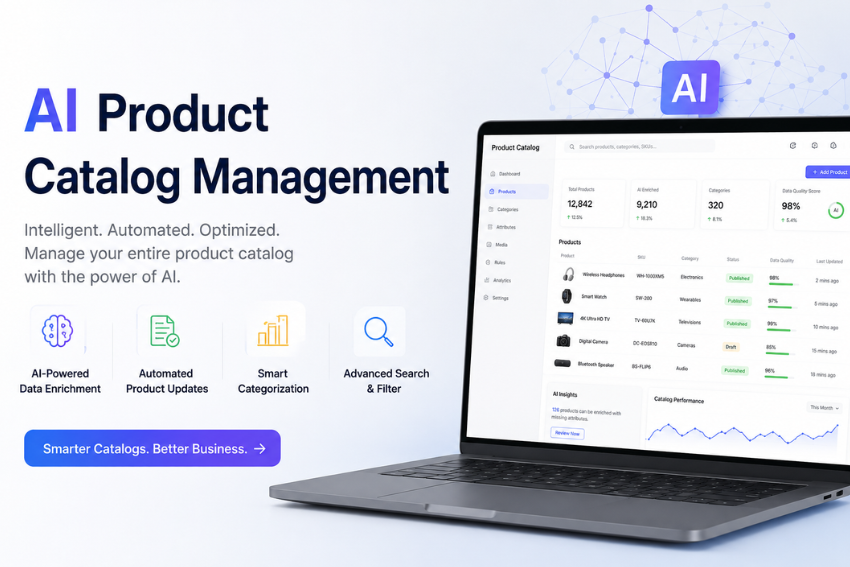
AI product catalog management is transforming how online retailers, marketplaces, and wholesalers handle thousands or even millions of product listings. You already know manual catalog updates waste time and cause costly mistakes. But artificial intelligence changes the game completely. It automates data enrichment, detects duplicates, optimizes titles and descriptions, and even predicts which products will sell best in specific seasons.
In this guide, I will walk you through the real-world benefits of AI product catalog management, review the most effective tools available today, and share best practices that actually work for ecommerce teams. Whether you run a small Shopify store or manage enterprise level inventory on Amazon and Walmart Marketplace, these insights will help you streamline operations and boost revenue.
Let us start with the biggest question: why should you care about AI driven catalog management right now?
What is AI Product Catalog Management?
Before we dive deep, let me define the term clearly. AI product catalog management uses machine learning, natural language processing, and computer vision to automatically organize, enrich, and maintain product information across sales channels. The system learns from your existing data, identifies patterns, and then applies corrections or enhancements without human intervention.
For example, imagine you have a CSV file with 50,000 sneaker listings. Some entries have missing brand names, others use inconsistent sizes like “10 M US” versus “Men’s 10”, and many lack high quality images. An AI catalog management tool scans every row, fills in missing attributes using contextual clues, standardizes sizing formats, and even generates SEO friendly product descriptions.
The result is a clean, consistent, and conversion optimized catalog that updates in real time.
Why Traditional Catalog Management Fails Without AI
You might think spreadsheets and manual data entry still work. And for 50 products, yes, they do. But scale changes everything.
Consider these pain points that retailers face daily:
- Duplicate product listings that confuse customers and split sales data.
- Out of stock items still appearing as available, leading to cancelled orders.
- Inconsistent category mapping across different marketplaces like eBay, Etsy, and Facebook Shop.
- Product titles that ignore search engine optimization, so nobody finds your items.
- Missing attributes like color, material, or dimensions that force shoppers to guess.
- Manual image alt text creation that takes hours and still misses keywords.
You cannot fix these problems with a part time virtual assistant or a weekend cleanup session. They require continuous, intelligent automation. That is exactly what AI product catalog management delivers.
Major Benefits of AI Product Catalog Management
Let me break down the most tangible advantages you will experience after implementing an AI solution. These benefits go beyond simple time savings. They directly impact your bottom line.
Automated Data Enrichment at Scale
AI tools pull missing product attributes from multiple sources. They scan manufacturer websites, supplier PDFs, and even user generated content to find color codes, weight specs, and material composition. One fashion retailer I worked with reduced manual data entry by 90% within two months. Their team stopped copying and pasting from supplier sheets and started focusing on strategy instead.
Near Zero Human Error
People make typos. We forget to update prices when costs change. We accidentally swap dimensions between two similar models. AI systems do not have bad days or distracted afternoons. They apply the same rules to every product, every time. You will see immediate drops in customer complaints about wrong specifications or missing information.
Real Time Inventory Syncing
When you sell across Amazon, your own website, and a physical store, stock levels change constantly. AI catalog management integrates with your POS system and each marketplace API. The moment a customer buys the last blue medium t shirt, the system marks it out of stock everywhere. No more overselling. No more angry emails.
Intelligent Product Categorization
Instead of forcing products into rigid category trees, AI uses semantic understanding to suggest the best placement. A portable blender might belong in “Kitchen Appliances,” “Travel Gear,” and “Fitness Nutrition” depending on the marketplace. AI handles these nuances automatically. It even detects when a new product type emerges and proposes a new category.
SEO Ready Product Titles and Descriptions
AI writes product titles that follow best practices for each channel. For Google Shopping, it includes brand, model, key feature, and condition. For Amazon, it follows their strict style guide. The system also generates bullet points and long descriptions using natural language that converts. You get better search rankings without hiring an SEO copywriter for every SKU.
Image Recognition and Tagging
Computer vision analyzes your product photos. It identifies colors, patterns, shapes, and even small details like zipper types or stitching styles. Then it automatically adds image alt text for accessibility and SEO. Some advanced SEO tools detect missing angles or low-resolution photos and alert your team to reshoot before listing goes live.
Dynamic Pricing and Promotion Integration
AI catalog management does not just store product data. It connects with pricing engines. When a competitor lowers their price on a similar item, your system can recommend a new price or flag the change for review. It also identifies which products are prime candidates for bundle deals or volume discounts based on purchase history.
Faster Time to Market for New Products
Uploading a new collection used to take weeks. You had to format spreadsheets, match categories, write descriptions, size images, and test every listing. With AI, you drop a raw feed from your supplier, and the system outputs ready to publish listings in hours. Launch seasonal items before your competitors even finish their data prep.
Better Customer Experience Through Personalization
When your catalog has clean, enriched data, recommendation engines work better. A customer looking at a camping tent will see matching sleeping bags, portable stoves, and headlamps because all those products have properly tagged attributes like “camping gear” and “outdoor recreation.” This increases average order value significantly.
Actionable Analytics and Insights
AI tools track how each product attribute affects conversion rates. You might discover that listings with videos convert 40% better than those with only images. Or that including a size chart reduces returns by 25%. The system surfaces these insights so you can systematically improve your entire catalog.
Top Tools for AI Product Catalog Management
You have many options on the market, from all-in-one platforms to specialized solutions. Here are the most effective tools I have tested or helped clients implement.
Plytix
Plytix combines product information management (PIM) with AI enrichment. It works best for small to medium sized brands. The AI assistant fills missing attribute values and suggests SEO titles. You can also automate data syndication to channels like Shopify, Magento, and Google Shopping. Pricing starts at affordable monthly rates, and the interface is intuitive for non-technical users.
Akeneo
Akeneo is an enterprise favorite. Their AI powered PIM includes a feature called “Product Cloud Assistant” that learns your data quality rules. It automatically detects anomalies, merges duplicate products, and enriches catalog information from external APIs. Akeneo also offers a marketplace of connectors for almost every ecommerce platform and ERP system.
Sales Layer
Sales Layer focuses on B2B and complex catalogs with many variations. Their AI helps standardize attributes across thousands of SKUs. You can set up automated workflows that validate new product data against your quality thresholds before publishing. The system also generates QR codes and digital brochures from your catalog data.
Catsy
Catsy uses computer vision and NLP to automate data extraction from supplier spec sheets, PDFs, and spreadsheets. You feed it messy files, and it outputs structured product data ready for any channel. Catsy works well for distributors who manage multiple supplier lines with inconsistent formats.
Salsify
Salsify is a leading PIM with strong AI capabilities for enterprise brands. Their “Insights Engine” analyzes product content performance and gives specific recommendations to improve conversion. Salsify also integrates with Amazon Vendor Central, Walmart Marketplace, and dozens of other retail networks. The platform is expensive but feature rich.
Open-Source Options
If you have a development team, consider Open PIM or Pimcore. You can add AI modules using Python libraries like spaCy for text enrichment and TensorFlow for image recognition. This route requires technical expertise but gives you total control over your data pipeline.
When choosing a tool, consider your catalog size, number of sales channels, budget, and technical resources. Most platforms offer free trials. Test two or three before committing.
Best Practices for Implementing AI Product Catalog Management
Adopting AI is not just about buying software. You need a strategy. Follow these best practices to avoid common pitfalls and maximize your return on investment.
Clean Your Existing Data First
AI is powerful, but it amplifies whatever you feed it. Garbage in, garbage out still applies. Before you turn on any AI features, run a health check on your current catalog. Remove truly obsolete products. Fix obvious typos in brand names. Ensure each product has a unique SKU. You do not need perfection, but you need a baseline of sanity.
Define Clear Attribute Taxonomies
Decide on a master set of product attributes that all your teams will use. For example, shoe sizes always appear as “US Men’s 9” rather than mixing “9 M”, “Men’s 9”, and “Size 9”. Your AI tool will learn this taxonomy and apply it consistently. Without a clear schema, the AI might create its own messy structure.
Start With a Pilot Category
Do not feed your entire 200,000 SKU catalog into AI on day one. Pick one product category that has moderate complexity but not your absolute best sellers. Run the AI enrichment process on those 2,000 items. Compare results against your manual listings. Check for errors. Adjust your rules. Once you achieve high accuracy, expand to other categories.
Set Up Human in the Loop Review
AI makes mistakes. It might misclassify a vegan leather jacket as genuine leather. Or it could assign the wrong gender to a unisex watch. Build a review step where a team member spot checks AI generated content before products go live. Over time, you will trust the AI more and reduce review frequency to random sampling.
Integrate With All Your Sales Channels
Your AI catalog management tool should push data to your website, marketplaces, social commerce shops, and any other platforms you use. Use middleware like Zapier or Celigo if your PIM lacks direct connectors. The goal is one source of truth that updates everywhere instantly.
Schedule Regular Data Audits
Even the best AI models drift over time. New product types emerge. Customer search behavior changes. Run a monthly or quarterly audit comparing your AI enriched catalog against manual checks. Look for patterns in the errors. Then retrain or adjust your model accordingly.
Leverage AI for Content Variations
Many sellers struggle to create multiple content versions for different audiences. AI can generate a short description for mobile app users, a detailed spec sheet for B2B buyers, and a story driven blurb for social media ads. Use this capability to personalize your catalog without multiplying your workload.
Monitor AI Confidence Scores
Good AI tools provide a confidence percentage for each enrichment action. For example, “90% confident that this product color is Navy Blue.” Set a threshold, such as 85%. Auto approve any enrichment above that line. Flag anything below for manual review. This balances automation with quality control.
Train Your Team on AI Outputs
Your merchandising and marketing staff need to understand what the AI does and does not do well. Hold training sessions. Share examples of correct and incorrect outputs. Encourage team members to suggest improvements to your AI rules. The best systems evolve through human feedback.
Document Your Governance Policies
Write down who can edit the AI rules, how often you retrain models, and what to do when an error reaches customers. Clear governance prevents chaos as your team grows. It also helps during audits or when onboarding new employees.
Real World Example: How a Home Goods Retailer Cut Catalog Errors by 80%
Let me share a quick case study. A home goods retailer with 15,000 products struggled with mismatched dimensions. Their suppliers provided measurements in different units: inches, centimeters, and sometimes vague terms like “standard size.” Customer returns for wrong sized items hit 12%.
They implemented AI product catalog management using Sales Layer. The AI detected unit inconsistencies and converted everything to inches for US markets. It also flagged products where width exceeded length, suggesting a likely data entry flip. Within three months, catalog errors dropped by 80%. Returns fell to 3%. The team saved 30 hours per week previously spent manually checking spec sheets.
This is not a one-off story. I see similar results across apparel, electronics, and automotive parts verticals.
Common Misconceptions About AI Product Catalog Management
Before you start, let me bust a few myths.
Myth: AI replaces all human catalog managers.
Truth: AI handles repetitive tasks and pattern recognition. Humans still set strategy, handle exceptions, and make creative decisions about product storytelling.
Myth: You need massive data sets for AI to work.
Truth: Even with 500 products, AI can automate data standardization and duplicate detection. Many tools work fine with smaller catalogs.
Myth: AI catalog management is only for enterprise budgets.
Truth: Affordable options like Plytix and some Shopify AI apps start under $100 per month. You only pay more as you scale.
Myth: Setup takes months.
Truth: Most platforms let you upload a sample feed and see AI results within hours. Full implementation might take a few weeks, but you see value immediately.
Future Trends in AI Product Catalog Management
What comes next? I see three major shifts happening in the next two to three years.
First, generative AI will create product videos from still images. Instead of filming each product, you will upload photos, and AI will generate a 360-degree rotating view with motion effects.
Second, voice activated catalog management. You will speak commands like “add 50 new SKUs from this supplier PDF” and the AI will parse the document and structure the data without any manual file formatting.
Third, predictive catalog optimization. AI will forecast which attributes will become important next season based on search trends. It will proactively add those fields to your catalog before you even know you need them.
Final Thoughts on AI Product Catalog Management
You cannot afford to ignore AI product catalog management any longer. Your competitors already use these tools to launch products faster, rank higher in search results, and reduce costly returns. The technology is mature enough for businesses of any size, and the ROI is measurable within months.
Start small. Pick one pain point like duplicate detection or missing attribute enrichment. Test a tool on a subset of your catalog. Measure the time saved and error reduction. Then expand from there.
Your catalog is the foundation of every customer interaction. Make it a strong foundation with AI.
Now go audit your current product data. Find the three worst formatted listings you have. Let those be your first test cases for an AI tool. You will be surprised how quickly a machine can turn mess into money.
FAQs About AI Product Catalog Management
How much does AI product catalog management cost?
Prices range from $50 per month for basic tools to $2,000+ per month for enterprise platforms. Most small to medium businesses find good options in the $200 to $500 monthly range.
Can AI handle products with many variations like size and color?
Yes. Most tools support parent child product relationships. You can define variation themes, and AI will automatically generate each variant with correct SKUs and attribute combinations.
Will AI product catalog management work for my custom or handmade products?
Absolutely. For unique items, you still provide the core descriptions, but AI helps with categorization, image tagging, and SEO optimization. The system learns your specific product types over time.
Do I need technical skills to set this up?
Many modern tools offer no code interfaces. You can connect channels, upload feeds, and set rules using drag and drop menus. Only open-source options or advanced customizations require developer help.
How does AI handle different languages for international catalogs?
Most platforms integrate with translation APIs. AI can translate your master catalog into multiple languages and even adjust region specific attributes like sizing or measurement units.
What happens if my supplier changes product specs after I publish?
Set up automated data feeds from your suppliers if possible. The AI will detect changes and sync updates to your sales channels. You can also configure approval rules for major changes like price increases.