
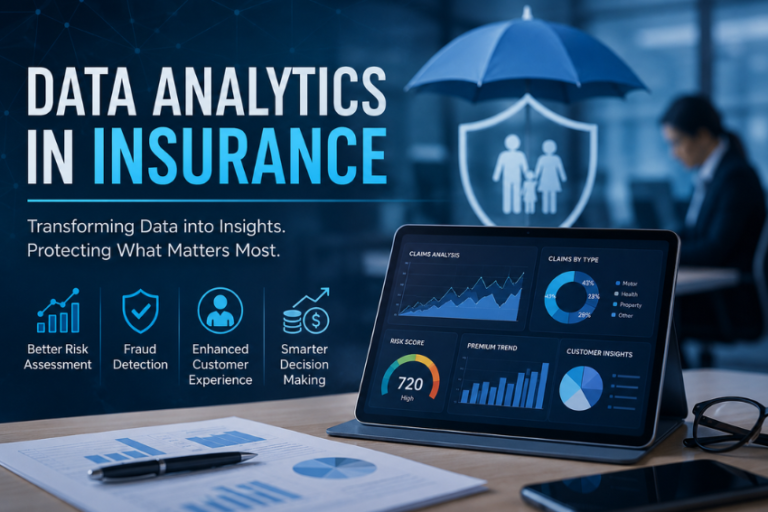









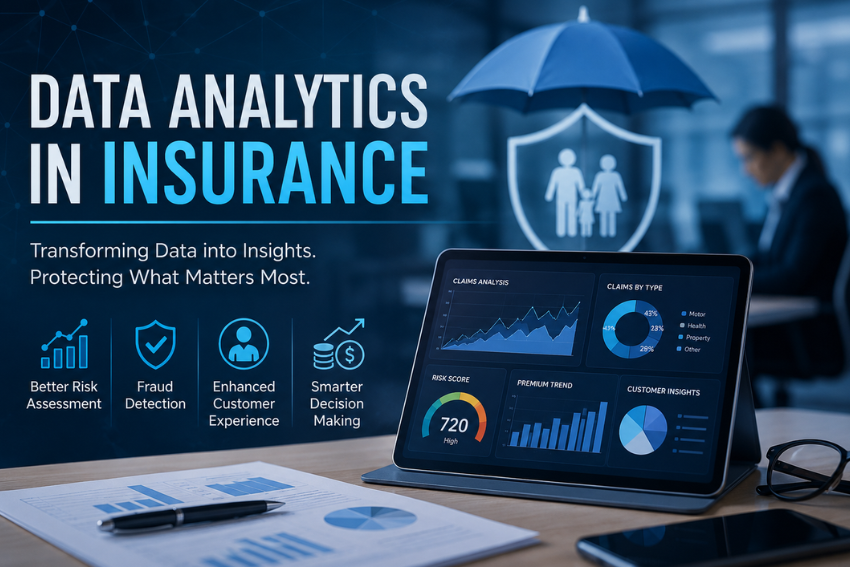
Data analytics in insurance is changing how modern carriers evaluate risk, set premium rates, and process daily claims. Insurance companies have always relied on statistics, but traditional methods often fall behind today’s rapid market changes. Modern carriers now process massive amounts of real-time data to make faster, smarter business decisions.
Instead of relying solely on historical mortality tables or delayed loss reports, forward-thinking insurers use predictive models and real-time streams from connected devices. This technological shift turns massive, unstructured datasets into actionable strategic advantages. It allows carriers to move away from reactive payout models and step into a new era of proactive risk management.
What is Data Analytics in Insurance?
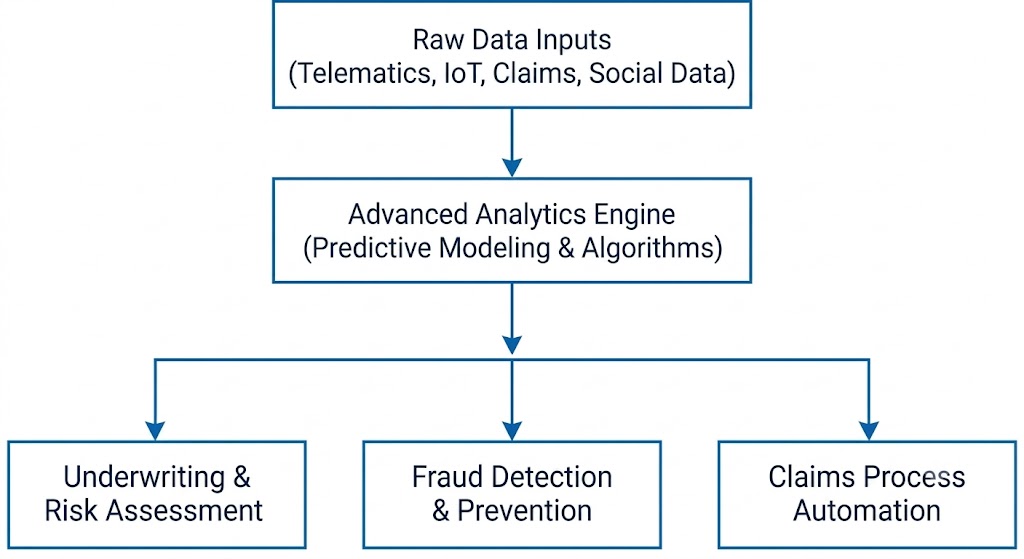
Data analytics in insurance involves collecting, processing, and analyzing raw information to identify underlying pattern trends and forecast future outcomes. Insurers extract valuable insights from multiple modern channels, including smart home sensors, vehicle telematics, satellite imagery, wearable medical devices, and digital customer interactions.
Historically, insurance companies relied on backward-looking data collected over years or decades. Actuaries calculated risks based on demographic averages rather than individual behavior. Modern data analytics changes this dynamic completely by combining historical statistical models with real-time operational feeds.
Data analytics in the insurance sector generally falls into four main methodology categories:
- Descriptive Analytics: Evaluates historical data to understand past operational performance, claim volumes, and loss ratios.
- Diagnostic Analytics: Investigates past trends and data anomalies to determine why specific claim spikes or sudden losses occurred.
- Predictive Analytics: Uses machine learning models and statistical algorithms to forecast future losses, claim frequencies, and customer behavior.
- Prescriptive Analytics: Recommends specific strategic actions and automated decisions based on predicted future outcomes.
Key Use Cases of Insurance Data Analytics
Insurers apply advanced analytics across every single phase of the policy lifecycle. These strategic applications deliver massive operational returns while fundamentally reshaping how policyholders interact with their coverage. Here are the top areas where data analytics transforms daily insurance operations:
Automated Underwriting and Risk Assessment
Machine learning algorithms evaluate applicant risk profiles almost instantly. By analyzing non-traditional data sources alongside traditional credit scores and medical histories, carriers price policies accurately without lengthy manual reviews.
Real-time Fraud Detection and Prevention
Fraud costs the insurance industry billions of dollars every year. Advanced analytics tools flag anomalous claims patterns, suspicious medical billing codes, and staged vehicle accidents before payouts ever happen. Natural language processing tools also analyze claim notes to detect subtle linguistic red flags.
Claims Management Automation
Smart claims systems route simple, straightforward claims through automated workflows for instant approval. These touchless claims processing reduces administrative costs and gives policyholders immediate relief after minor accidents or property damages.
Usage-Based Insurance (UBI) and Telematics
Auto insurers place small telematics devices in vehicles or track driving metrics through mobile apps. These systems stream real-time driving speed, cornering force, braking habits, and time-of-day mileage data to adjust auto policy premiums dynamically based on actual driving safety.
Customer Churn Prediction and Retention
Machine learning models spot subtle behavioral cues that indicate a policyholder might switch providers soon. Factors like frequent customer support inquiries, policy modifications, or price sensitivity signals prompt automated retention teams to offer personalized policy adjustments before the client cancels.
Catastrophe Modeling and Geographic Mapping
Property and casualty insurers use satellite imagery, climate data, and spatial analytics to model natural disasters accurately. When a hurricane or wildfire approaches, carriers pinpoint exact exposure areas, estimate potential losses within hours, and deploy emergency adjusters directly to affected regions.
Major Benefits for Insurers and Policyholders
Adopting data analytics tools strengthens long-term financial stability for carriers while simultaneously providing better, lower-cost services to individual customers.
| Benefit Category | Direct Impact on Insurers | Direct Impact on Policyholders |
|---|---|---|
| Pricing Accuracy | Aligns risk profiles directly with individual premium costs | Delivers fairer rates for safe drivers and low-risk homeowners |
| Processing Speed | Reduces manual claims reviews by up to 70% through automation | Guarantees faster claims payouts and instant policy approvals |
| Fraud Mitigation | Saves billions annually by catching fraudulent claims early | Keeps overall premium costs lower across the entire customer base |
| Customer Engagement | Creates targeted, highly relevant product offerings | Delivers custom coverage options suited to specific lifestyle needs |
| Operational Costs | Minimizes administrative overhead and paperwork bottlenecks | Streamlines digital self-service tools for policy updates |
Critical Challenges in Implementation
Despite the obvious advantages, insurance organizations face distinct operational obstacles when scaling their analytics platforms across enterprise environments.
Legacy Infrastructure and Technical Debt
Many established insurance carriers still run core operations on legacy mainframe systems built decades ago. These outdated architectures lack the computing capacity to ingest, store, and process high-velocity real-time data streams smoothly. Integrating modern cloud analytics engines with legacy software requires substantial financial investment and complex engineering.
Data Silos and Disparate Systems
Information inside large insurance companies often lives in isolated organizational silos. The claims department, marketing team, billing section, and underwriting division frequently use separate databases that do not communicate with each other. Without a unified data lake or cohesive data pipeline, analytics models struggle to draw accurate, enterprise-wide insights.
Data Privacy, Governance, and Regulations
Insurance involves handling some of the most sensitive personal data imaginable, including financial histories, medical records, and location tracking metrics. Strict legal frameworks like GDPR in Europe and CCPA in California limit how carriers collect, store, and utilize personal information. Insurers must maintain rigorous data governance frameworks to prevent security breaches and avoid massive regulatory fines.
Data Quality and Unstructured Information
Algorithms need high-quality data to make accurate predictions. However, much of the data held by insurance carriers is unstructured text, such as hand-written adjuster notes, scanned police reports, medical images, and call center audio recordings. Cleaning, organizing, and standardizing this raw data into usable analytics inputs demands immense effort.
Talent Shortages in the Industry
Building robust analytics systems requires specialized talent that understands both modern data science and complex insurance principles. The insurance industry faces intense competition from big tech companies for skilled data engineers, machine learning specialists, and quantitative analysts who possess actuarial knowledge.
Future Trends Shaping Insurance Analytics
The next wave of insurance analytics centers on generative AI, continuous sensor tracking, and predictive risk prevention. Insurance carriers will continue moving away from reactive damage compensation toward active loss prevention.
Smart home sensors will detect minor plumbing leaks or electrical faults before pipes burst or fires start. Wearable health trackers will give life and health insurers real-time health indicators, enabling them to reward policyholders who maintain active, healthy lifestyles with lower rates. Furthermore, advanced AI tools will automatically synthesize complex claim files into instant summaries, enabling adjusters to resolve catastrophic losses faster than ever before.
Conclusion
Data analytics is no longer a luxury for ambitious insurers; it is the backbone of modern risk management and customer satisfaction. By shifting from historical guesswork to real-time, data-driven decisions, carriers can streamline claims, stop fraud, and offer fairer pricing to policyholders. Overcoming challenges like legacy tech and regulatory constraints takes real effort, but the payoff is clear. Insurers that invest in robust data capabilities today will build a strong competitive advantage, leading the market into a smarter, more proactive era of insurance.