






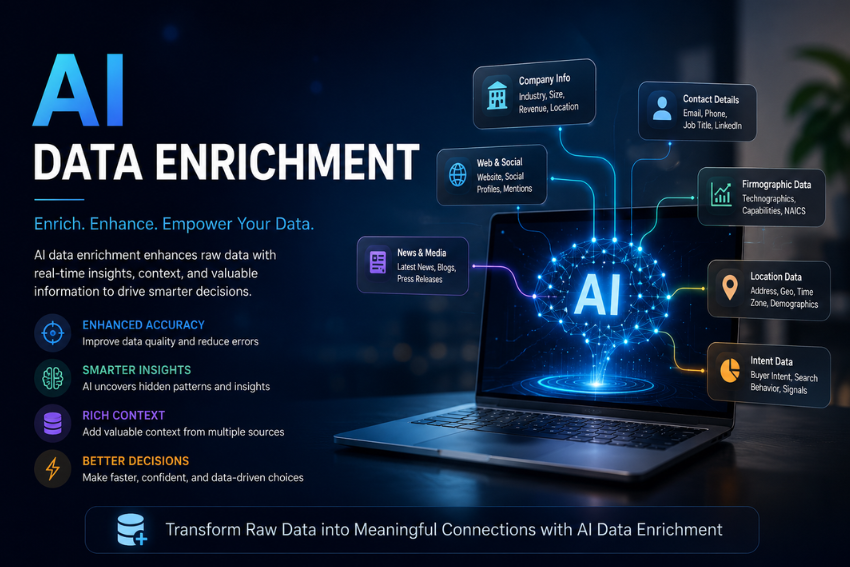
The era of using AI Data Enrichment for processing raw information is here. Companies no longer have to sift through incomplete and messy data sets but instead rely on smart algorithms to fill in missing information, correct the mistakes, and provide added context. It’s like putting new life into your data – converting facts into actionable insights that would normally require hours of manual effort.
In this post, I’ll explain exactly what AI powered data enrichment is, how it can impact your bottom line and how real companies are leveraging it daily. No jargon, no fluff – just straight tips that you’ll be able to use.
Understanding AI Data Enrichment
Traditional data enrichment consists of joining external data with the data in your database. For instance, you can add a customer’s age, income or shopping habits, based on third party information, to their email address. That may work, but it’s labor-intensive, costly and sometimes hopelessly obsolete by the time you’re done.
AI Data Enrichment changes all that. The entire process is automated using machine learning models and natural language processing (NLP). They are able to look at your raw data, look for missing attributes, then predict values based on patterns and pull information from thousands of sources in real time. You receive the cleaner, richer and more accurate data without the need to hire a team of analysts to do the heavy lifting.
So, what makes it unique? AI continuously learns from new data while traditional methods are based on static lookups. Adjusts to shifting patterns in consumer behavior, market fluctuations or slang or misspellings in text. This translates to having fresh and relevant enriched data.
Why Your Business Needs AI Powered Data Enrichment
You might think your data looks fine on the surface. But most companies sit on a goldmine of incomplete records. Here is what typically happens. Sales teams waste hours chasing contacts with wrong phone numbers. Marketing sends offers to people who already churned. Product teams build features based on outdated usage stats. These problems cost real money.
AI Data Enrichment solves those headaches in three powerful ways.
Boosts Accuracy
Millions of data points are cross referenced by algorithms to verify each record. Should a customer’s address change, the system will recognize the change and automatically update the address. You no longer send your packages to old addresses or waste your ad spending money on the wrong crowd.
Saves Massive Time
This once-weekly manual cleaning process can now be completed in minutes. Your team ends up having to fight with spreadsheets and begins to take action on insights. That’s a very competitive pace!
Uncovers Hidden Patterns
AI identifies relationships that humans don’t. It may identify that customers who purchase product A will almost always click on a certain email subject line, or that a specific zip code indicates that customers are more likely to return the product. These findings enable personalization and minimization of waste.
Key Benefits of AI Data Enrichment
Let me outline the most impactful benefits you can expect when you implement this technology.
Sharper Customer Profiles
It is the desire of every business to know their customers better. AI Data Enrichment generates 360-degree profiles by gathering demographics, social media presence, purchase and support history. Not only will you learn what people buy, you will also learn why they buy it. That results in improved product suggestions and customer service.
Higher Lead Quality
Sales teams hate bad leads. With AI enrichment, you automatically score and prioritize prospects based on firmographics, intent signals, and engagement data. Your reps only call people who are actually ready to buy. Conversion rates go up. Wasted dials go down.
Reduced Data Decay
Data decays fast. Studies show that contact information degrades by about 30 percent per year. Emails bounce. People change jobs. Companies merge. AI enrichment continuously monitors for changes and refreshes your records. You maintain a clean database without constant manual audits.
Smarter Segmentation
Generic blasts kill engagement. AI helps you slice and dice audiences by hundreds of attributes. You can target left-handed guitar players in Texas who bought strings last month, or recent home buyers looking for lawn care services. Segments become dynamic and hyper relevant.
Fraud Detection That Works
Fraudsters evolve quickly. Static rules-based systems always lag behind. AI enrichment analyzes transaction patterns, device fingerprints, and behavioral signals in real time. It flags anomalies before they become chargebacks. Banks and ecommerce stores use this to stop fraud without blocking legitimate customers.
Regulatory Compliance Help
Laws like GDPR and CCPA demand accurate, consented data. AI enrichment helps you identify and remove stale or non-compliant records. It can also append consent flags and opt out statuses automatically. You stay on the right side of regulators without building a massive legal team.
Real World Use Cases of AI Data Enrichment
Now let’s get practical. Here is how different industries apply AI Data Enrichment to solve real problems.
Ecommerce and Retail
Online stores sit on tons of transaction logs, but they often lack context. AI enrichment adds product categories, brand affinities, and even weather data at the time of purchase. A clothing retailer might learn that customers buy raincoats when humidity rises above 80 percent. They then trigger automated promotions before a storm hits. Another use case is returns reduction. By enriching customer addresses with delivery zone risk scores, retailers flag addresses that historically cause lost packages. They offer alternate pickup points or require signature confirmation, saving millions in replacement costs.
Financial Services
Banks and lenders use AI enrichment to assess credit risk more fairly. Instead of relying only on traditional credit scores, they enrich applications with utility payment history, rental data, and even social media stability signals. That helps approve loans for thin file customers who pose low risk. For wealth management, advisors enrich client portfolios with real time news sentiment, geopolitical events, and sector trends. They get alerts when a stock in a client’s portfolio faces a new regulatory risk. Proactive calls build trust and reduce churn.
Healthcare and Life Sciences
Patients can have typing errors, incorrect codes or insurance information in their records. AI enrichment cleans and standardizes data at scale. A hospital system may connect the lab results with the proper patient identification, add diagnosis codes and alert for any drug interactions automatically. During clinical trials, researchers add genetic markers, lifestyle and environmental exposures to the data collected from participants. They find out why some patients are benefiting from a drug and others are not, speeding progress.
Real Estate
Property listings suffer from inconsistent data. One agent calls a home a “cottage,” another says “bungalow,” and a third uses “ranch.” AI enrichment normalizes these terms and adds property attributes like school district ratings, flood risk scores, and commute times to major employers. Buyers search with natural language, and the system returns accurate matches. Property managers use enrichment to predict maintenance needs. By adding appliance ages and local weather patterns, AI flags which water heaters will likely fail before winter. Preventive repairs save thousands.
B2B Sales and Marketing
Here, AI Data Enrichment really comes into its own. The AI returns comprehensive firmographics when sales teams upload a list of company domains—including industry, revenue range, employee count, tech stack and recent funding news. Marketers add company size, job titles to Web visitors and then present them with personalized content. Different visitors from logistics companies are interested in case studies about fleet optimization and different visitors from a hospital are interested in patient engagement solutions. Conversions double or triple.
Human Resources
Hundreds of suboptimal resumes are submitted to recruiters. AI enrichment analyzes each resume, identifies skills, years of experience, and education, and then compares them with the skills needed on the job posting. It also adds social signals to the profile, portfolio URLs, and even language signals for culture fit for candidates. The system automatically filters out those who weren’t qualified and puts into the spotlight hidden gems who had non-obvious job titles. HR departments save 70% of time to hire.
Logistics and Supply Chain
Routes and schedules are subject to change based on weather, port delays, fuel costs and beyond on a daily basis. AI enrichment integrates real-time data from various sources like traffic cameras, marine tracking devices, and weather satellites. It adds an estimated arrival window, as fine as an hour level, to each shipment. Enriched product information is used to forecast products that are likely to be depleted next week for the warehouse manager. They re-order just in time to reduce storage costs. Route planners add laws governing rest periods, bridge height restrictions to drivers’ schedules, avoiding expensive infractions.
How to Implement AI Data Enrichment Without Breaking Things
You are probably thinking this sounds great, but where do you start? Follow these steps for a smooth rollout.
Step one, audit your current data. Identify the dirtiest, most incomplete datasets. Customer addresses. Product categories. Lead scores. Pick one area with a clear business pain point.
Step two, choose an enrichment tool. Many options exist, from Salesforce Einstein to Clearbit to custom built models on AWS or Google Cloud. Look for pre-built connectors to your CRM or data warehouse. That saves integration headaches.
Step three, run a pilot. Enrich a small sample, maybe 5,000 records. Compare the results against manual checks. How many errors did it fix? How much time did you save? Use those numbers to build a business case.
Step four, set governance rules. Decide who can trigger enrichment calls. Set rate limits so you don’t blow your API budget. Define what happens to enriched data, like automatically flagging low confidence matches for human review.
Step five, train your team. Show them how to interpret enriched fields and where to find the confidence scores. Emphasize that AI is a helper, not a replacement. Human judgment still matters, especially for edge cases.
Step six, monitor and iterate. Check enrichment quality monthly. As your business changes, update the fields you care about. Retrain custom models with fresh examples. AI gets better over time, but only if you feed it good feedback.
Common Mistakes to Avoid
I have seen companies trip over the same pitfalls again and again. Learn from their errors.
Mistake one, enriching everything at once. That costs a fortune and overwhelms your team. Start narrow, then expand.
Mistake two, ignoring data privacy. Some enrichment providers sell your data or use it to train their models. Read the fine print. Sign a business associate agreement if you handle healthcare info. Stay compliant.
Mistake three, trusting every enrichment blindly. AI makes mistakes. A zip code might geocode to the wrong city. A sentiment score might misread sarcasm. Always keep confidence thresholds and allow manual overrides.
Mistake four, skipping documentation. Future you will thank present you for writing down which enrichment sources you use, how often you refresh, and what each field means. Otherwise, you create a black box that nobody understands.
Future Trends in AI Data Enrichment
This field moves fast. Here is what is coming next.
Real time enrichment at the edge. Instead of sending data to a cloud API, tiny AI models will run directly on your phone or IoT device. That means zero latency enrichment for field workers and delivery drivers. A technician scans a barcode, and the device instantly pulls up maintenance history, part numbers, and safety alerts without an internet connection.
Synthetic data generation. When real data is scarce or private, AI will create realistic synthetic records for training and testing. Banks already simulate fraud patterns to enrich their detection models. Healthcare researchers generate synthetic patient journeys to test care protocols without exposing real medical records.
Explainable enrichment. Regulators want to know why an AI made a certain decision. New tools will output plain English explanations. “We enriched this loan application as high risk because the business address changed three times in six months and the listed phone number is disconnected.” That transparency builds trust and defends against bias claims.
Cross domain enrichment fusion. Today’s tools pull from one type of source, like social media or transaction logs. Tomorrow’s AI will fuse weather, news, economic indicators, and biometric data into a single enriched profile. A retailer might see that rainy weather plus a competitor’s stockout plus a customer’s recent raise equals a perfect moment to sell a premium umbrella.
Measuring the ROI of AI Data Enrichment
You need hard numbers to justify investment. Track these metrics before and after implementation.
Data completeness percentage. How many of your critical fields are filled? For a sales database, that might be phone, email, and title. After enrichment, you should see a jump from 40 percent to 90 percent or higher.
Lead response time. AI enrichment automates lead scoring and routing. Measure how long from form fill to sales call. Good enrichment cuts that from hours to seconds.
Marketing conversion rates. Compare segmented campaigns using enriched data versus generic blasts. A 2x to 5x lift is common.
Customer support ticket volume. Enriched customer profiles help agents solve issues faster. Track average handle time and repeat contacts. Both should drop.
Fraud losses. If you operate in finance or ecommerce, measure chargeback rates and false positives. Good enrichment cuts fraud by 30 to 50 percent without increasing friction.
Final Thoughts
AI Data Enrichment is not a buzzword. It is a practical tool that turns messy, incomplete information into a strategic asset. You stop guessing about your customers, your operations, and your risks. You start making decisions backed by real, enriched, and constantly updated data.
Start small. Pick one painful dataset. Enrich it. Measure the difference. Then expand. The companies that adopt this technology today will leave their competitors in the dust tomorrow. Your data already holds the answers. AI just helps you find them faster.
Frequently Asked Questions
Is AI Data Enrichment expensive?
Costs vary widely. Cloud APIs charge per lookup, often a fraction of a cent per record. For large volumes, custom models on your own infrastructure cost less per record but have higher setup fees. Start with a free tier or pilot to gauge expense.
Does AI Data Enrichment work with small datasets?
Yes, but results improve with more data. For under 1,000 records, traditional manual enrichment might be simpler. For anything above that, AI saves time even on modest volumes. Some tools work well with as few as 100 examples.
How does AI handle misspelled or messy data?
Very well. Modern NLP models correct typos, normalize abbreviations, and even interpret slang. For example, “NYC” becomes “New York.” “John D.” becomes “John Doe” if context suggests. Confidence scores tell you when the model is uncertain.
Can AI Data Enrichment violate privacy laws?
It can if you enrich with nonpublic or unconsented data. Stick to reputable providers who use publicly available or permission-based sources. Anonymize personal identifiers where possible. And always get legal review before enriching sensitive fields like health or financial info.
What is the difference between data cleaning and AI Data Enrichment?
Cleaning fixes errors and removes duplicates. Enrichment adds new attributes. Think of cleaning as sweeping the floor and enrichment as buying new furniture. Most projects do both. AI can handle cleaning tasks too, like standardizing date formats or correcting misspellings.
How do I know if my enrichment provider is reliable?
Run a blind test. Take 100 records you already know well. Send them to the provider, then compare their enriched output against your ground truth. Look for accuracy above 95 percent and low variability across different types of records. Ask for a service level agreement that guarantees uptime and data freshness.