










Why do some Walmart listings win visibility while similar products struggle to rank, convert, or stay competitive?
The gap often becomes clear in the Walmart Listing Quality Score. It evaluates the listing across five core areas: content quality, price competitiveness, shipping speed, published and in-stock status, and ratings and reviews. These components translate listing quality into measurable signals across content, offer competitiveness, fulfillment, availability, and trust.
This blog breaks down what the score measures, why individual SKU audits matter more than catalog averages, and how sellers can improve weak components through better content, stronger attribute coverage, competitive pricing, faster shipping, inventory discipline, and review management. It also explains how to audit listing quality using Walmart Seller Center tools and prioritize fixes that protect visibility, conversions, and marketplace performance.
What the Walmart Listing Quality Score Measures
Source: Walmart
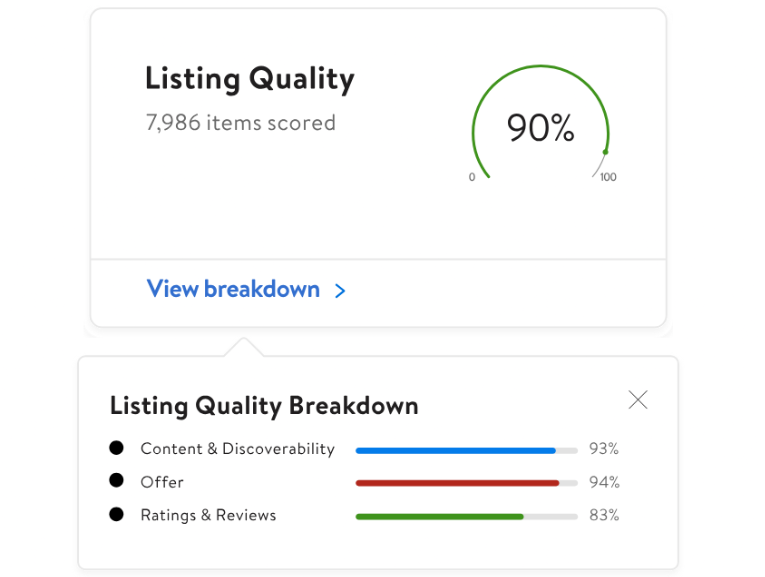
Walmart calculates the listing quality score across five component categories; each tied to a specific part of the product detail page.
| Component | What It Measures |
|---|---|
| Content quality | Item name, item description, key features, and images |
| Price competitiveness | Offer price compared with the same product on external marketplaces |
| Shipping | Promised delivery speed by ZIP code (excludes items over 50 lbs or under $10) |
| Published & in stock | How often the item is live and available, based on the last seven days |
| Ratings & reviews | Review volume and average rating per item |
Note: Components that show N/A at the item level are excluded from the rollup. A new SKU with no review history is not penalized on the ratings and reviews component until enough reviews exist to score. A healthy catalog-level Walmart listing quality score can still mask weak component scores on individual SKUs. Item-level audits matter more than catalog averages.
The Listing Quality dashboard frames the score around three measurable outcomes: greater product visibility, higher conversion on the detail page, and fewer returns when the listing matches what the customer receives. The score is operational; every component responds to specific changes at the SKU level.
How to Improve Walmart Listing Quality Score
Optimize Content Quality
Item Name
Walmart’s content guidance prioritizes structured titles over keyword-dense ones. A working format that meets the platform’s recommendations is:
Brand + Item Name + Key Attribute + Pack Count or Size or Color
For a category like home and kitchen, the format reads cleanly: “OXO Good Grips Stainless Steel Mixing Bowl, 3-Quart, Non-Slip Base.” That title carries the brand, the product type, the material, the size, and a key feature in under 75 characters.
Note for Sellers: A 100-character item name with a clear product type, a primary attribute, and a size descriptor will outscore a 140-character title that stuffs synonyms. Repeated keyword variants reduce the content quality score rather than help it.
Description and Key Features
The item description should run between 500 and 4,000 characters, with three to four sentences per paragraph. Walmart’s content guidance points to four rules that move the content quality score:
- Short paragraphs. Three to four sentences each, never a wall of text.
- Natural keyword use. Index the search terms shoppers actually type, without keyword stuffing.
- Factual language. Skip “amazing,” “premium,” “the best.” Subjective claims trip content quality flags.
- Benefit-first bullets. Three to ten bullets, each between 80 and 150 characters, written as benefit statements rather than feature lists.
For instance, a clean key-feature list for a running shoe reads:
- Lightweight and breathable mesh upper
- Cushioned sole for all-day comfort
- Available in multiple sizes and colors
- Designed for both casual and athletic use
Images
| Attribute | Walmart Requirement |
|---|---|
| File Format | JPEG, JPG, PNG, BMP (no GIF) |
| Background | Seamless white (RGB 255,255,255) |
| Aspect Ratio | 1:1 (square) |
| Recommended Dimensions | 2,200 x 2,200 px |
| Minimum for Zoom | 1,500 x 1,500 px |
| Maximum File Size | 5MB |
| Color Format | RGB |
| Minimum Images Per Listing | 4 |
| Variant Coverage | Separate images per size, color, or pack |
| Swatch Image Size | 100 x 100 px |
Enhance Discoverability Through Attribute Coverage
Content quality and search ranking both depend on how completely a listing’s attributes are covered. Brand, manufacturer part number, color, size, and material attributes drive Walmart’s left-nav filtering. A listing that omits attributes still publishes. It does not surface in filtered category browsing, which removes a meaningful share of qualified traffic from the funnel.
Treat the attribute schema for each category as a checklist. Walmart’s category templates are the authoritative source for which attributes apply. Common gaps that hold the Walmart listing quality score back include:
- Empty manufacturer part number fields prevent accurate product-type matching.
- Generic category assignment, where a SKU sits in a broader product type than its closest match.
- Variant attributes entered as part of the title rather than as structured variants.
- Inconsistent brand spelling across the catalog, which fragments brand-level visibility.
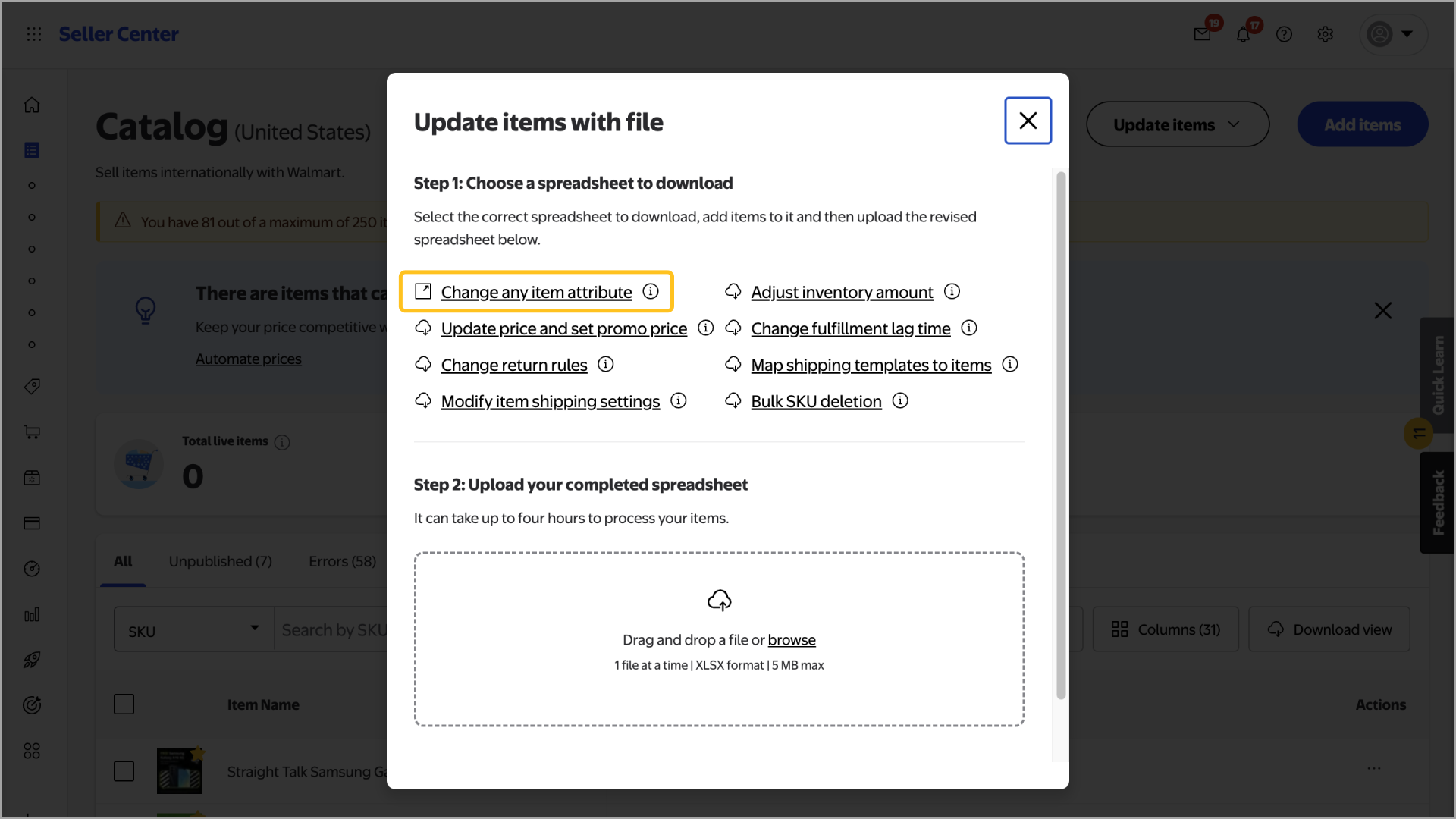
For brand owners and authorized resellers, the Brand Portal provides priority access to attribute updates.
Source: Walmart
Non-brand owners often see attribute edits blocked. Walmart’s content prioritization logic gives precedence to brand-owner content when available.
Monitor Price Competitiveness
Price competitiveness compares the listed price against the same item on external marketplaces. When Walmart’s algorithm detects a lower price elsewhere, the price competitiveness component drops. The listing can be unpublished, and the SKU loses Buy Box eligibility. The Pricing Insights dashboard in Seller Center shows where each offer stands relative to its comparison set.
The fix is rarely a flat discount. Most sellers recover the price competitiveness component by:
- Auditing the comparison set in Pricing Insights and disputing incorrect matches.
- Aligning Walmart pricing within a 3 to 5 percent band of the lowest external offer for the same SKU.
- Removing stranded SKUs whose price was set during a promotional period and never reset.
- Coordinating MAP enforcement across resellers so the Walmart offer is not the high-price outlier.
Note: Items priced at $10 or less are excluded from the shipping component but not from price competitiveness.
Ensure Shipping Transparency & Speed
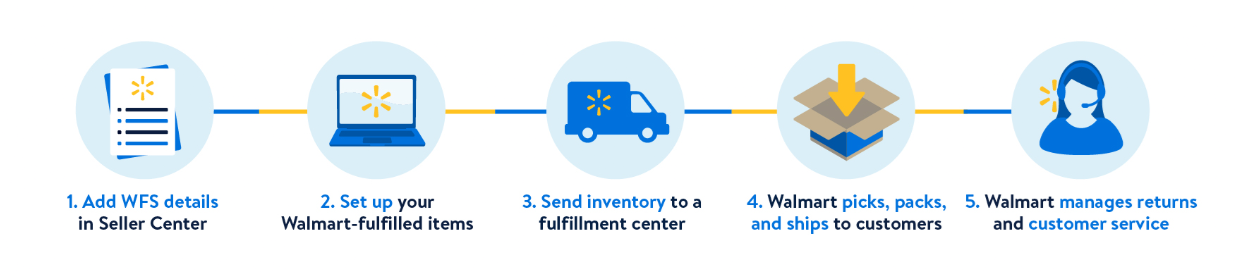
The shipping component measures promised delivery speed across ZIP codes. The fastest path to a high shipping score is enrollment in Walmart Fulfillment Services (WFS). WFS-eligible items qualify for free 2-day or 1-day delivery and earn the corresponding badges on the listing.
Source: Walmart
Sellers who cannot use WFS can still raise the shipping score through self-fulfillment configuration:
- Add multiple ship-from origins to expand 2-day coverage geographically.
- Configure carrier rate shopping rather than defaulting to a single carrier.
- Set realistic lead times. Aggressive lead times that trigger late shipments hurt the score more than slower but accurate ones.
- Enable TwoDay or OneDay shipping templates at the SKU level where supported.
The 2-Day Shipping tag carries a measurable conversion lift. Walmart Marketplace attributes a 50% GMV lift to items carrying the Walmart Fulfilled designation. This increases the impact of Walmart’s listing quality score on organic visibility.
Maintain Published and In-Stock Status
The published and in-stock components are scored over a seven-day window. A SKU that stocks out on day two of the window will see its component score drop. The dip persists even if the SKU is back in stock by day four.
The operational levers are inventory cadence and platform sync.
| Risk | Operational Fix |
|---|---|
| Frequent stockouts | Set safety stock thresholds at the SKU level, not the parent level |
| Multi-channel desync | Use a central inventory system that updates Walmart in near real-time |
| Listing suppression | Subscribe to Seller Center alerts and resolve flags within 24 hours |
| Promotional spikes | Forecast event-driven demand using the prior year’s lift, not the trailing 30 days |
Strengthen Ratings and Reviews
Ratings and reviews influence the score in two ways. While volume strengthens the signal, average rating sets the score ceiling. Neither metric moves quickly. Content and pricing fixes register on the dashboard within a refresh cycle, while review-based components shift over weeks. This component is a continuous workstream, not a one-time correction.
Operational levers that move the component score:
- Enroll active SKUs in Walmart’s Review Accelerator program where eligibility allows.
- Address negative reviews through Seller Center with a public response, correction, or replacement offer.
- Analyze the return reasons on a weekly basis and use it to refine the listing copy. For example, when 30 percent of returns cite “smaller than expected,” the issue is with the size descriptor or imagery, not the customer. Treat return reasons as a direct diagnostic signal.
- Avoid review-padding tactics. Walmart classifies incentivized or third-party reviews as a suspension-level risk, and the policy cost exceeds the value of accelerated review accumulation.
Listings that combine a 4.0+ rating tend to achieve higher scores. However, it also factors in the other four components also performing at a high level.
How to Audit Walmart Listing Quality Score Across the Catalog
The audit work runs on the free tools Walmart provides inside the Seller Center. Four reports do the bulk of the work:
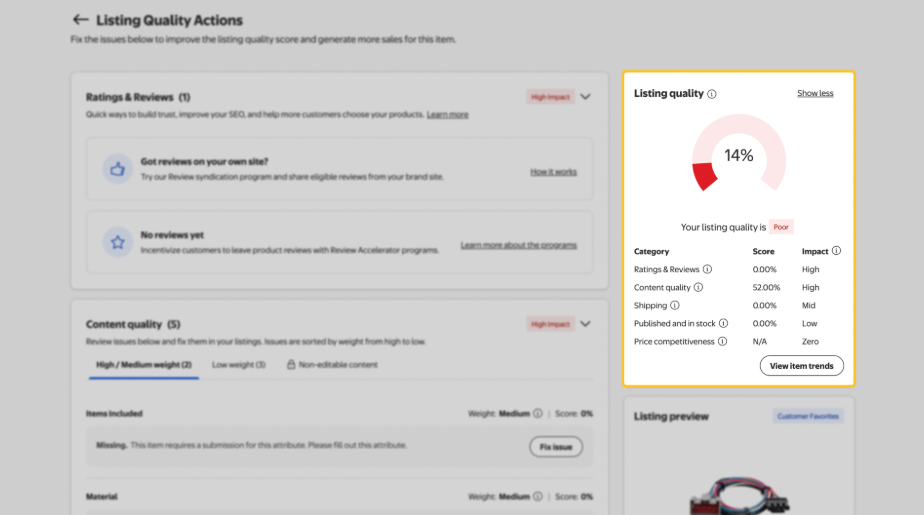
- Listing Quality Dashboard: The primary source for item-level and catalog-level scores. The dashboard also surfaces areas needing optimization, competitor comparisons, and feedback trends.
- Search Insights Dashboard: Reports page views, clicks, and traffic performance for top items in the catalog. Items with a Walmart listing quality score under 50 may be excluded from this report. The exclusion itself flags SKUs that need priority attention.
- Search Catalog Performance: A section within Search Insights that shows how individual keywords influence an item’s search performance. Useful for diagnosing whether a low-scoring listing is missing search-term coverage rather than content depth.
- Search Query Report: Also located inside Search Insights. Reveals the keywords shoppers use to find products. Gaps between top customer queries and listing copy are direct opportunities to raise the score.
A defensible audit cadence looks like this:
- Pull item-level scores monthly. Export the Listing Quality Dashboard view as a CSV, or call the Item Listing Quality Detail API for the same dataset. Save each pull with the date so month-over-month deltas remain traceable. Monthly is the operational floor for catalogs above 100 SKUs. Weekly is justified during active remediation cycles or post-launch windows.
- Segment SKUs by score band. Group the catalog into 90+, 80 to 89, 70 to 79, and under 70. The 90+ band needs maintenance, not work. The 80 to 89 band is where most catalogs sit and where targeted fixes deliver the highest return on time invested. The 70 to 79 band signals two or more component gaps. Anything under 70 needs an immediate review for suppression risk.
- Diagnose the lowest-scoring component and rank by revenue impact. For every SKU under 80, identify the lowest-scoring component from the Item Listing Quality Detail breakdown. Cross-reference Search Insights traffic data and 90-day GMV to confirm the SKU justifies the work. The prioritization rule multiplies the lowest component score by the highest revenue. The SKU at the top of that ranking receives the first fix.
- Use the Bulk Attribute Editor for shared component gaps. When the audit reveals the same gap across 10 or more SKUs, push the fix through the Bulk Attribute Editor instead of editing each listing manually. Common patterns include missing manufacturer part numbers across a vendor’s full catalog, or generic category assignment across an entire collection. One-by-one edits are reserved for SKUs with unique gaps that bulk logic cannot resolve.
- Extract scores 30 days after each push to confirm the lift held. A successful push moves the average score in that SKU group up by 5 to 15 points within one refresh cycle. If the lift did not hold, either the fix missed the lowest-scoring component, or another component dropped in parallel. The team should re-run the diagnosis on the affected SKUs before pushing a second fix.
The Business Case for Walmart Seller Listing Optimization
On Walmart Marketplace, where listing quality directly shapes search visibility, Buy Box eligibility, and growth program access, managing listings requires structured workflows, consistent performance monitoring, component-level audits, and category-aligned attribute coverage.
Walmart listing optimization services provide the data infrastructure, operational bandwidth, and field-level expertise that most in-house teams lack to manage alongside various business operations such as, sales, fulfillment, and customer support functions. This ensures catalog consistency, faster SKU remediation, reduced suppression risk, and sustained visibility across large or growing catalogs.