








If you own a business or manage a brand or are employed in digital marketing, then you have likely thought about how you can be found online. For a long time, there was a simple answer.
“Invest in SEO to be more prominent with Google.”
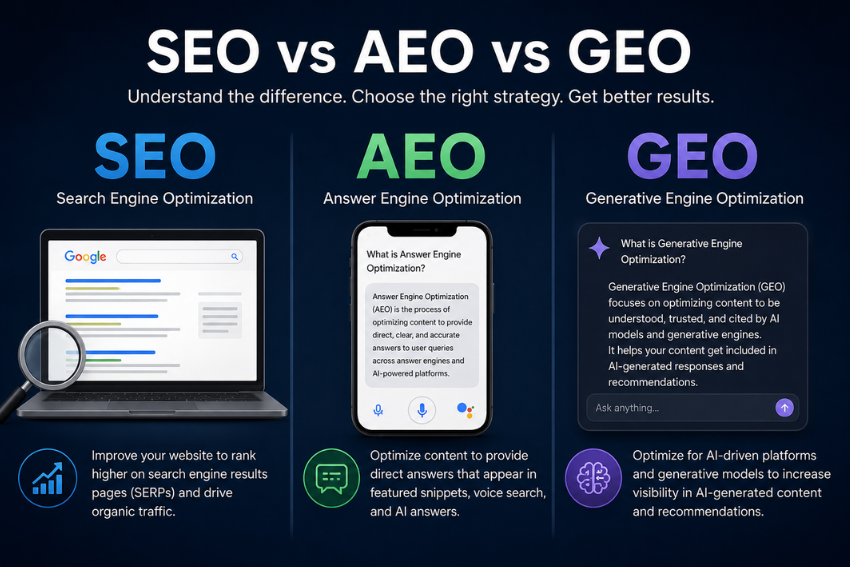
The landscape has changed drastically. SEO, AEO and GEO – these three different approaches are influencing the image of companies in the digital world.
- SEO (Search Engine Optimization)
- AEO (Answer Engine Optimization)
- GEO (Generative Engine Optimization)
Each approach focuses on the different types of discovery experience.
| SEO | AEO | GEO |
|---|---|---|
| It helps you rank in traditional search results. | It positions your website as the ultimate answer to certain questions. | It guarantees that your company is referred to and recommended by AI-powered tools such as ChatGPT, Google Gemini, and Bing Copilot. |
Understanding the differences between the two is not an option for companies that wish to remain ahead of the competition. It doesn’t matter if you handle the SEO in-house or use professional SEO services; knowing where to put your time and effort can make all the difference. Let us understand the meaning and differences between SEO, AEO and GEO.
What is SEO?
Search Engine Optimization is the process of enhancing your site and content so that search engines such as Google and Bing can rank it higher on their result pages. It has been a cornerstone in digital advertising for nearly two decades. Despite frequent algorithm changes, it’s still among the top and most reliable, and long-lasting strategies to drive organic traffic.
At its heart, SEO operates on the idea that search engines utilize algorithms to judge pages based on hundreds of elements like authority, relevance, speed, and the user’s experience, links, and much more. When you optimize your website for these aspects, your site will be more likely to show up when users type their queries into search engines.
SEO’s 4 Pillars of SEO
- On-Page SEO: Optimizing individual pages by using keywords, meta tags, headings, internal linking, and content quality.
- Technical SEO: Making sure your website is crawlable, speedy, mobile-friendly, and free of errors that can hinder crawlers.
- Off-Page SEO: Building your domain’s authority by gaining backlinks, mentions, and other external signals of trust.
- Content Optimization: Making valuable and keyword-rich content that addresses what your audience is looking for.
Businesses that invest in professional SEO services generally get a compounding return over time. In contrast to paid ads, which cease once you stop spending money, SEO creates momentum. A properly optimized page could draw people for months or years with no additional expense.
But SEO is not without its problems. It can take 3 to 6 months before you see meaningful results. Also, it requires constant efforts from competitors who are constantly trying to rank you higher. Search engines regularly change their algorithms.
What is AEO?
Answer Engine Optimization began to emerge as search behavior started to change. As voice assistants such as Siri and Alexa became popular and Google introduced featured snippets of content and “People also ask” and “People Are Also Asking” boxes, the world changed. Users stopped simply searching; they began asking. They expected answers to their questions rather than the 10 blue links to click through.
AEO is the act of arranging your content in a way that it meets specific requirements and is chosen as the best answer for voice search and other devices. Instead of trying to get a top ten ranking, you are competing for the one answer that is read aloud or is displayed at the top of the search results page.
How AEO Works in Practice
To make the best use of answer engines, you need to imagine yourself as someone who is asking an inquiry and provide the most concise, precise, and authoritative answer that is possible. This includes:
AEO: Content that is based on questions. Structured articles based on questions your readers ask, such as:
- What is AEO?
- How do I implement AEO in my content?
- Why isn’t my content being included in AI-generated responses?
Schema Markup: Utilizing organized data so that search engines can recognize and retrieve your information more efficiently.
- FAQ schema
- What is a schema? How to schema
Simple formatting: Giving the most important information in just 40-60 words, before going into more detail.
Voice search capability: Using natural spoken language, which is well read when spoken by an assistant voice.
AEO is especially efficient for local firms, healthcare facilities, legal services, local businesses, and educational digital platforms in which users are asked specific, intent-driven questions. If someone asks, “What are the nearest professional SEO services in Ahmedabad? “ If your site’s content is optimized to address the question with authority, there is a high possibility of being featured as a result.
The major difference from conventional SEO can be seen in the fact that AEO prefers to be selected over ranking. It is not necessary to be the top organic result. All you need is the organized content so that search engines find it to be the most relevant.
What is GEO?
Generative Engine Optimization is the most recent among the 3 disciplines developed because of the advent of AI-powered devices that produce responses, rather than just listing websites. If a user types ChatGPT or queries Google’s AI overviews or makes use of Perplexity AI to study an area, it is not receiving the traditional result from a search. They will receive an AI-generated, synthesized answer that is pulled from multiple sources and then presented as a curated answer.
Generative engine optimization is the process of making your company’s brand and your expertise, content, and brand evident and credible enough to be included in AI-generated answers. It’s about ensuring that, when an AI tool comes up with an answer regarding your industry, business, or your field, which you specialize in, that it cites or suggests you.
What Makes GEO Different?
Traditional SEO is focused on rankings and keywords. AEO is focused on the format for questions and answers. GEO concentrates on authority, credibility, and the breadth of its digital presence. AI models are trained from huge quantities of publicly accessible data-driven articles, reviews, social media, academic material, news coverage, and much more. They combine this information to determine which leading voices are in each area.
To rank high in the world of generative engines, companies must:
- Create the authority of the digital world: Be mentioned in, quoted, and referenced across a variety of reliable platforms, including news websites, industry blogs, podcasts, forums, and social media.
- Create original research and thought leadership: AI algorithms prefer sources that provide new insights, data, and perspectives to a discussion.
- Maintain consistent branding details: Your business name, service, location, and messages should be the same across every platform on which your business is.
- Create a solid reputation and review footprint: reviews of Google, Trustpilot, G2, and other similar platforms indicate the trustworthiness of the generative AI systems.
- Utilize clear, citable information: Write in a style that AI can easily understand, as well as quote and attribute specific statistics, named authors, and substantiated assertions.
GEO is not about gaming algorithms in the conventional sense. It’s about becoming a source that AI systems are confident enough to endorse. In a variety of ways, it rewards the exact aspects that quality marketing and journalism have always been rewarded for, such as accuracy, experience, and a solid reputation.
SEO vs AEO vs GEO: A Side-by-Side Comparison
Now that we have explored each discipline individually, let us look at how they compare directly across key dimensions.
| Primary Goal | Primary Platform | Content Focus | Time to Results | Best For | |
|---|---|---|---|---|---|
| SEO | Ranks higher in traditional search engine results pages (SERPs) | Google, Bing, Yahoo, and other traditional search engines | Keywords, backlinks, technical site health, and page authority | 3–6 months for meaningful traction, long-term compounding returns | Any business wanting long-term organic traffic growth |
| AEO | Is selected as the direct answer to a specific question. | Voice assistants (Siri, Alexa, Google Assistant), featured snippets, | Q&A formatting, schema markup, and concise direct answers | Can see featured snippet results in weeks with the right content | Businesses targeting voice search and question-intent queries |
| GEO | Get cited or referenced in AI-generated responses | ChatGPT, Google Gemini, Perplexity AI, Bing Copilot | AI Overviews, Brand authority, citations, original research, and multi-platform presence | Ongoing requires sustained authority building over time | Brands building thought leadership and AI-era discoverability |
Do You Need All Three – SEO, AEO and GEO?
The quick answer is yes, but it is not necessary to deal with all three at once, particularly if you are small or just beginning to learn about online marketing.
Without a well-optimized website, strong content, and healthy technical health, neither AEO nor GEO efforts will be able to reach the full benefits. Consider SEO as the foundation upon which the rest of everything else is built.
AEO can be considered the second layer. When you have established your SEO foundation by adding content that is answer-optimized, you have the best chances of attracting users who are willing to act, not simply browse. This is particularly important for companies operating in sectors where ranking first organically is a challenge, but securing an ad-hoc snippet of content is attainable.
GEO is becoming increasingly crucial as AI tools for searching increase in popularity. A study published in 2024 by BrightEdge discovered that the number of AI-generated responses in search results had increased by more than 30% in just one year. As people become more comfortable with receiving direct answers via AI assistants, companies that do not pay attention to GEO are at risk of being unnoticed by a large group of searchers, even though their SEO is top-notch.
Engaging with a professional SEO service that is knowledgeable of all three disciplines provides businesses with the clearest way ahead. A competent agency will evaluate your online presence, determine where your largest gaps are, and then develop a plan to phase into SEO, AEO and GEO in a manner that fits your budget and objectives.
Practical Steps to Get Started
If you are new to the HTML space and you are wondering where to start with HTML, here’s a helpful guideline:
Start with an SEO Audit
Before you do anything else, be aware of the current condition of your site. Tools such as Google Search Console, Ahrefs, or SEMrush will reveal technical issues or gaps in your keywords, as well as opportunities for backlinks. If your website has fundamental issues that cause slow loading times or broken links, as well as a poor mobile experience, you need to fix them first.
Identify Your Most Common Customer Questions
Contact your sales staff, read support tickets for customers, and review what your customers are asking on forums such as Reddit or Quora. These are the types of questions you must be answering on your website to aid AEO in addition to SEO. Create specific FAQ pages, blog posts, and landing pages that address each query in detail.
Implement Schema Markup
Structured data serves as the link between your content, and both answer engines and generative AI. The addition of the FAQ schema, the how-to schema, and the Organization schema to your website aids search engines and AI tools in comprehending the content you have posted and how trustworthy your brand’s authority is.
Build Your Brand Presence Across Platforms
For GEO, the diversity of your presence is crucial. Contribute guest blog posts to respected magazines in your field and be featured on podcasts, get included in directories of your industry, and encourage customers who are satisfied to write reviews on major platforms. The more credible sources that refer to your company, the more probable it is that AI systems will view you as a trusted authority.
Create Cited AI Content
Create original surveys, case studies, research papers, and guides that are useful and citeable. When AI tools search for additional information, they look for sources that provide verifiable, specific data. Writing that is based on names, statistics, and clear, expert-level perspectives, is much better suited to being used than general material.
Why SEO, AEO and GEO Work Best Together
It is an error to think of the three strategies as rival alternatives. They are all complementary elements of the modern digital marketing strategy.
Content that appears at the top of Google (SEO) is displayed as a prominent snippet of content when people ask a similar question (AEO) and is also cited because of ChatGPT whenever a person requests recommendations. AI assistant for suggestions (GEO) performs in all three platforms at the same time. This kind of multi-channel visibility is the modern way to discover.
Companies that are aware of this convergence are preparing themselves to compete in the future of search. Businesses that focus solely on ranking signals that are traditional risk losing their visibility as searchers increasingly use AI devices and assistants for help.
The positive side is that the principle that underlies each strategy is to create authentic, credible content that meets your target audience’s actual wants and needs. Strategies change, but the content quality and relevance will never be out of fashion.
Final Thoughts
The landscape of digital marketing is more complicated than it’s ever been; however, it is more brimming with opportunities. SEO remains the foundation of internet visibility. AEO can help you reach the increasing number of people who are looking for immediate, clear responses. Furthermore, GEO places your brand in the AI-powered tools for discovery, which are quickly changing the way people search for information.
The companies that can thrive in this climate are not necessarily those with the largest budgets. They are those who are aware, change rapidly, and dedicate themselves to establishing credibility in their industry. If you manage your digital strategy internally or work with professional SEO services, knowing SEO, AEO and GEO will give you an edge in the market.
Start from where you are now, build on what you already have, and focus on the most important thing: making real value for real people. The traditional algorithms or AI-powered ones will be followed.