











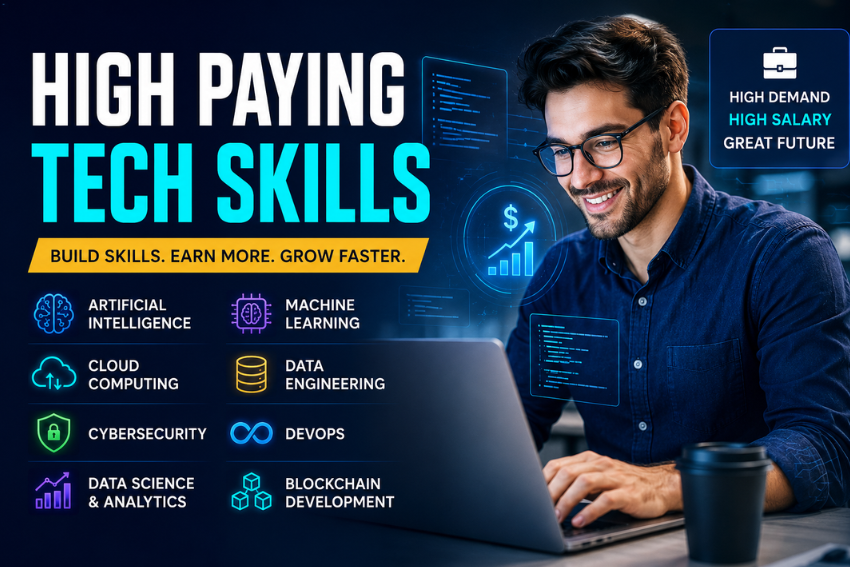
As companies in all sectors continue to invest heavily in AI, cloud computing, cybersecurity, data engineering, and digital transformation, the future of careers in 2026 is defined by high paying tech skills. Industries are no longer seeking workers who can do repetitive laboring tasks. Instead, they’re looking for professionals who can help them find solutions to complex business problems with modern technologies and automate processes and create innovation.
This is a trend that opens up the opportunity for talented technology staff to earn more, enjoy better benefits and work remotely. From students to IT professionals and anyone looking to change their career, acquiring the correct tech skills now can lead to thrilling and lucrative job prospects.
The technology world continues to change at an astounding rate and it is important to learn skills that benefit the future long-term career and not just a fad of the moment. The best-paying positions demand a blend of technical knowledge, hands-on experience, and ongoing education in fields such as building AI-powered applications, ensuring cloud infrastructure security, handling hefty data pipelines, and crafting scalable software solutions.
In this guide, you’ll learn the high paying tech skills that employers are looking for in 2026, why they’re in demand, the career opportunities they present, and how you can begin developing the skills necessary to remain competitive in today’s rapidly evolving digital landscape.
How We Selected These High Paying Tech Skills
With a little foresight, one could select a skill that is likely to advance their career in the next 10 years. This is the list of technologies that are commonly seen as a part of industry’s hiring reports, salary surveys, and current job market analysis despite being less popular in the short run. All the skills presented here meet four criteria:
| Selection Factor | Why It Matters |
|---|---|
| High salary potential | Companies are willing to pay premium compensation. |
| Strong global demand | Jobs are available across multiple countries. |
| Long term growth | Demand is expected to continue for years. |
| Cross industry adoption | Skills are valuable in healthcare, finance, retail, manufacturing, and technology. |
Industry experts also recommend building complementary skills instead of learning technologies in isolation. For example, an AI engineer who understands cloud deployment and cybersecurity becomes far more valuable than someone who only knows machine learning algorithms.
Similarly, an architect with DevOps background can design, deploy and maintain enterprise applications much faster. A mix of expertise and hands-on experience is the emerging norm for lucrative technology jobs.
Top 15 High Paying Tech Skills in 2026
Artificial Intelligence and Generative AI
In 2026, AI remains the most valuable technical skill to master, dominating the technology industry. AI is now being leveraged in areas such as customer service automation, fraud detection, healthcare diagnostics, software development, content creation, predictive analytics, and enhancing customer shopping experiences.
The widespread use of LLMs, RA, AI agents and enterprise automation platforms has skyrocketed the need to build, customize and deploy intelligent solutions.
There is an increasing demand for engineers with expertise in prompt engineering, Python programming, vector databases, AI model assessment, and responsible usage of AI. According to hiring data, AI related roles continue to pay more, as there are fewer professionals with experience in the field.
Professionals interested in developing their skills in Artificial Intelligence should also prioritize cloud AI platforms, vector databases, Retrieval Augmented Generation, OpenAI APIs, LangChain, and TensorFlow/PyTorch. AI career opportunities can be boosted by creating real-life applications and a impressive portfolio. Theoretical knowledge is not the only thing that is valuable to employers. Security, cloud deployment, and business strategy are key areas where AI pros can accelerate their growth to senior engineering or AI leadership roles.
With many organizations integrating AI into normal daily operations, it can be said that Artificial Intelligence is likely to be one of the biggest earning and growing technical skills globally.
Machine Learning Engineering
Machine learning engineering is still one of the most profitable careers in technology, as it converts basic data into intelligent business solutions. Machine learning engineers differ from traditional software developers in that they create systems that learn patterns, can make predictions, and can continuously improve their performance based on data.
In the modern world, the fields include recommendation systems, financial forecasting, autonomous vehicles, fraud detection, medical diagnosis, robotics and natural language processing. Intelligent automation will continue to add value to organizations in all major industries as it reduces the operational costs and increases the efficiency.
Machine learning engineers must have a solid grasp of mathematics, statistics, programming and software engineering. The main language for machine learning is still Python, and the newer packages TensorFlow, PyTorch, Scikit learn and cloud machine learning services are still in the ascendancy. Engineers are also expected to have an understanding of data preprocessing, feature engineering, model deployment, monitoring, and optimization.
As companies continue to grow their AI-driven products and services, the number of Machine Learning Engineers is on the rise and they are also among the highest-paid technology professionals, according to recent salary projections.
Cloud Computing and Cloud Architecture
Cloud computing remains one of the high paying tech skills since almost all businesses today depend on cloud technology for applications, data storage, and efficient scaling. Businesses are moving away from the traditional data center to the cloud to help cut costs, boost flexibility, and accommodate remote workers.
With the increasing adoption of cloud technologies, there is an increasing demand for cloud professionals to create secure, scalable, and highly available cloud environments. Cloud Architects and Cloud Engineers are essential in aiding companies to modernize their technology stacks while guaranteeing performance, compliance, and disaster recovery.
Amazon Web Services (AWS), Microsoft Azure, and Google Cloud Platform (GCP) are the three major cloud platforms. Firms tend to look for individuals with knowledge of infrastructure as code, containerization, Kubernetes, serverless computing, networking, identity and access management and cloud security. Understanding of Terraform, Docker, CI/CD pipelines and monitoring tools will definitely help improve employability. Professionals who can reduce the costs of cloud systems with reliability are also a value-add to businesses, as cloud is now a big expense.
Cloud transformation projects are complicated so that is one reason why cloud professionals are paid a high price. If the cloud architecture isn’t designed correctly, it can result in security risks, performance bottlenecks, and high costs.
Organizations can help prevent these risks and promote innovation with the help of skilled architects. Those with cloud expertise, AI expertise, or cyber security or DevOps expertise tend to take on senior technical leadership roles more rapidly than those who are experts in just one of these areas.
Essential Skills
- AWS, Azure, or Google Cloud Platform
- Kubernetes and Docker
- Terraform
- Infrastructure as Code
- Cloud networking
- Cloud security
- Serverless architecture
- Cost optimization
Common Job Roles
| Role | Average US Salary Range |
|---|---|
| Cloud Engineer | $130,000 to $170,000 |
| Cloud Architect | $160,000 to $220,000 |
| Solutions Architect | $150,000 to $210,000 |
Cybersecurity
Cyber security has emerged as one of the most important tech fields as cyber attacks persist in becoming more frequent and advanced. Sensitive customer data, financial records, IP, and cloud infrastructure protection against more sophisticated threats is a priority for businesses. In addition, governments globally have enacted more stringent privacy and security laws and regulations, further driving the need for skilled cybersecurity specialists.
The cybersecurity professionals of today are much more than just installing antivirus software. They evaluate and identify the risks in the organizations, secure cloud environments, leverage AI to detect threats, perform pen testing, and respond to incidents, and adopt zero trust security models. The need for professionals with knowledge of identity management, endpoint protection, threat intelligence, network security, digital forensics, and security automation is rapidly growing.
AI is transforming cybersecurity, too. The attackers leverage AI to develop more compelling phishing attacks and automate attacks, while the defenders utilize AI to detect anomalies and act in response to threats quicker. This changing environment requires cybersecurity practitioners to adapt and continually learn new skills to keep up with new threats. Businesses understand this and are ready to pay higher wages to the professionals that can defend business operations.
Valuable Cybersecurity Certifications
- CISSP
- CEH
- CompTIA Security+
- CISM
- GIAC Certifications
- Microsoft Security Certifications
- AWS Security Specialty
Cybersecurity is one of the most secure career options as businesses continue expanding their online activities, and digital security will be more important than ever in the years to come.
Data Engineering
Behind the scenes, data engineers make things possible, whereas many people think of data science when they think of business intelligence. Reliable and clean data that is well organized is the basis for every AI model, dashboard, recommendation engine, and analytics platform. Effective data pipelines are essential for any organization looking to make sense of their data or develop successful AI applications.
Data Engineers are responsible for building systems that gather, manipulate, convert, and publish very large data sets from various sources. They are tasked with the development of pipelines for ETL, data warehouse management, database optimization, data quality, and assisting machine learning teams. Structured and unstructured data are vast quantities that are created daily within modern businesses, and that is where data engineers come in.
As real time analytics has gained ground, there is also growing demand for anyone with knowledge of distributed computing technologies like Apache Spark, Kafka, Hadoop, Snowflake, Databricks and cloud based data platforms. Candidates must also be proficient in SQL, Python, database optimization, and cloud services.
There is an emphasis on analytical thinking and problem solving skills for those entering this profession. As more and more organizations rely on data driven decisions, skilled data engineers often move into higher level architecture and technical roles, with lucrative compensation.
Core Technologies
- SQL
- Python
- Apache Spark
- Apache Kafka
- Snowflake
- Databricks
- BigQuery
- Redshift
- Azure Data Factory
MLOps and AI Infrastructure
It is not sufficient to have a successful training of the AI model to create business value. These also need to be used in production, monitored, updated, secured and continually improved. Therefore, MLOps is one of the fastest growing and high paying tech skills for 2026, and the responsibility falls upon the shoulders of the MLOps professional.
In essence, MLOps is a fusion of machine learning, DevOps principles, cloud engineering, automation, and software engineering, aimed at streamlining the lifecycle of AI models. The organizations that use enterprise AI solutions need to engage those who can automate the model training, manage version control, monitor the performance, detect model drift, and ensure successful deployment of the model in the cloud.
With the growth of AI projects across businesses, maintaining hundreds of models manually becomes impossible. All the processes mentioned above can be automated by MLOps platforms, ensuring consistency, governance, and reliability. These experts frequently collaborate with AI engineers, software developers, cloud architects, and cybersecurity teams to create AI solutions that are ready for deployment in real-world applications.
Popular options are MLflow, Kubeflow, Docker, Kubernetes, Jenkins, GitHub Actions, Terraform, Azure ML, AWS SageMaker and Vertex AI. Candidates who are familiar with CI/CD pipelines, monitoring platforms, cloud infrastructure, and orchestration of containers are particularly appealing to employers.
As companies realize that implementing AI goes beyond building accurate models, the demand for MLOps engineers is growing. AI applications require robust infrastructure that can scale to meet the demands of businesses.
DevOps and Platform Engineering
DevOps has come a long way in the last 10 years. In today’s world, Platform Engineering takes the DevOps principles even further, by developing internal platforms that are standardized for development teams to use to build and deploy software quickly. By using platform engineering, companies can eliminate development bottlenecks, enhance software quality, and speed up product delivery.
DevOps experts automate deployments, infrastructure management, testing, monitoring, and software reliability. They remove repetitive manual tasks and enhance communication between dev and ops teams. Today’s businesses update software several times a day, and automation is a must to keep up with speed without compromising quality.
Platform Engineers go one step further and create infrastructure that can be re-used, developer portals, standardized deployment environments, and self-service tools that will make software development easier in large organizations. It’s a new field that’s incredibly valuable, as companies want engineering teams to focus on product building, not infrastructure.
Key Technologies
- Docker
- Kubernetes
- Jenkins
- GitHub Actions
- Terraform
- Ansible
- Linux
- Prometheus
- Grafana
- ArgoCD
When combined with DevOps and cloud skills, cybersecurity and automation skills are a match made in heaven for experts, offering outstanding career progression. DevOps and Platform Engineering will continue to be some of the most valuable technical career paths for businesses to invest in their digital transformation.
Full Stack Development
Full Stack Development remains a high paying tech skill due to the fact that businesses greatly appreciate the professionals who can create end-to-end web applications ranging from front-end user interfaces to back-end services and databases. Many startups, and even large enterprises, opt for engineers who can work on all phases of an app, rather than hiring someone to work on each individual layer. The versatility is able to cut down development expenses, accelerate product releases and enhance team coordination.
Modern Full Stack Developers are expected to have knowledge of the following technologies: JavaScript, TypeScript, React, Angular, Vue.js, Node.js, Python, Java, .NET, and other related tools.NET, PostgreSQL, MongoDB, REST or GraphQL APIs. They know about authentication, security, cloud deployment, performance optimization and responsive design as well. AI-powered applications are increasingly becoming a requirement for developers, and employers are looking to them to incorporate the ability to leverage AI through APIs from the leading AI platforms.
In addition to technical proficiency, Full Stack Developers should also be adept at problem-solving and have a focus on user experience. Businesses want to hire individuals who can translate business requirements to scalable applications while also being able to write clean and maintainable code. As digital products play an important role in business dynamics, Full Stack Development is one of the most secure and profitable tech job paths.
Data Science and Analytics
Businesses collect a vast amount of data on a daily basis, but without being digested and turned into information, it’s worthless. That’s why Data Science continues to be one of the highest paying technology skills in 2026. Data scientists are critical to businesses for making better decisions, forecasting customer behavior, fine-tuning processes, fending off fraud, and uncovering new revenue streams.
A modern Data Scientist is a programmer, a statistician, a mathematician, a machine learning specialist, and a business knowledgeable. Typical tools used for collecting, cleaning, visualizing, and interpreting data are Python, R, SQL, Power BI, Tableau, and cloud analytics platforms. Moreover, AI has found its way into data science, enabling professionals to create predictive models and automate complex data analysis tasks.
Communication with non-technical audiences of technical results is becoming a critical skill sought by employers. Often, there is a gap between senior and junior data scientists with regards to clear communication. Business acumen is a talent that can often lead to promotion to higher-paying leadership roles when it can relate analysis to business results.
Blockchain Development
Blockchain is no longer just about cryptocurrencies. Now, companies are leveraging blockchain for its ability to enhance transparency, security and traceability in sectors like finance, healthcare, supply chain management, insurance and digital identity verification. With the increasing adoption of blockchain, Blockchain Development is still one of the most niche and lucrative technology skills to learn.
Blockchain Developers are responsible for building decentralized applications, smart contracts, and secure distributed systems. Web3 development frameworks, Rust, Hyperledger Fabric, Solidity, Ethereum, and Polygon are some of the popular technologies. One of the most critical factors is security as a break in security of smart contracts can cost a lot of money.
While the blockchain hiring market is volatile and depends on the market, the demand for blockchain professionals with expertise in distributed systems, cryptography, and secure application design is ongoing as more enterprises embrace the technology. Candidates with strong skills in blockchain, cybersecurity, and cloud computing are highly sought-after in the job market.
Site Reliability Engineering
There simply is no room for a prolonged downtime in modern businesses. Users take website, mobile apps, payment systems, and cloud services for granted and depend on them for 24×7 availability. In order to overcome this challenge, software engineering has evolved into Site Reliability Engineering or SRE, which integrates infrastructure management with software engineering to enhance system reliability, scaling, and performance.
Site Reliability Engineers automate repetitive work, track production systems, optimize incident response, and enhance application resilience. They have extensive experience interacting with Kubernetes, Docker, Linux, cloud platforms, monitoring tools, and automation frameworks. They are looking to avoid failures that impact customers and want systems to recover quickly in the event of a failure.
Since businesses rely on digital services for generating revenue, SRE is getting even more valuable. Short outages can come at a cost of millions of dollars and be harmful to customer confidence. It is therefore not surprising that organizations spend large sums of money on their skilled reliability engineers who can keep systems stable, secure and high performing.
Internet of Things
Known as IoT, the Internet of Things (IoT) is revolutionizing industries by linking intelligent software with physical devices. From manufacturing plants to hospitals, transportation systems to smart cities, agriculture to energy providers, IoT technologies are used in a myriad of applications to gather data, automate processes, and optimize operations.
IoT pros focus on designing embedded systems, adding sensors, creating communication protocols, analyzing device data and securing connected infrastructure. There is still value in programming languages like C, C++, Python and Java and cloud platforms are crucial for processing and managing the data that can be retrieved from connected devices.
Security is one of the major concerns of IoT as billions of devices are connected and hence creating an extra surface for attacks. Embedded development, networking, cloud computing and cybersecurity skills are all in-demand for professionals in every industry as organizations continue to invest in connected technologies.
AR and VR Development
AR and VR are no longer just technologies for entertainment, but they are also applicable in the business world. Immersive simulations are used in medical training, manufacturers use virtual environments to teach employees, retailers use virtual demonstrations of products to improve the customer experience, and educational institutions provide interactive experiences.
AR/VR Developers create immersive applications by leveraging platforms like Unity, Unreal Engine, ARKit and ARCore, as well as advanced 3D modeling tools. They also collaborate with spatial computing, computer vision, and AI technologies to deliver more realistic user experience.
With the falling cost of hardware and rising adoption in the enterprise, there is a growing need to find people who can create fun and useful “immersive” applications. While this area of work is more niche than software creation, AR/VR professionals with experience and expertise are sought after and demand higher pay, as quality people are scarce.
Product Management
Product Management is not a coding job, but it’s one of the highest paid in technology because Product Managers bring together business strategy and engineering execution. They are responsible for developing product vision, prioritizing product features, bringing together cross functional teams, analyzing customer feedback and making sure the technology investments bring measurable business value.
Technical Product Managers have a solid grasp of software development, cloud, AI, cyber, and user experience. With this technical knowledge, they can interact effectively with engineers and make business decisions on the basis of facts. There is a growing demand for product managers to know the latest technologies and recognize innovation opportunity.
Great product managers are known for their communication, leadership, analytical, and stakeholder management abilities. Technology startups that make lots of money can easily advance up the ranks to executive-level roles with high salaries.
AI Security and Governance
With the increasing AI penetration into business operations, privacy, compliance, fairness, transparency, and cybersecurity are becoming increasingly significant issues. So, AI Security and Governance has become one of the newest and fastest growing high paying tech skills in 2026.
They create policies and technical measures that promote responsible and secure usage of AI systems. They assess biases in AI models, track adherence to policies and regulations, safeguard sensitive training data, defend against attacks on AI infrastructure, and create governance structures for ethical AI use.
The realization of the importance of trust in successful AI implementation has grown with increased business awareness. There’s a growing awareness amongst businesses that success with AI depends as much on trust as it does on performance.
Businesses like financial institutions, healthcare providers, governments, and international companies need experts with expertise in cybersecurity, risk management, regulatory compliance, and machine learning. The demand for AI governance professionals will likely surge in the next few years as regulations are still in flux around the world.
Which High Paying Tech Skill Should You Learn First?
If you are beginning your technology career, focus on developing a strong foundation before specializing. Start with programming, databases, and cloud computing, then gradually build expertise in advanced domains.
A practical learning path looks like this:
- Learn Python or JavaScript.
- Understand SQL and database fundamentals.
- Gain experience with cloud platforms.
- Build real world projects.
- Learn Git and collaborative development.
- Explore AI, cybersecurity, or data engineering based on your interests.
- Earn industry recognized certifications.
- Continuously update your portfolio and GitHub profile.
The most successful professionals never stop learning. Technology evolves rapidly, and continuous skill development is one of the best investments you can make.
Conclusion
There has never been a greater need for high paying tech skills. Industries are transforming and even more amazing opportunities for career advancement are emerging for those who want to commit to learning, especially in the fields of Artificial Intelligence, Machine Learning, Cloud Computing, Cybersecurity, Data Engineering, DevOps, and AI Governance.
Today, experienced software engineers are no longer the only ones who can earn top dollar. These days, employers are more inclined to pay professionals who can not only apply the technical skills, but also show their problem solving abilities, business knowledge, communication and practical experience. From students to IT professionals aspiring for growth to anyone considering a career change, gaining knowledge of these technologies can pave the way for long-term success.
Rather than acquiring every new skill, acquire one highly in-demand skill, use it on real world projects, and branch out to related technologies over time. This approach not only boosts your income but also enhances the sustainability of your career in an ever-changing tech landscape.
Frequently Asked Questions
What is the highest paying tech skill in 2026?
Currently, AI and Generative AI are among the most in-demand and highly compensated technology skills, as they are gaining widespread adoption by enterprises and in demand globally.
Which tech skill is easiest to learn for beginners?
All three fields (Full Stack Development, Cloud Computing, Data Analytics) are excellent choices, as they offer solid career prospects and technical skills.
Do I need a computer science degree to get a high paying tech job?
No. For many companies, the hands-on skills, credentials, and project work are more important than a degree, particularly in fields such as cloud computing, AI, cybersecurity, and software development.
Which programming language should I learn first?
Python is extensively used and recommended as it is a beginner friendly language, and is a key language in Artificial Intelligence, Data Science, Automation, Machine Learning, and Cloud Engineering.
How long does it take to learn a high paying tech skill?
The timeline will be based on your learning capacity and background. Many learners turn to jobs for entry level positions in 6-12 months with regular study and practice, and with further experience, some can be job ready for advanced specializations.