









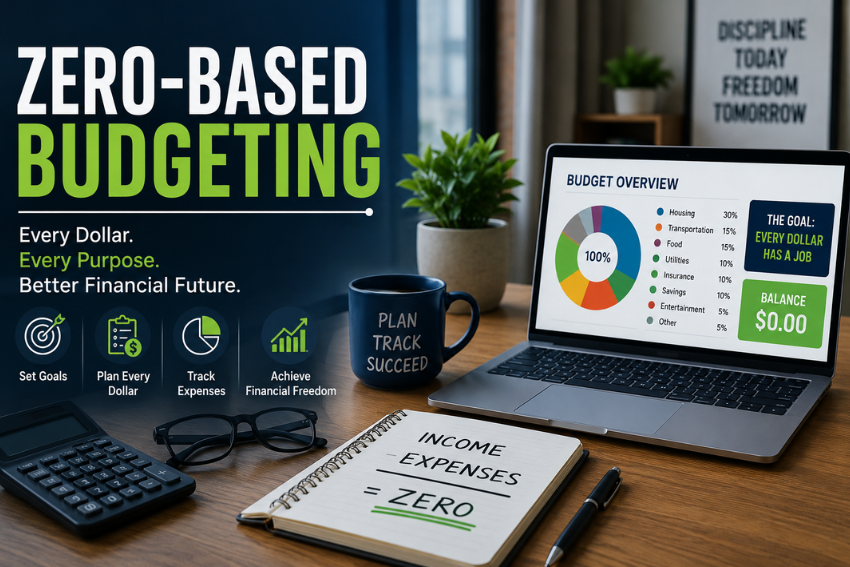
Zero-based budgeting is one of the most practical ways to control money because it forces every dollar to serve a purpose instead of disappearing into everyday spending.
Money has a strange habit of slipping away quietly. One day your paycheck arrives and a few weeks later you wonder where it all went. Subscriptions renew automatically, grocery bills climb, weekend plans happen, and somehow saving becomes something you promise yourself for next month.
That is exactly why zero-based budgeting has gained renewed attention among households, businesses, and even governments trying to improve spending discipline. Instead of building a budget based on what happened last month or last year, this method starts from zero and requires every expense to earn its place.
If the name sounds extreme, relax. It does not mean spending all your money. It means assigning every dollar a job.
This guide explains exactly how zero-based budgeting works, who should use it, examples, advantages, disadvantages, and practical steps to start today.
What is Zero-Based Budgeting?
At its core, zero-based budgeting means every dollar of income receives an assignment before the month begins.
Imagine your income is $5,000. Instead of spending naturally and saving what remains, you intentionally allocate the entire amount. Rent gets one portion. Utilities receive another. Savings gets its allocation. Investments, entertainment, groceries, insurance, emergency reserves, and discretionary purchases all receive designated amounts.
By the end:
Income − Allocations = Zero
That equation does not mean your bank account becomes empty. It means no dollar sits around without a purpose.
Traditional budgets often create vague categories and leave room for uncontrolled spending. Zero-based budgeting creates intentionality.
Think of your money like employees inside a company. Every employee has a role. If someone stands around doing nothing, productivity drops. Money behaves the same way.
History and Evolution of Zero-Based Budgeting
Zero-based budgeting originated in corporate financial planning during the 1970s and became known through work developed by budgeting strategist Peter Pyhrr. The concept focused on evaluating expenses from scratch instead of automatically carrying forward previous allocations.
Over time, businesses adopted it to reduce inefficiency and redirect capital. Today the concept has returned with fresh momentum.
Several organizations continue using zero-based budgeting principles to improve cost visibility and spending discipline, especially during periods of economic pressure and operational change. Research has documented renewed corporate interest tied to cost optimization strategies.
At the personal finance level, digital budgeting apps and growing awareness around intentional spending have made the method more accessible than ever.
How Zero-based budgeting Works: The Step-by-Step Process
Implementing zero-based budgeting isn’t a quick exercise. It requires a structured, methodical approach. Here is a breakdown of how the process typically works.
Step 1: Define Objectives and Scope
The journey begins by clearly defining the budget period and the scope of the exercise. This involves identifying which departments, functions, or projects will be part of the ZBB process. It is also critical to establish the organization’s strategic goals upfront, as these will serve as the benchmark for evaluating all proposed spending.
Step 2: Identify and Map All Activities
Next, you must document every single activity and recurring expense. This is a granular process where operating expenses are broken down into detailed line items like salaries, marketing costs, utilities, travel, and software subscriptions. The goal is to achieve complete visibility into where money is currently going.
Step 3: Assess and Justify Costs
This is the core of the ZBB process. Every activity and expense must be justified in terms of its relevance to the organization’s strategic objectives. Managers must answer: “Why is this expense necessary?” and “How does it support our goals?” This is not about asking for a percentage increase; it’s about proving the entire cost is essential.
Step 4: Create Decision Packages
For each expense or activity, a “decision package” is created. This package provides detailed information, including the costs, expected benefits, and potential alternatives. A decision package might also outline different levels of funding for an activity, such as:
- Minimum Level: The bare minimum required to keep the lights on and meet regulatory obligations.
- Current Level: The funding needed for business-as-usual operations.
- Enhanced Level: Discretionary funding for innovation, growth, and new initiatives.
This tiered approach allows leadership to make strategic trade-offs, such as funding a department at a minimum level to free up cash for a high-priority growth project.
Step 5: Rank and Prioritize
Once all decision packages are created, management evaluates and ranks them according to importance, business impact, and expected returns. Activities that are most critical to the company’s strategy receive funding first. This ranking process ensures that resources are allocated based on current priorities, not past spending.
Step 6: Finalize and Approve the Budget
The final step is to compile the approved decision packages into the new zero-based budget. This approved budget is then communicated to all relevant parties, and the process of tracking and monitoring actual spending against the plan begins.
Zero-Based Budgeting vs. Traditional Budgeting
To truly understand ZBB, it helps to see how it contrasts with the traditional approach.
| Feature | Traditional Budgeting | Zero-Based Budgeting |
|---|---|---|
| Starting Point | Uses the previous year’s budget as a baseline | Starts from a “zero base” with no assumptions |
| Justification | Managers justify only changes from last year | Every expense must be fully justified from scratch |
| Focus | Focuses on incremental increases or decreases | Focuses on strategic goals and value creation |
| Process | Often a top-down process where management sets the budget | A bottom-up process where teams propose spending plans |
| Outcome | Can perpetuate inefficiencies and “budget creep” | Promotes efficiency, transparency, and strategic alignment |
The Benefits of Zero-Based Budgeting
Why would an organization choose to go through this intensive process? The potential rewards are significant.
- Significant Cost Reductions: By forcing a justification for every expense, ZBB naturally identifies and eliminates unnecessary or outdated costs. Companies using ZBB can see consistent savings of 15% to 25%.
- Strategic Alignment: ZBB ensures that every dollar spent is tied to a current strategic priority, eliminating “zombie” projects that no longer serve a purpose.
- Enhanced Transparency and Accountability: The process creates a culture of fiscal discipline where every line-item owner is accountable for their spending.
- Improved Resource Allocation: Funds are directed toward the most essential and impactful activities, ensuring financial efficiency and goal alignment.
The Drawbacks and Challenges of ZBB
While powerful, zero-based budgeting is not without its challenges.
- Time-Consuming and Resource-Intensive: Building a budget from scratch is a heavy lift. It requires meticulous planning, extensive documentation, and significant time from managers and finance teams. The first implementation cycle can take three to six months.
- Risk of Short-Term Thinking: The intense focus on justifying every cost can lead to short-term cost-cutting at the expense of long-term investments like research and development or brand building.
- Potential for “Budget Wars”: The process can create internal conflict as departments compete for limited funds. Without strong leadership and a clear strategic vision, ZBB can devolve into a political battle.
- Complexity: The detailed financial analysis required can slow down decision-making and put pressure on organizations with limited resources.
Zero-Based Budgeting for Personal Finance
The principles of ZBB aren’t just for corporations. It’s a highly effective strategy for personal money management.
In a personal zero-based budget, your goal is to ensure your income minus your expenses equals zero. This doesn’t mean you have no money left; it means you assign every dollar you earn a specific purpose. You give every dollar a job, whether it’s for rent, groceries, savings, or entertainment.
This approach forces you to be incredibly intentional with your money. It helps identify wasteful spending, aligns your spending with your financial goals, and encourages consistent saving by treating it like a non-negotiable expense. While it requires more effort than a rough estimate, it offers unparalleled control over your finances.
Real-World Examples: The Scalpel vs. The Axe
The success of ZBB often comes down to how it’s implemented. Two famous examples highlight this contrast perfectly.
- Kraft Heinz (The Warning): Following a merger, Kraft Heinz applied an aggressive, “ruthless” ZBB model. While their profit margins shot up instantly, they cut too deeply into critical areas like R&D and brand-building. The result was massive brand erosion and billions of dollars in write-downs. This serves as a cautionary tale of using ZBB as a blunt axe.
- Unilever (The Blueprint): In response to market pressure, Unilever adopted a “Save to Grow” ZBB model. They targeted specific administrative costs but “ring-fenced” strategic areas like innovation. The savings they generated were immediately reinvested into the business. This proves that ZBB can be a scalpel for growth, not just a tool for austerity.
Is Zero-Based Budgeting Right for You?
Zero-based budgeting is not a one-size-fits-all solution. It is best suited for organizations undergoing significant change, such as a merger, restructuring, or facing rising costs and declining margins. It is also a powerful tool for any company looking to instill a deep culture of cost discipline and strategic resource allocation.
For individuals, it is ideal for those with ambitious financial goals, such as aggressively paying down debt or saving for a major purchase, and who enjoy the meticulous planning it requires.
Conclusion
Zero-based budgeting changes the conversation from asking where your money disappeared to deciding where it should go. That shift creates clarity. Every dollar receives a purpose. Every expense becomes intentional.
Whether your goal is reducing debt, increasing savings, running a healthier business, or simply understanding your spending habits, Zero-based budgeting offers a practical framework that turns financial decisions into deliberate actions.
The first month may feel unfamiliar. By month three, many people start wondering how they ever managed money differently.