








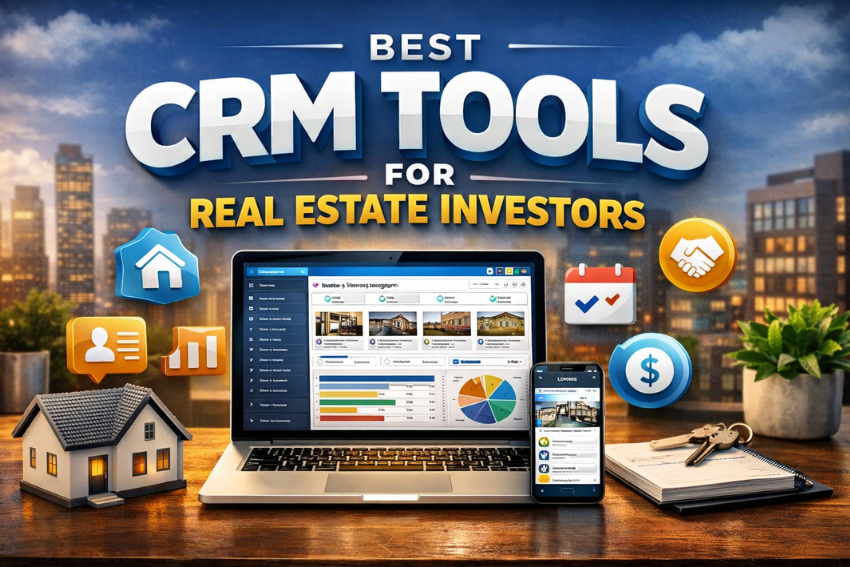
Finding the right CRM tools for real estate investors can feel overwhelming. You need something that tracks leads, manages properties, and automates follow ups without breaking the bank. After testing dozens of platforms and talking to successful investors, I have narrowed down the top solutions that actually deliver results.
Let me be clear. This is not another generic list. Each tool here solves a specific pain point for real estate investors. Whether you flip houses, buy and hold rentals, or wholesale properties, you will find a CRM that fits your workflow.
Why Real Estate Investors Need a Specialized CRM Tools
Most people think any CRM works. That is wrong. A standard sales CRM does not understand contract deadlines, property details, or the unique way investors build their pipelines. You need a system that handles things like:
- Disposition timelines for fix and flip projects.
- Tenant and vendor communication for rentals.
- Lead sources from driving for dollars, bandit signs, and online ads.
- Document storage for purchase agreements and inspection reports.
Without these features, you waste hours switching between spreadsheets, email, and sticky notes. A good CRM brings everything into one place. It saves you time and helps you close more deals.
Quickly Compare Real Estate CRM Tools
Here is a quick comparison of the 10 CRM tools for real estate investors with their primary use case.
| Tool | Best For | Starting Price (Monthly, USD) |
|---|---|---|
| REI Blackbook | Wholesalers, fix & flippers | $81 |
| LionDesk | Beginners & value focused investors | $25 |
| Podio | Customizable workflows | $9 |
| PropertyRadar | Motivated seller prospecting | $59 |
| Salesforce | Large teams & deep analytics | ~$25/user |
| FreedomSoft | High volume wholesalers | $197 |
| HubSpot CRM | Solo investors on a budget | Free |
| Pipedrive | Visual sales pipelines | $14/user |
| Real Geeks | Investor friendly agents & teams | $299 |
| Follow Up Boss | Mobile first teams | $69/user |
Top 10 CRM Tools for Real Estate Investors
Now let me walk you through my top 10 picks of CRM tools for real estate investors. I have ranked them based on ease of use, automation power, pricing, and investor specific features.
REI Blackbook
REI Blackbook tops my list because it was built from the ground up for real estate investors. The founders are actual investors who got tired of forcing generic CRMs to work for their wholesale and fix and flip business.
What makes this tool special is the intelligent skip tracing and lead scoring. You upload a list of properties, and the system automatically finds owner contact information. It then scores each lead based on equity, motivation, and likelihood to sell.
Key features include automated text and voicemail drops, a drip campaign builder with real estate specific templates, direct integration with PropStream and BatchSkipTracing, plus a mobile app for capturing leads on the go.
LionDesk
LionDesk has been around for a while, and for good reason. It offers a fantastic balance between price and functionality. Many real estate agents use it, but investors love the video email and text marketing features.
The standout feature is the automated video email. You record a short video about a new property or investment opportunity, and LionDesk sends it to your entire list. This personal touch gets way more opens than plain text emails.
You also get a built-in dialer with local presence. That means when you call a lead, your caller ID shows a local area code. People answer local calls at three times the rate of unknown numbers.
Podio
Podio is different from the others. It is a customizable work platform, not a traditional CRM. Real estate investors love it because you can build exactly what you need and nothing you do not.
You start with a blank workspace. Then you add apps for leads, properties, tasks, and contracts. You create custom fields for purchase price, ARV, rehab budget, and closing date. This flexibility is a game changer for investors who have unique workflows.
The downside is the learning curve. You need to spend time setting things up. But once you do, you will have a CRM that fits like a glove. Many successful investors use Podio with the Globiflow add on for advanced automations.
PropertyRadar
PropertyRadar focuses on one thing. Finding distressed homeowners before your competition does. It combines a CRM with powerful property data and predictive analytics.
The system tracks public records for notices of default, foreclosure filings, and tax delinquencies. When a property triggers a certain event, you get an alert. You can then add that owner to your CRM and start an outreach campaign.
This proactive approach helps you find motivated sellers without cold calling random lists. The CRM side handles follow ups, task reminders, and deal tracking. PropertyRadar also includes pre written scripts and email templates for different scenarios.
Salesforce for Real Estate
Salesforce is the 800-pound gorilla of CRM. Most people think it is too expensive or too complex for real estate investors. But Salesforce offers a non-profit discount and a small business edition that works wonderfully.
Why would an investor choose Salesforce over specialized tools? The reporting and analytics are unmatched. You can track every metric from lead source ROI to average days on market for your flips. You build custom dashboards that show your entire business health at a glance.
Salesforce also integrates with hundreds of apps. You connect it to your dialer, your email marketing platform, your accounting software, and your project management tools. Everything talks to everything else.
FreedomSoft
FreedomSoft targets real estate wholesalers specifically. The entire platform revolves around the concept of a deal pipeline. You move leads from initial contact to signed contract to assignment fee collected.
The system includes a power dialer that calls lead one after another. You never wait for a number to connect. This feature alone can triple your daily call volume. FreedomSoft also offers automated text messaging with custom keywords.
Another unique feature is the built-in contract generator. You fill out a simple form with buyer and seller information, and the system creates a state compliant purchase agreement. This saves you from hunting for templates or paying a lawyer every time.
HubSpot CRM
HubSpot offers a free CRM that never expires. For real estate investors just getting started, this is a fantastic option. You get contact management, deal tracking, and email templates at zero cost.
The free version includes up to one million contacts. You can log calls, schedule tasks, and create simple pipelines. HubSpot also connects to Gmail or Outlook so every email syncs automatically.
As you grow, you can upgrade to paid plans for marketing automation, sales sequences, and reporting. But many investors stay on the free plan for years and build successful businesses. The main limitation is no built-in dialer or texting. You need to add those separately.
HubSpot also has a huge library of tutorials and a supportive community. You never feel lost. For new investors who want to learn CRM basics without spending money, HubSpot is the obvious choice.
Pipedrive
Pipedrive is famous for its visual sales pipeline. You see every deal as a card that moves across columns. This design mirrors exactly how real estate investors think about their deals. You have leads, appointments, offers, under contract, and closed.
The interface is clean and fast. You drag and drop deals from one stage to the next. Each card shows key details like property address, offer amount, and next task due date. You can set activity reminders so you never forget to follow up.
Pipedrive includes robust email integration. You send and receive emails directly inside the deal record. The system also tracks email opens and link clicks. This helps you know which leads are actually interested.
Real Geeks
Real Geeks started as a website and lead generation platform for real estate agents. But investors have adopted it because of the powerful lead routing and automated follow up features.
The system captures lead from your website, Facebook ads, and Google PPC. It then assigns each lead to a specific campaign based on their behavior. For example, someone who downloads a free guide about rental property analysis enters a different sequence than someone who fills out a contact form.
Real Geeks includes a dialer, text messaging, and email automation. You also get a custom website with IDX integration if you work on the agent side. The reporting shows exactly which lead sources generate the most appointments and deals.
Follow Up Boss
Follow Up Boss rounds out my list because of its speed and simplicity. Real estate teams love how quickly you can log activities. You click a button, type a note, and move on. No waiting for pages to reload.
The system offers smart lists that automatically group leads based on criteria you set. For instance, you create a list of all leads who have not been contacted in seven days. Then you run a bulk text campaign to re-engage them.
Follow Up Boss also provides a mobile app that works offline. You log notes and tasks without an internet connection. The app syncs once you reconnect. This is huge for investors who spend time driving neighborhoods or touring properties.
How to Choose the Right CRM for Your Real Estate Business
You have seen ten great options. Now how do you pick one? Start by answering three questions.
First, what is your budget? Free tools like HubSpot work for beginners. Paid tools start around $25 and go up to $500. Do not overspend on features you will not use.
Second, what is your primary investment strategy? Wholesalers need dialers and skip tracing. Buy and hold investors need tenant management. Fix and flippers need project tracking. Match the tool to your strategy.
Third, how many team members use the system? Solo investors can use simpler tools. Teams need user permissions, shared calendars, and activity logs.
My advice is to sign up for free trials. Test two or three tools with real leads. See which one feels natural. The best CRM is the one you actually use every day.
Common Mistakes Investors Make with CRMs
I have seen investors waste money on CRMs they never fully adopt. Here are the mistakes to avoid.
First, not setting up automations from day one. You buy the CRM but manually enter every note and task. Automate everything you can. Set reminders for follow ups. Create templates for common emails. Build workflows that move leads through stages without your constant input.
Second, ignoring data hygiene. You import old spreadsheets full of duplicate contacts and wrong numbers. Then you wonder why your metrics look off. Clean your data before importing. Remove duplicates. Verify phone numbers and emails.
Third, switching CRMs too often. You jump from one tool to another every few months. Each migration costs time and risks losing data. Pick a solid CRM and commit to learning it deeply. Most tools have more features than you realize.
The Future of CRM for Real Estate Investors
Artificial intelligence is changing how CRMs work. New tools use AI to predict which leads will convert. They suggest the best time to call or text. Some even draft personalized messages based on lead behavior.
We will also see more integration with virtual reality and drone footage. Imagine sending a lead a VR tour of a property directly from your CRM. Or pulling drone images from public records without leaving the platform.
Blockchain based contracts might also appear inside CRMs. Smart contracts execute automatically when conditions are met. This reduces paperwork and speeds up closings.
For now, focus on the fundamentals. Track your leads. Follow up consistently. Measure your results. The best CRM will not close deals for you. But it will make your life easier and your business more profitable.
Final Thoughts
Choosing among the best CRM tools for real estate investors comes down to your specific needs and work style. REI Blackbook and FreedomSoft lead the pack for wholesalers. LionDesk and HubSpot offer great value for beginners. Podio gives you unlimited customization. Salesforce delivers enterprise power.
Start with a free trial this week. Put fifty leads into the system. Run a follow up campaign. See how it feels. The right tool will click into place and become a natural part of your daily routine.
Your time is your most valuable asset. A good CRM buys you more of it. Do not waste another month juggling spreadsheets and sticky notes. Pick one tool from this list and commit to mastering it. You will close more deals and sleep better at night.
Frequently Asked Questions
What is the best free CRM for real estate investors?
HubSpot CRM offers a completely free plan with up to one million contacts. You get deal tracking, email templates, and task management. The free version never expires and works well for investors just starting out.
Can real estate agents use the same CRM as investors?
Yes, but look for investor specific features like skip tracing, ARV tracking, and contract management. LionDesk and Follow Up Boss work well for both agents and investors.
Do I need a CRM if I only flip two houses per year?
You can manage two deals with spreadsheets. But a CRM helps you build systems that scale. If you plan to flip more houses in the future, start with a free CRM now.
Which CRM has the best mobile app for investors on the go?
Follow Up Boss offers an offline mobile app that works without internet. REI Blackbook and LionDesk also have excellent mobile apps for property visits and open houses.
Can I import my existing leads from a spreadsheet?
Every CRM on this list allows CSV imports. Just clean your data first. Remove duplicates and standardize phone number formats. Then map your columns to the CRM fields.
How do CRMs help with real estate lead generation?
CRMs do not generate leads on their own. But they help you organize leads from different sources, automate follow ups, and track which sources perform best. Some like PropertyRadar include lead data directly.