








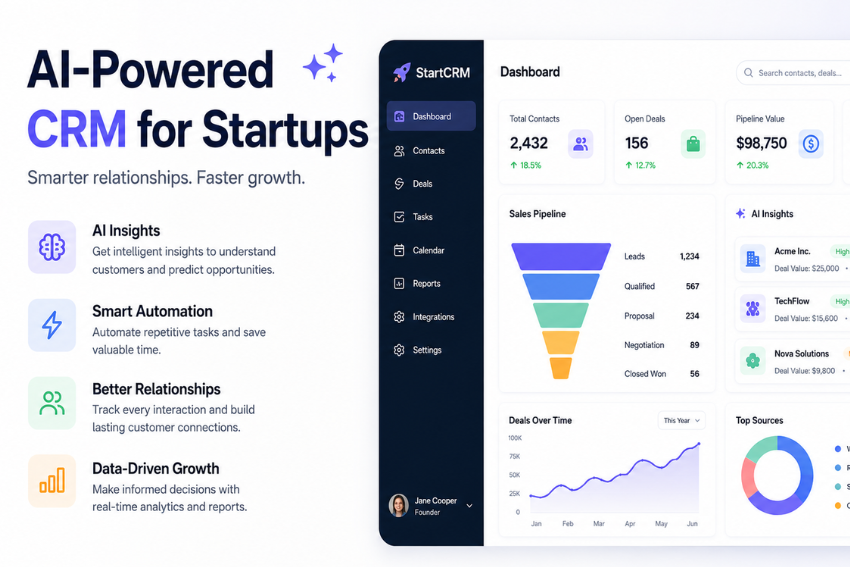
Finding the best AI-Powered CRM for Startups can feel like searching for a needle in a haystack, but you don’t need to settle for clunky software that drains your team’s energy. Most early-stage companies jump into a basic contact manager, then quickly realize they’re still drowning in manual data entry, missed follow ups, and zero visibility into which actually matter. That’s where AI changes everything.
I’ve spent years helping founders pick the right tools, and here’s the truth: a standard CRM won’t make you smarter. But an AI powered one? It works while you sleep. It predicts who’s about to buy, reminds your sales team when to reach out, and even writes follow-up emails for you. For a lean startup without a massive operations team, that’s pure gold.
Let’s break down what makes these systems different, which five tools deliver real results, and how to pick the perfect fit for your stage.
What Exactly Is an AI Powered CRM for Startups?
Think of it as a traditional customer relationship tool on steroids. You still track contacts, deals, and communication history. But the AI layer adds three superpowers:
- Automated data entry. It pulls info from emails, calendars, and calls so no one has to type anything manually.
- Predictive lead scoring. The system analyzes past closed deals and tells you which new prospects look like your best customers.
- Smart next step suggestions. It recommends the ideal time to call, what to say, and even drafts personalized messages.
Most importantly, it learns from your team’s behavior. The more you use it, the sharper its predictions get. That means your startup stops guessing and starts acting on real signals.
Why Startups Can’t Afford to Ignore AI Driven CRMs
You have limited headcount. Every minute your sales reps spend copying contact details from LinkedIn into a spreadsheet is a minute they aren’t selling. AI powered CRMs fix that instantly.
Here is what actually happens when you deploy one properly:
- Your close rates improve by 15 to 25 percent within three months. Not because you hired more people, but because you stopped chasing bad leads.
- New hires ramp up twice as fast. The AI guides them through workflows instead of relying on tribal knowledge from a senior rep who is already overwhelmed.
- You reduce churn before it happens. The system flags accounts show disengagement patterns so you can intervene early.
I have seen bootstrapped SaaS teams double their pipeline without adding a single sales head. That is the power of working smarter, not harder.
Top 5 AI Powered CRMs That Actually Work for Startups
Not every tool labeled AI delivers. After testing dozens, here are the five that balance automation with ease of use for early-stage companies.
HubSpot Sales Hub (Starter Tier)
HubSpot gets a bad rap for becoming expensive later, but its free and starter tiers pack serious AI punch. The intelligent lead scoring automatically ranks contacts based on email opens, site visits, and meeting bookings. You also get AI powered email sequencing that suggests the best sent times and subject lines.
Best for startups already using HubSpot’s free marketing tools or those wanting a gentle learning curve. The downside? Advanced forecasting requires a pricier upgrade.
Pipedrive with Smart AI Add On
Pipedrive built its name on visual sales pipelines. Now its “Smart AI” feature analyzes every deal’s history and predicts the likelihood of closing within a specific week. It also flags stalled deals and recommends specific actions like scheduling a demo or sending a proposal.
What makes this great for startups is the price point. You start around 10. No long-term contracts. If you love kanban style boards and want predictive insights without bloat, pick Pipedrive.
Attio (Best for Modern, Flexible Workflows)
Attio is the new kid on the block, built specifically for startups that hate rigid CRM structures. Its AI automatically enriches contact records with social profiles, company news, and mutual connections. You can set up “agents” that watch for specific signals, like a competitor mention or a funding announcement, then trigger tasks for your team.
The interface feels like Notion meets a spreadsheet. It is incredibly fast and customizable. The catch? Attio’s AI is still maturing compared to HubSpot, but for a lean, design focused startup, it is a breath of fresh air.
Freshsales (by Freshworks) with Freddy AI
Freshsales comes with Freddy AI, a built-in assistant that does three things really well. First, it automatically scores lead based on demographic and behavioral data. Second, Freddy suggests the next best action for each deal, like sending a pricing guide or scheduling a follow-up call. Third, it surfaces deal insights right inside your email composer, so your reps never have to switch tabs.
Startups love Freshsales because the free tier includes built in phone and chat. The AI upgrade stays affordable, usually under $30 per user per month. If you want a unified sales and support view, this is a strong contender.
Zoho CRM with Zia AI
Zoho’s AI assistant, Zia, works like a team member who never sleeps. You can ask Zia natural language questions like “Show me deals likely to close this month” or “What is the best time to call Acme Corp?” Zia also detects anomalies, for example, if a hot lead suddenly stops opening emails, it flags the risk instantly.
The biggest win for bootstrapped startups is price. Zoho CRM starts at $14 per user per month, and Zia comes included in the professional plan. The trade off? The interface feels a bit dated, and you might need a few days to customize workflows.
Features You Must Look for Before Signing Up
Don’t get dazzled by flashy demos. Focus on practical AI functions that solve your real daily headaches.
| Feature | Why It Matters for Startups |
|---|---|
| Automated contact enrichment | Saves hours of manual research. AI fills in job titles, company size, and social links from just an email address. |
| Conversation intelligence | Records and transcripts of sales calls. AI then highlights action items, objections, and competitor mentions. |
| Workflow automation | Triggers follow up tasks, change deal stages, or send slack alerts based on lead behavior. |
| Mobile AI assistance | Let’s you dictate notes on the go. The AI structures them into clean activity logs. |
Avoid any tool that forces you to buy a separate AI module for three times the base price. That defeats the whole startup friendly angle.
How to Implement Your AI Powered CRM Without Chaos
Throwing software at your team rarely works. Follow this three step rollout plan instead.
Step 1: Clean your existing data before you import.
AI models get poisoned by garbage in, garbage out. Deduplicate contacts, standardize lead sources, and tag lost reasons on old deals. Spend one afternoon on this.
Step 2: Pick one AI feature to master each week.
Do not turn on everything at once. Start with automated lead scoring. Once your team trusts the scores, add email drafting. Then turn on call transcription. Layer features slowly.
Step 3: Set a monthly review of AI accuracy.
Once per month, review the AI’s predictions. Did it mark a deal as “likely to close” that later went cold? Feed that example back into the system. Most CRMs let you retrain the model with custom events.
Startups that rush this process end up ignoring the AI entirely. Patient teams get a competitive edge.
Common Mistakes Founders Make (And How to Avoid Them)
I have watched too many founders blow their CRM budget on overkill systems. Here is what to sidestep.
Mistake 1: Buying for future needs instead of today’s reality.
You do not need enterprise AI forecasting when you have only three sales reps. Focus on automation and lead scoring first. Upgrade later.
Mistake 2: Letting everyone opt out of using AI suggestions.
When you first turn on AI features, some reps will ignore them because they think their gut knows better. Require them to log a reason whenever they override an AI recommendation. That builds accountability.
Mistake 3: Forgetting about integration with your stack.
Your CRM must talk to your email, calendar, and support tools. Otherwise the AI lives in a silo. Check native integrations for Slack, Gmail, Zoom, and your form builder before buying.
Real Talk: Is an AI Powered CRM Overkill for a Very Early Startup?
If you are pre revenue or have fewer than 50 leads total, skip the AI upgrade. Use a simple spreadsheet or a free contact manager like Streak. You need proof of concept before adding automation.
But the moment you feel overwhelmed by manual follow ups, or you notice leads slipping through the cracks every week, that is your green light. An AI powered CRM for startups becomes a necessity, not a luxury, once you hit consistent inbound leads or a small outbound motion.
I have seen two person agencies scale to eight figure revenue using nothing but a well-tuned AI CRM. The tool does not replace your hustle. It amplifies it.
Final Verdict: Which AI Powered CRM for Startups Wins?
If you want the safest bet with the most mature AI, choose HubSpot Sales Hub. It scales from one user to one hundred without forcing you to migrate data.
If you prefer a lean, affordable, and visual pipeline with reliable predictions, go with Pipedrive.
If your team craves flexibility and works like a modern product studio, give Attio a serious look.
If you need an all-in-one platform with built-in phone and chat, plus an AI CRM assistant that feels like a teammate, Freshsales is your answer.
If budget is your number one constraint and you still want powerful natural language AI, Zoho CRM delivers ridiculous value for the price.
The best AI powered CRM for startups is the one your team actually uses every day. So, sign up for a free trial, import a handful of real deals, and let the AI lose on your actual workflow. Within a week, you will know which tool feels like a teammate and which one feels like a chore.
Stop juggling spreadsheets. Let the machines handle the boring stuff. You have a company to build.
Frequently Asked Questions
How much should a startup budget for AI powered CRM?
Expect to pay between 50 per user per month for solid AI features. Some tools offer free tiers with basic AI, but the good stuff like predictive scoring and conversation intelligence starts around that range. Avoid annual prepayment until you test the workflow for 60 days.
Can an AI CRM work for a B2B service startup or just SaaS companies?
Absolutely. Service businesses benefit even more because you track longer sales cycles and more stakeholders. AI helps you remember who said what across multiple calls and recommends when to send proposals based on past winning deals.
Will AI replace my sales team?
No. It handles repetitive tasks so your reps can focus on building relationships and closing complex deals. The human skills of empathy, negotiation, and reading the room become more valuable, not less.
Do I need a dedicated data person to run the AI?
Not anymore. Modern AI CRMs use pretrained models that work out of the box. You just need to feed them clean data. A founder or office manager can manage this in one hour per week.
What is the fastest way to see ROI from an AI powered CRM?
Turn on automated data captures from email and calendar on day one. Then watch how many manual tasks disappear. Most startups recoup the monthly cost in saved admin time within two weeks.