









Choosing the wrong backend developer can be costly, and the cost usually doesn’t show up right away. It shows up months later, in the form of slower APIs, security holes nobody caught, and a codebase that’s painful for anyone else to work in. This is the reason why, more than ever before, so many CTOs and founders are taking the time to think about their hire before they get the seat filled up with Node.js developer.
With the explosion of Node.js as one of the preferred languages for creating fast, scalable backend systems, so too has the demand for capable developers also increased. When hiring a Node.js developer, it’s good to know what it means by “skilled” other than a resume with the right catchy words.
It takes you through the technical and non-technical skills that are important to look out for before you make an offer, the role’s value and where dedicated Node.js talent will bring the best value.
Why Hire Node.js Developers for Your Business
Running JavaScript on the server using Chrome’s V8 engine, Node.js is capable of processing a large number of concurrent connections without lagging to a crawl. A single feature of that is a good part of the reason for its success in the first place. Other technol can freeze until a query runs or a file loads, but while that is happening, Node.js will continue to work on the queue.
It is a platform that executes JavaScript code on the server running through Chrome’s V8 engine and doesn’t slow down even with lots of simultaneous connections. A single feature of that is a good part of the reason for its success in the first place. Other technol can freeze until a query runs or a file loads, but while that is happening, Node.js will continue to work on the queue.
It is also worth noting the more prosaic, day-to-day reason why this has been a good choice for them. There are developers working in JavaScript on the frontend, who then continue using the same language and, in many cases, even the same toolset, when working on the backend.
If high load is a requirement for your application, then you should look for a Node.js developer who has not only an understanding of the language, but also the “why” of the event-driven approach of Node.js. This is a key part of development, and much more significant than most job postings suggest.
Teams that standardize on Node.js often find it easier to move engineers between projects, since the language and much of the tooling remain consistent whether someone is working on an internal dashboard or a customer-facing API.
How to Hire Node.js Developers
Once a company decides to hire Node.js developers, it may choose from one of three routes – by forming its own team of developers, by hiring freelancers or by employing a development agency that has a team of dedicated developers. Each comes with real trade-offs.
In-house hiring is your best option for complete control and a perfect fit within the culture, yet it requires time, and backend specialists’ salaries are only increasing across all major markets. It may take you two or three months to find and hire a good specialist, since the recruitment, selection, technical interview, and negotiation process take time.
The flexibility of freelancers is an advantage, but properly evaluating and utilizing their work for anything that requires long-term engagement can be quite difficult. For instance, while it may be easy to identify a freelancer’s capability in the initial two weeks, they can easily vanish during the sixth month of construction.
Agencies fall in between. You receive prescreened talent, project management, and a team whose size adjusts to the project’s needs, with lower overhead than hiring people directly. This way comes at the expense of reduced control over who actually does the work for you. However, reputable agencies grant you the right to conduct interviews and to approve developers individually.
Regardless of which way you go, the actual interview process should have a similar feel. The best candidates, such as Node.js experts who focus solely on one customer’s codebase, will be asking you just as many questions regarding your architecture and goals as you will be asking about them. It is a much better sign than any certificate in their CVs. When a candidate asks you how your system deals with retries or how your existing bottlenecks are, they think of the system, not of the tickets.
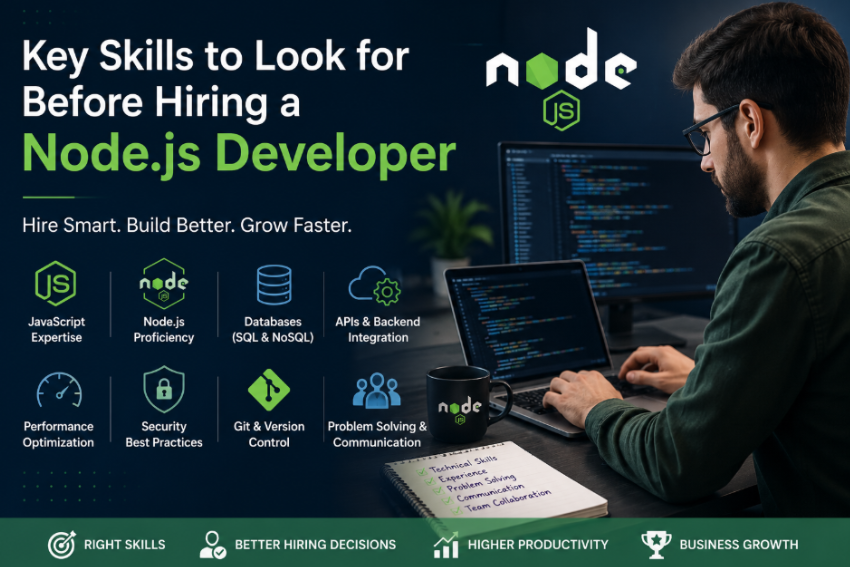
Top 10 Skills to Look for Before Hiring a Node.js Developer
Here’s a list of key technical skills to check before you hire a Node.js developer. Discover the most important skills of Node.js, JavaScript, API, database, testing, security and backend development.
Core JavaScript and Asynchronous Programming
The ideal Node.js developer should know the latest JavaScript, TypeScript, closures, the event loop, and promises and async/await.
The architecture of Node.js, as described on its site, can be summarized as a non-blocking, event-driven environment and a programmer who can’t explain it who will not even manage to build a simple application with CRUD. Try to find people that have actually dealt with these issues in a production setting, a setting where the learning of theory won’t help them.
A good example of an interview question is how you would deal with a slow third party API, without slowing down the entire application. Their response provides you much more information than any other part of their resume. There’s plenty more to discuss about what happens when the same API starts to become sporadic, and how you could put in a retry mechanism without causing a load on the API.
Node.js Fundamentals and Architecture
The essential skills of a good Node.js developer are understanding the Node.js runtime, event-driven architecture, non-blocking I/O, modules, streams, buffers and the event loop. The understanding of this enables developers to create applications that are responsive, efficient, and able to handle multiple simultaneous requests.
Candidates should also know how to design and develop Node.js applications using different design patterns and development practices. Coding skills in npm, package management, middleware, error handling, and application architecture can suggest a developer’s ability to create maintainable and scalable Node.js applications.
Framework and API Development Experience
Writing Node.js code based on production is done against some framework such as Express, NestJS, Fastify or Koa. You don’t require an individual with experience in all frameworks on the market. Instead, you need someone who knows the REST/GraphQL API architecture, understands and knows the correct use of status codes, thinks about versioning upfront, and structures routes and middleware to keep the codebase maintainable for the long-term.
Consider asking candidates to explain how they would design a new API from scratch, as well as where to place the business logic in the API, how to divide it up between route handlers, and where the validation should be stored. The answer normally helps to determine if one has been working on a codebase that has been growing or simply performed small projects that never encountered another developer.
Database and Data Modeling Knowledge
Work on the backend cannot be done without working with data. It will be beneficial to ask a prospective candidate about their knowledge of relational databases such as PostgreSQL and MySQL and non-relational ones such as MongoDB, and understand when each is a solution to a particular problem.
Designing schema, developing an indexing approach, and optimizing queries are important aspects to discuss with candidates, as they are some of the areas that can take shortcuts at the beginning but will need a rewrite later on.
A good way to conduct such a test is by giving a slightly complicated schema of your own product and seeing how the candidate would optimize it.
Testing, Debugging, and Code Quality
Find out how candidates test their code. In case they use Jest or Mocha for unit testing, do integration testing as a routine practice, and consider a linter as a mandatory part of their daily work process, chances are high that in six months you will have a maintainable codebase because debugging is also crucial.
Common errors along the way to creating a node application include memory leaks and promise rejection, and someone who experienced it the first time will likely not have it happen again.
It also helps to ask what tools they reach for when something goes wrong in production. Someone who mentions logging strategy, structured error tracking, or Node’s built-in profiler is thinking about the debugging process before there’s ever a fire to put out, which tends to matter more than any answer they give in a hypothetical coding round.
Security Awareness
Security must not be an afterthought in a developer’s mind. A seasoned developer considers issues such as input validation, authentication and authorization, secure management of secrets and environment variables, and patterns of vulnerabilities in their coding practices.
The documentation by MDN Web Docs provides very practical and highly regarded advice regarding the fundamentals of web security, and it would be worthwhile to know if a candidate has referenced such documentation on their own during the interview process.
In addition, ask what they would do differently to rate limit a public API, or if they would consider the same number of requests per unit of time for an endpoint that contains payment information as for an endpoint that is used to serve public content. If you treat all endpoints the same when it comes to security, you may not have experienced an incident yet.
Performance Optimization and Scalability
One important quality to look for in a Node.js developer is their ability to optimize performance, especially in scenarios where the app needs to manage heavy traffic or concurrent users. Check for experience with profiling, memory management, caching, database optimization, asynchronous processing, and finding performance bottlenecks.
It’s also essential for a skilled developer to learn how to make Node.js applications scalable. As traffic and workloads grow, understanding how to perform load balancing, horizontal scaling, clustering, microservices, queues, and cloud infrastructure will help make sure apps continue to function effectively.
DevOps and Deployment Familiarity
In today’s environment, Node.js developers don’t limit themselves to just writing code and passing it on. Docker, CI/CD pipelines, cloud platforms (AWS or Azure) and basic monitoring are all things that make a difference when you can ship new features without adding extra work for your ops team down the road.
When you’re not hiring individual developers and are instead going through a node js development company, inquire about how they deploy and monitor their day to day work, and how they have dealt with a poor deployment that required a quick rollback procedure.
Problem-Solving and Software Architecture
A professional Node.js developer must be able to understand complex technical issues, determine the root causes of problems, as well as find workable solutions. In particular, it is essential to have good problem-solving skills when troubleshooting production problems, optimizing existing applications, integrating third-party services, or dealing with new technologies.
Software architecture knowledge is also important because software developers must make choices that impact the long-term maintainability and scalability of applications. Be sure to cast your eyes for design patterns, modular architecture, system design, separation of concerns, and the right trade-offs with technology when designing applications for Node.js.
Soft Skills and Communication
Having technical skills will only take you half way. Ideally, the developers should know the pros and cons of each option, be able to ask the relevant questions and tell you the truth, rather than shocking you with news at the last minute.
Communication is as critical to the technical checklist as anything else, if you are hiring a full-time Node.js developer to join your current team. It is most noticeable when a project first encounters a real problem, such as a competitively priced estimate, or a bug that gets into production.
This would save you a lot more time than a developer who tries to solve all the problems himself and only lets you know about them when something goes wrong.
Benefits of Hiring Dedicated Node.js Developers
Deeper Product and Codebase Knowledge
When building your product, a dedicated Node.js developer will spend more time within your codebase and will become very familiar with your product, business logic and technical requirements.
Better Communication and Collaboration
When working with the same developers over time, communication and collaboration is enhanced. Teams can invest less effort in explaining the existing code, and more effort in development and problem solving.
Faster Development and Delivery
With environment based on JavaScript, Node.js can effectively support the front-end JavaScript technologies, and can be used directly in the back-end development process. This can benefit the developer by helping them to switch from front-end to back-end development tasks, especially at the last minute when startups are aiming for an early launch.
Improved Development Velocity
Knowing the existing architecture, tools, and workflows enables focused developers to accomplish work more quickly, and makes it easier to overcome the learning curve of constantly evolving development tools.
Easier Scalability
With a growing product, passionate Node.js developers can make improvements to the app at all times, including implementing caching, optimizing performance, adding microservices, and dealing with additional traffic.
Reduced Need for Major Refactoring
If a developer knows the architecture from the start, they can make improvements to the application’s scalability gradually and not risk being forced to rebuild or extensively refactor an MVP in the future.
Long-Term Technical Expertise
Over time, developers who continue to work on a project can build up an understanding of how it works, what its business needs are, what the technical challenges have been, and what has been achieved in the development.
Better Developer Retention and Continuity
A long-term commitment means less knowledge loss as freelancers and/or short term developers come and go from a project. This provides greater continuity and makes future development and maintenance easier.
Cost of Hiring a Node.js Developer
The cost will depend upon the developer’s country of origin, their level of experience, and the fact that you will be hiring the developer yourself or using an agency to do so.
When it comes to in-house hiring in the US, Node.js developers will ask for salaries that are higher than the global average due to the high cost of living in the region and due to the high demand from industries like finance, healthcare, and enterprise software. The rate of freelancers can vary drastically. Hiring a development company with dedicated Node.js developers offshore or nearshore will be one of the cheapest options available for a company.
Rather than focusing on the hourly rate alone, consider the potential cost of hiring someone poorly compared to the cost of hiring someone thoroughly evaluated. Developers who write neat, well-tested code and speak clearly are generally cheaper overall than those whose work requires fixing. This is because the cost of reworking their code is never included in the initial quote and ends up delaying everything else in the launch schedule.
For companies particularly comparing where to hire Node.js developers in the USA versus offshore talent. The choice typically depends upon time zone variations, budget, and how closely the work must follow your processes in-house on a daily basis. Others prefer a hybrid model: a very limited core team with a nearshore or offshore team to work on specific, contained areas of the product.
Industries That Hire Node.js Developers
Node.js is now used across a wide range of industries, largely because real-time data handling and scalability matter almost everywhere.
- Fintech and banking applications rely on it for transaction processing and fraud detection systems that can’t afford any lag.
- js is used in healthcare applications, such as telemedicine applications, patient portals, and systems that require dealing with sudden surges of simultaneous users.
- E-commerce applications use Node.js for their product catalogs, checkout processes, and inventory management systems that have to stay responsive during traffic peaks.
- Media applications and video streaming applications need many connections at a time to be opened, and therefore Node.js is used by them in live chat functionality, push notifications, and content delivery systems.
- The logistics and travel applications need real-time tracking and a booking engine to be integrated, and for that purpose, Node.js is used.
The popularity of JavaScript and its ecosystem, including NodeJS, is reflected in its status as one of the most active open-source technologies, according to data from GitHub’s State of the Octoverse research. This sort of usage, of course, also implies a greater pool of candidates to draw from when hiring.
However, it does make the screening process outlined above the more crucial part considering the fact that popularity is not a measure of quality.
Final Thoughts
The right Node.js developer isn’t the one who can mention a few of these frameworks in his/her interview. It’s about finding someone who knows how to write asynchronous code; someone who will write safe and maintainable code; someone who can communicate; and, perhaps most of all, someone who cares for the product they will create.
If you have an in-house development team, hire freelance developers or work with a company that has dedicated developers then use the aforementioned checklist of skills and be prepared to spend time on a proper interview. It will be a worthwhile outcome.