






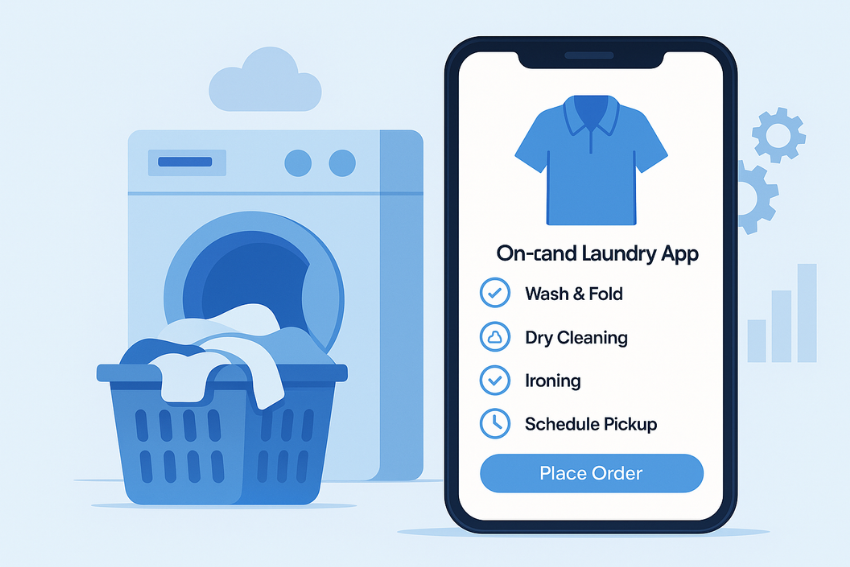
On-demand laundry app development bridges the gap between busy urban consumers and local wash-and-fold services by putting door-to-door laundry care right onto smartphone screens. Modern consumers want their time back. Between long work hours, family commitments, and social lives, spending weekends washing, drying, and folding clothes feels like a relic of the past.
For entrepreneurs and existing laundry business owners, building a dedicated mobile application opens up a scalable revenue stream. This comprehensive guide covers business models, essential features, real development costs, and the step-by-step process of bringing an on-demand laundry application to market.
Understanding the On-Demand Laundry Market & Business Models
Before writing a single line of code, you need to select the right business structure for your platform. The operational workflow of your software depends entirely on how you handle order fulfillment and logistics.
The Marketplace / Aggregator Model
Under the aggregator model, your platform acts as a digital broker connecting users with third-party local laundromats and dry cleaners. You do not need to own washing machines, physical facilities, or delivery vans. You manage the tech platform, user acquisition, and customer support, while local vendors handle the actual cleaning and fulfillment.
- Pros: Low capital investment, high scalability across cities, zero equipment maintenance.
- Cons: Less control over cleaning quality and delivery timelines.
The Dedicated / In-House Business Model
Existing laundromat owners, dry-cleaning chains, or commercial facility operators benefit most from the dedicated model. You build an app specifically for your brand to streamline pickup requests, boost customer retention, and optimize your internal workflow.
- Pros: Direct control over service quality, higher profit margins per order, strong brand loyalty.
- Cons: Limited to your local geographical footprint and physical processing capacity.
The Marketplace with In-House Fleet Model
This hybrid strategy lets you partner with top-rated local cleaners for service fulfillment while maintaining your own fleet of drivers for pickups and deliveries. You control the customer experience at the doorstep while outsourcing the asset-heavy cleaning operations.
Must-Have Features for an On-Demand Laundry App Platform
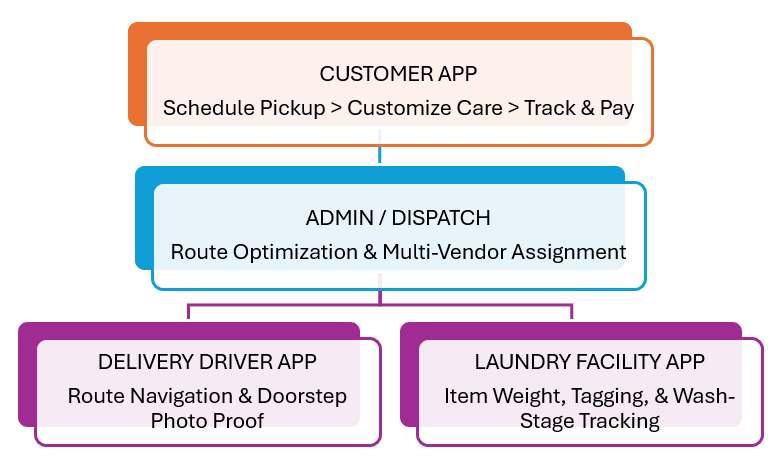
A complete on-demand laundry system requires four interconnected portals. Each user role needs tailored tools to keep daily operations running smoothly.
| On-Demand Laundry Ecosystem Architecture | |
|---|---|
| Customer Portal | Booking, Custom Wash Rules, Live GPS |
| Driver Portal | Route Optimization, Delivery Proof |
| Laundry Vendor App | Tagging System, Status Updates, Payouts |
| Central Admin Panel | Real-Time Fleet Map, Analytics Control |
Customer App Interface
| Feature | Function & Value |
|---|---|
| Social Signup & Profile Management | Lets users set default addresses, garment preferences, and payment profiles quickly. |
| Custom Wash & Care Options | Enables users to pick detergent types, water temperature, folding styles, or request delicate dry cleaning. |
| Flexible Pickup Scheduling | Allows users to choose precise time slots for pickup and doorstep delivery. |
| Upfront Cost Estimator | Calculates order totals automatically based on weight, garment counts, and add-on services. |
| Live Order Tracking | Shows real-time updates as clothes move from pickup to washing, drying, folding, and delivery. |
| In-App Payment Gateway | Supports credit cards, Apple Pay, Google Pay, and digital wallets. |
Delivery Driver App Interface
- Smart Route Optimization: Integrated mapping tools calculate the fastest paths to collect and deliver garments, saving fuel and time.
- Order Acceptance Toggle: Drivers can switch their availability on or off and accept or decline incoming pickup requests in real time.
- Photo Proof of Pickups & Deliveries: Driver’s photograph dropped-off bags at customer doors to establish clear accountability.
- Earnings Dashboard: Tracks completed trips, daily tips, weekly earnings, and distance metrics.
Laundry Provider / Merchant App
- Order Management System: Visualizes incoming laundry batches, pickup status, special wash requests, and target turnaround times.
- Garment Tagging & QR Scanner: Enables staff to scan barcode tags attached to laundry bags, matching every item to the correct customer profile.
- Inventory & Chemical Tracking: Monitors stock levels for detergents, fabric softeners, starch, and packaging materials.
Central Admin Panel
- Real-Time Fleet Map: Offers complete visibility over active drivers, order volumes, and regional service demands.
- Dynamic Pricing Engine: Enables operators to adjust delivery fees, surge pricing, or minimum order limits during peak demand hours.
- Analytics & Business Intelligence: Tracks key revenue metrics, customer acquisition costs, churn rates, and vendor performance ratings.
Step-by-Step On-Demand Laundry App Development Process
Building a high-performing mobile app requires a structured, multi-phase execution plan. Skipping structural planning often leads to costly rework later.
Pro Tip: Focus on launching a Minimum Viable Product (MVP) first. An MVP includes core scheduling, payment integration, driver routing, and status tracking. This approach gets your platform into real users’ hands quickly, allowing you to gather user data before investing in advanced automation tools.
Step 1: Market Research & Discovery Phase
Analyze your local competitors, map out customer pain points, and define your target audience. Identify gaps in existing laundry services, such as slow turnaround times or poor item tracking. Document all technical specifications, user personas, and compliance needs during this initial phase.
Step 2: UI/UX Design & Prototyping
Focus on making the user experience intuitive and simple. Users should be able to schedule a laundry pickup in three taps or fewer. Designers map out clear user flows, wireframes, and interactive visual prototypes. Early usability testing ensures the booking process feels simple and natural for every age group.
Step 3: Frontend & Backend Engineering
Developers build the core engine of your software platform during this stage.
- Backend Architecture: Engineers set up secure database schemas, server structures, RESTful APIs, and real-time websockets to handle live locations and push notifications.
- Frontend Mobile Apps: Software teams build iOS and Android apps using native frameworks (Swift, Kotlin) or cross-platform solutions (Flutter, React Native).
Step 4: Quality Assurance & Testing
Comprehensive software testing protects your launch from bugs and system crashes. QA engineers run automated test scripts and manual checks across several areas:
- Unit testing for critical business logic.
- Integration testing for payment gateways and SMS notification systems.
- Stress testing to confirm backend servers handle sudden spikes in pickup requests.
- Security audits to safeguard customer data and payment credentials.
Step 5: Deployment & Continuous Maintenance
After thorough testing, your team submits the mobile apps to the Apple App Store and Google Play Store. Launching the platform is just the beginning. Continuous app maintenance involves monitoring server metrics, resolving user issues, updating operating systems, and releasing feature updates based on customer feedback.
How Much Does On-Demand Laundry App Development Cost?
The total investment required for on-demand laundry app development ranges between $15,000 and $75,000+, depending on platform scope, feature set, and tech stack choices.
Cost Breakdown by App Complexity
| App Complexity | Estimated Cost Range | Average Development Timeline | Included Deliverables |
|---|---|---|---|
| Basic MVP | $15,000 – $25,000 | 8 to 12 weeks | Simple Customer & Driver apps, basic Admin panel, standard payments, fixed scheduling. |
| Mid-Level App | $25,000 – $45,000 | 14 to 20 weeks | Cross-platform builds, real-time GPS tracking, promo engines, customized care options, merchant app. |
| Advanced Platform | $45,000 – $75,000+ | 22+ weeks | Multi-city platform, automated driver dispatching, route optimization, AI detergent management, advanced BI dashboard. |
Key Cost-Driving Factors
- Development Team Location: Software development rates vary globally. North American agencies often charge $100 to $180 per hour, while offshore engineering teams in Eastern Europe or Asia range from $25 to $60 per hour.
- Choice of Technology: Building separate native applications for iOS (Swift) and Android (Kotlin) increases costs by up to 40%. Choosing a unified cross-platform framework like Flutter or React Native cuts development timelines and budgets significantly.
- Third-Party API Integrations: Adding advanced external tools—such as Twilio for SMS alerts, Google Maps for route navigation, or Stripe for payment processing—incurs monthly licensing fees and custom integration work.
Monetization Strategies for Laundry Apps
Launching your platform requires a clear model for generating sustainable profits. Successful apps often combine several revenue streams:
- Direct Service Fees: Charge customers directly per pound of laundry, per clothing item, or per dry-cleaning service.
- Vendor Commissions: If you run an aggregator app, take a percentage (typically 10% to 25%) on every booking sent to local laundry partners.
- Delivery & Service Charges: Add flat pickup, doorstep delivery, or distance-based charges on orders that fall below minimum price thresholds.
- Express Turnaround Premiums: Charge extra fees for customers who need guaranteed same-day or overnight wash-and-fold services.
- Subscription Plans: Offer monthly wash plans (e.g., $49/month for 40 lbs of laundry with free pickup) to generate reliable, recurring revenue.
Recommended Technology Stack
Selecting a reliable tech stack guarantees high platform stability, robust data security, and seamless scalability as your user base grows.
| Recommended Production Tech Stack | |
|---|---|
| Mobile Frontend | React Native / Flutter (iOS & Android) |
| Web Admin Portal | React.js / Vue.js |
| Backend & APIs | Node.js / Python (FastAPI / Django) |
| Database Layer | PostgreSQL (Relational) + Redis (Caching) |
| Cloud Storage | Amazon Web Services (AWS) / Google Cloud |
| Maps & Routing | Google Maps Platform API / Mapbox |
| Payments & SMS | Stripe / PayPal + Twilio |
Final Thoughts
Entering the on-demand laundry market offers a major business opportunity as consumers continue prioritizing convenience and time-saving digital services. Success requires striking the right balance between clean app design, robust routing logistics, and dependable local cleaning partners.
By launching an MVP, validating your services with early users, and expanding your feature set over time, you can build a scalable, high-margin laundry business. Partnering with an experienced mobile development team turns this operational vision into a seamless digital product.