








The terms Catholic and Protestant represent two of the largest branches of Christianity, yet many people struggle to articulate exactly what sets them apart. You have probably heard phrases like sola scriptura or the papacy thrown around, but what do they actually mean for everyday faith and practice?
While both traditions share a deep commitment to Jesus Christ as Lord and Savior, they diverge significantly on issues of authority, salvation, worship, and church structure. These differences are not just academic—they shape how millions of Americans pray, worship, and understand their relationship with God.
Let us walk through the most important differences between Catholic and Protestant so you can clearly see where these two traditions stand.
The Ultimate Authority: Scripture Alone or Scripture Plus Tradition?
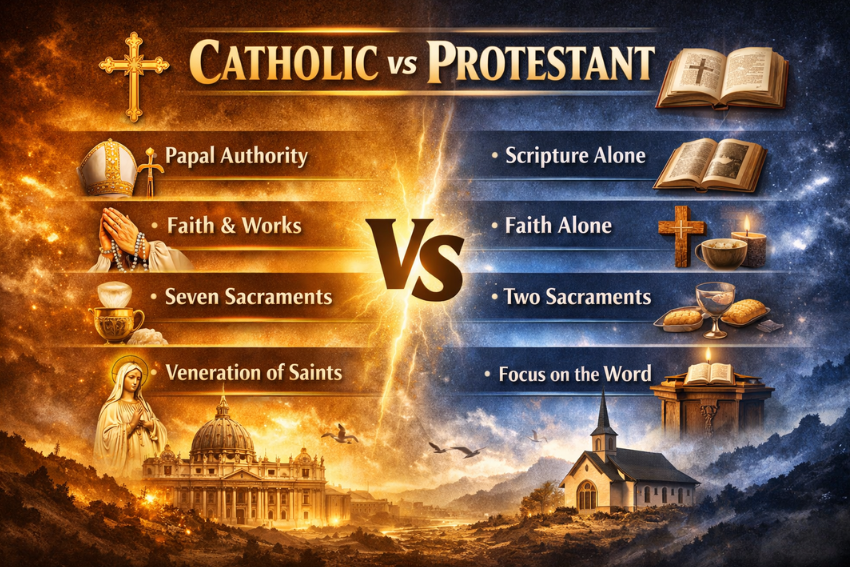
This is the big one. The question of where ultimate authority lies is perhaps the single greatest dividing line between Catholics and Protestants.
Protestants hold to a principle called sola scriptura, which means “Scripture alone.” They believe the Bible contains everything necessary for salvation and that no outside authority—whether church tradition, councils, or popes—carries equal weight. The Bible is sufficient, clear, and ultimately authoritative for all matters of faith and practice.
Catholics, on the other hand, view authority as a three-legged stool: Scripture, Sacred Tradition, and the Magisterium (the Church’s teaching authority). They argue that the Bible itself never claims to be the only source of truth and point to the oral teachings of Jesus and the apostles that were passed down before the New Testament was even written. For Catholics, Tradition and Scripture flow from the same divine wellspring and must be honored equally.
This difference explains a lot about how each tradition approaches theology. Protestants often ask, “Where is that in the Bible?” Catholics respond, “The Church has always taught this.”
How Are People Saved? Faith Alone Versus Faith and Works
Another major flashpoint concerns salvation. If you ask a Protestant and a Catholic how someone gets to heaven, you will hear two distinct answers.
Protestants emphasize sola fide—”faith alone.” They teach that justification (being declared righteous before God) happens entirely through faith in Christ’s finished work on the cross. Good works are important, but they flow from salvation rather than contributing to it. As Ephesians 2:8-9 puts it, salvation is a gift of God, not a result of works.
Catholics believe salvation involves both faith and works—but not in the way many Protestants assume. Catholic teaching holds that justification begins with God’s grace, but human cooperation through faith and acts of love plays a role in the ongoing process of sanctification. Good works, empowered by grace, actually merit an increase in grace and virtue. This is not “earning” salvation in a crude sense, but rather participating in the salvation God offers.
The difference is subtle but profound. For Protestants, Christ’s work is completely finished and applied to the believer through faith alone. For Catholics, that work is applied through a lifelong process of cooperation with grace.
The Bible: 66 Books or 73?
Here is a difference you can see on your bookshelf. Protestant Bibles contain 66 books. Catholic Bibles contain 73.
The extra seven books—Tobit, Judith, 1 and 2 Maccabees, Wisdom of Solomon, Sirach (Ecclesiasticus), and Baruch—are what Protestants call the Apocrypha. Catholics refer to them as deuterocanonical, meaning “second canon.” These books were part of the Greek Old Testament (the Septuagint) used by the early church.
During the Reformation, Protestants removed these books because they were not part of the Hebrew Old Testament and because they contain passages that seemed to support Catholic doctrines like praying for the dead and purgatory.
The Sacraments: Seven Versus Two
Sacraments are outward signs of inward grace, but Catholics and Protestants count them very differently.
Catholics recognize seven sacraments:
- Baptism
- Confirmation
- Eucharist (Communion)
- Penance (Reconciliation/Confession)
- Anointing of the Sick
- Holy Orders (ordination)
- Matrimony (marriage)
Most Protestants recognize only two sacraments (often called ordinances): Baptism and the Lord’s Supper (Communion). These are the only two explicitly instituted by Christ in the Gospels.
Why the difference? Catholics view the sacraments as actual channels of God’s grace that confer what they signify. Protestants tend to see them as symbolic acts of obedience and remembrance, though views vary among different Protestant denominations.
The Pope and Church Structure
The role of the Pope is another major distinction.
Catholics believe the Pope, as the successor of Peter, has universal jurisdiction over the entire Church. When he speaks ex cathedra (from the chair) on matters of faith and morals, Catholics believe he is infallible—protected from error by the Holy Spirit. The Pope, along with the bishops, forms the teaching authority of the Church.
Protestants reject the Pope’s authority outright. They see no biblical basis for papal supremacy and view the papacy as a human institution that usurped authority that belongs to Christ alone. Protestant churches are generally governed by elders, pastors, congregations, or a combination of these, depending on the denomination.
Mary and the Saints
Catholics have a deep devotion to Mary and the saints. Protestants often struggle to understand this, and the differences here are significant.
Catholics hold four dogmas about Mary:
- She is the Mother of God (Theotokos)
- She was conceived without original sin (Immaculate Conception)
- She remained a virgin her entire life (Perpetual Virginity)
- She was assumed body and soul into heaven (Assumption)
Catholics also ask Mary and the saints to intercede for them, viewing them as powerful advocates in heaven.
Protestants generally reject all of these teachings, seeing them as lacking biblical support. They emphasize that there is only one mediator between God and humanity: Jesus Christ (1 Timothy 2:5). While Protestants respect Mary as the mother of Jesus, they do not pray to her or seek her intercession.
Purgatory: A Place of Purification or a Man-Made Doctrine?
Catholics believe in purgatory—an intermediate state after death where souls destined for heaven undergo purification to achieve the holiness necessary to enter God’s presence. This is not a second chance at salvation but a cleansing from the temporal effects of sin. Catholics pray for the dead and offer Masses for their repose, believing these actions can help shorten their time in purgatory.
Protestants reject purgatory entirely. They argue it has no basis in Scripture and undermines the sufficiency of Christ’s sacrifice on the cross. For Protestants, to be absent from the body is to be present with the Lord (2 Corinthians 5:8)—there is no intermediate state of purification.
The Lord’s Supper: What Happens to the Bread and Wine?
This is one of the most ancient and emotional debates in Christianity.
Catholics believe in transubstantiation—the teaching that the bread and wine actually become the body and blood of Christ during the Mass, while retaining the appearance of bread and wine. This is why Catholics treat the Eucharist with such reverence and reserve it for worship.
Protestants have varying views, but they generally reject transubstantiation. Some believe Christ is spiritually present (Reformed view), others believe in a real but sacramental presence (Lutheran view), and still others see Communion as purely symbolic or memorial (Zwinglian view).
Compare Differences Between Catholic and Protestant
| Topic | Catholic | Protestant |
|---|---|---|
| Authority | Scripture + Tradition + Magisterium | Scripture alone (sola scriptura) |
| Salvation | Faith + works, cooperating with grace | Faith alone (sola fide) |
| Bible | 73 books (includes deuterocanonicals) | 66 books |
| Sacraments | Seven | Two (generally) |
| Pope | Supreme authority, infallible in certain teachings | Rejected |
| Mary | Mother of God, immaculate, perpetually virgin, assumed into heaven | Honored but not venerated; no special dogmas |
| Saints | Intercessors, prayed to for help | Believers in Christ; not prayed to |
| Purgatory | Believed as a state of purification | Rejected |
| Lord’s Supper | Transubstantiation (becomes body and blood) | Memorial or spiritual presence (varies) |
Why These Differences Matter Today
You might wonder why these historical disagreements still matter in the 21st century. The answer is simple: they shape how people live out their faith every day.
When a Protestant prays, they go directly to God through Christ alone. When a Catholic prays, they might also ask Mary or a patron saint to intercede for them.
When a Protestant opens their Bible, they believe they can understand it for themselves with the Holy Spirit’s help. When a Catholic reads Scripture, they do so within the interpretive framework of the Church’s teaching authority.
When a Protestant faces death, they rest in the finished work of Christ. When a Catholic faces death, they also rest in Christ, but with the additional hope that the prayers of the living can aid them in purgatory.
These are not minor quibbles. They are deeply felt convictions that influence worship, devotional life, and even how people cope with grief and suffering.
A Word of Grace
For all their differences, Catholics and Protestants share far more than they often realize. Both affirm the Trinity, the deity of Christ, His death and resurrection, and the inspiration of Scripture. Both confess the Apostles’ Creed and the Nicene Creed. Both seek to follow Jesus and proclaim the gospel.
In an age of secularism and moral confusion, these shared convictions matter. Many Catholics and Protestants now find themselves standing together on issues like the sanctity of life, religious freedom, and the importance of traditional marriage.
Understanding the differences between Catholic and Protestant traditions does not have to divide us. It can help us appreciate the richness of the Christian heritage and engage in more meaningful conversations with brothers and sisters in Christ who see things differently.
Whether you are Catholic, Protestant, or simply curious, knowing these distinctions equips you to understand the landscape of American Christianity with greater clarity and compassion.