











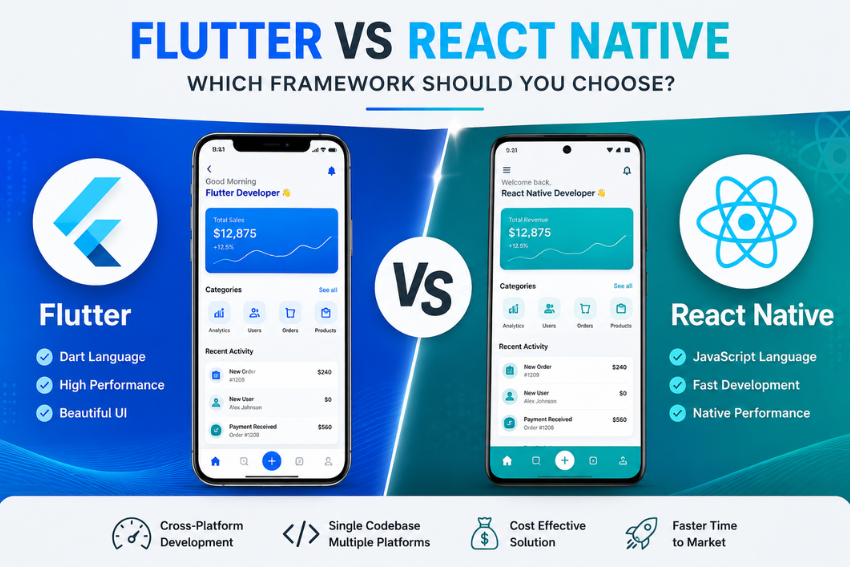
Flutter vs React Native is one of the most common comparisons for businesses and developers planning a cross platform mobile application. Both frameworks allow developers to build Android and iOS apps from a single codebase, reducing development time and cost while maintaining excellent user experiences.
Google’s Flutter and Meta’s React Native have become the leading cross platform frameworks, but they follow different approaches. Flutter uses its own rendering engine and the Dart programming language, while React Native relies on JavaScript and native UI components. Understanding these differences is essential before starting your next mobile app project.
This guide compares Flutter and React Native across performance, UI, development speed, learning curve, community support, costs, and more to help you choose the right framework for your business.
What is Flutter?
Flutter is Google’s open source UI toolkit, with the ability to create mobile, web, and desktop applications from the same codebase. It is written in Dart, and visualizes each UI element using a different graphics engine.
Flutter offers a large library of widgets with customizable features to help developers build visually consistent apps across platforms. It handles the entire rendering process, so that developers can create highly customized interfaces without having to worry about platform differences.
Flutter is one of the fastest growing mobile development frameworks due to its quick compilation, Hot Reload, and a comprehensive documentation.
What is React Native?
React Native is an open source framework created by Meta to create multi-platform mobile apps with JavaScript and React.
Unlike Flutter, React Native is based on UI elements natively supported by Android and iOS. It makes applications feel more natural on each platform, and developers can share the majority of their code across the devices.
JavaScript is already one of the most popular programming languages and React Native boasts a large developer base and a wide array of libraries.
Flutter vs React Native at a Glance
When deciding between Flutter and React Native, it is easier to make decisions when comparing their core features. Both have been used to make cross-platform applications, but they have very different architectures, programming languages, rendering methods, and developer communities. These differences can clarify the context of each technical choice, and enable an organization to make choices that focus on long-term business objectives rather than just the latest trend.
Others prefer more personalized UI and UX and heavily graphical applications, which makes it an appealing choice for them. Others have had a prior experience with JavaScript developers and want to use its existing skills, so React Native is a good option. In no particular scenario is one clearly better than the other. The key to success is choosing the right framework for your team and your application’s needs.
Flutter vs React Native: Quick Comparison
| Feature | Flutter | React Native |
|---|---|---|
| Developer | Meta | |
| Programming Language | Dart | JavaScript |
| UI Rendering | Custom Rendering Engine | Native Components |
| Performance | Excellent | Very Good |
| Learning Curve | Moderate | Easier for JavaScript Developers |
| Hot Reload | Yes | Yes |
| Community | Large and Growing | Very Large |
| Third Party Packages | Excellent | Extensive |
| Development Speed | Fast | Very Fast |
| UI Customization | Outstanding | Very Good |
| Best For | Highly Custom Apps | Business Apps and MVPs |
Flutter vs React Native Comparison
By analyzing different technical and business aspects, one can get a realistic view of Flutter vs React Native, not what is being touted by marketing hype or personal preference. Let’s compare each of them according to the criteria that most organizations need to assess prior to embarking on a mobile application project.
Performance
Performance is often the first metric that the businesses consider. In general, flutter is more efficient due to its ability to compile directly to the machine’s code and render its interface. This minimizes communication with operating system and hence smoother animation and rendering.
For most applications as well, React Native is a good performer. It has been enhanced in terms of performance, thanks to its new architecture. React Native generally works great with a variety of business apps, ecommerce, and social apps.
Flutter may have the edge if your app has complex animation or features that are graphics heavy.
Winner: Flutter
User Interface
Flutter is famous for its gorgeous and exceedingly custom user UI. As each component is created with Flutter widgets, developers can control the app’s look and feel.
Applications can be designed according to the Android and iOS design principles naturally with the help of react native using native UI components. This provides a comfortable user experience, but provides a bit less flexibility for advanced custom design.
If branding and unique designs are important, then Flutter is the choice. If you want native style, then opt for React Native.
Winner: Flutter
Programming Language
Google has developed the modern language Dart for Flutter. Learning Dart involves some work, but coders will find it clean and easy to comprehend.
React Native is built in JavaScript, which is great for teams familiar with both React and web development. As one of the most popular programming languages in the world, it’s typically easier to find developers for JavaScript.
Winner: React Native
Development Speed
Both frameworks can cut down the development time considerably as compared to creating separate native applications.
Flutter provides a full suite of widgets, IDE tools, and a great Hot Reload feature which accelerates UI development.
React Native leverages thousands of JavaScript libraries already available in the market which can be used to incorporate common features in just a short period of time.
React Native may be a quicker development path if your team is familiar with JavaScript.
Winner: Tie
Learning Curve
To learn Flutter, one must learn Dart and the flutter’s widgets based architecture. The documentation is great, but may take some time to get productive with for beginners.
Developers who have experience with JavaScript or React can find it easier to build with React Native. For those experienced with web development, it is relatively easy to make a switch to mobile development.
Both frameworks have to be familiarized with mobile development concepts by the absolutely new developers.
Winner: React Native
Hot Reload
The frameworks are both equipped with Hot Reload, enabling the developer to see code changes without restarting the application.
Flutter’s implementation is a little faster and more uniform, particularly with UI heavy applications.
React Native’s Fast Refresh is also excellent and makes us more productive.
Winner: Flutter
Third Party Libraries
One of the largest ecosystems exist in the mobile development field of React Native. Thousands of libraries are available to be authenticated, paid for, monitored, navigated, stored on the cloud and more.
The package ecosystem of flutter has been expanded and now covers most of the needs of commercial applications. Google’s continuous investment has made Flutter plugins more reliable than ever.
Flutter has come a long way, but there are a few more packages for React Native.
Winner: React Native
Community Support
There is a significantly longer history of React Native and it enjoys the support of millions of JavaScript developers around the world. Tutorials, solutions and experienced developers are easily found.
The community is still rapidly expanding around Flutter with good backing from Google. Documentation, online courses, GitHub repositories and developer events are increasing yearly.
Both communities are thriving and active, and there is a larger developer base for React Native.
Winner: React Native
Testing and Debugging
Built-in Unit testing, Widget testing and Integration testing support is available in Flutter. In addition, Flutter DevTools offer in-depth performance analysis and debugging features.
Popular tools like Jest and React Native Testing Library are available for React Native testing. Developers may require more testing on platform specific features, although superbly capable.
The architecture is unified across flutter which makes it easier to go through the testing process.
Winner: Flutter
Security
Flutter and React Native offer secure authentication, encrypted storage, and communication via HTTPS, as well as secure coding.
The security of an application is more about standards in development than about the framework. Regardless of your chosen framework, it’s still vital to make sure you keep your dependencies up to date and adhere to the best security practices.
Winner: Tie
App Size
Flutter applications generally have larger installation sizes because they include Flutter’s rendering engine.
React Native applications are often smaller since they rely more on native platform components.
Although the difference has become smaller over time, React Native usually produces lighter applications.
Winner: React Native
Cost of Development
Both frameworks save developers money by enabling them to write code for Android and iOS platforms in one code base.
With the consistent rendering engine, and fewer platform specific adjustments, Flutter might be able to lower long-term maintenance expenses.
React Native can reduce the expenses on hiring as JavaScript developers are generally widely available and the current React teams can rapidly develop mobile applications.
The overall cost of development will be largely based on your team’s experience and the complexity of your project.
Winner: Tie
Which Framework Should You Choose?
Choosing between Flutter vs React Native is not about selecting a universal winner. Instead, it involves matching the framework to your business objectives, technical resources, target audience, and future growth plans. Both are successfully used in production in ecommerce, healthcare, education, finance, logistics, entertainment and enterprise software.
No matter what you are building, what your goals are, and how scalable you need it to be, and how many resources you have, you’re always going to get better results if you understand your users.
Choose Flutter When
Flutter is an excellent choice if your project includes the following requirements:
- You want a highly customized and visually rich user interface.
- Smooth animations and graphics are essential.
- Consistent design across Android and iOS is a priority.
- You are building products that may later expand to web or desktop.
- Long term maintainability with a unified rendering engine matter.
- Your team is comfortable learning Dart.
Choose React Native When
React Native is often the better option in these situations:
- Your developers already use JavaScript or React.
- You need to launch an MVP quickly.
- Native platform appearance is important.
- You rely heavily on JavaScript libraries and existing React ecosystems.
- You want easier hiring because of JavaScript’s popularity.
- You already maintain React based web applications.
Final Verdict
Both Flutter and React Native are outstanding cross platform frameworks.
Flutter is known for its best UI customization, performance and consistency in development. It is perfect for companies creating rich and graphical applications, where high-end animation and full design flexibility are crucial.
The JavaScript ecosystem, the massive developer community, and the ability to quickly develop apps are the strengths of React Native. It is especially good for startups, business applications and organizations who already use React for web development.
There isn’t a single winner. The selection of the right choice will depend on your project needs, budget, development team and long term product goals.
Conclusion
The Flutter vs React Native debate ultimately comes down to your business needs. Flutter is a great option when designing high-quality apps, maintaining stability and ensuring advanced customization. For companies in a hurry to enter the market and wanting to tap into their JavaScript skills, React Native is still a great choice.
When considering, assess the team’s abilities, anticipated app complexity, upkeep needs, and potential expansion possibilities. The selection of the framework which matches you long term goals will be helpful in building a successful mobile application with minimum risk to the development.
Frequently Asked Questions
Which is faster, Flutter or React Native?
Overall, flutter has better runtime performance as it compiles to native machine code and renders its own UI. React Native is very efficient for the majority of business apps, but for some operations, it might have to use native bridges.
Is Flutter better for startups?
If you are a startup looking to create appealing applications, have uniform interfaces and scalable for the long-term, Flutter is a great option. If the start-up already has existing JavaScript developers, then React Native might be a better option.
Can Flutter build web and desktop applications?
Yes. With a common codebase, Flutter is available for Android, iOS, web, Windows, macOS, Linux, and embedded devices, rendering it an ideal solution for multi-platform product strategies.
Does React Native require native development knowledge?
Not always. React Native and JavaScript can be used for building most of the applications. For advanced integrations or native customized features, however, it may need iOS or Android development skills.
Which framework has a better future?
Google and Meta are making large investments in both of the platforms. Flutter is gaining traction from mobile to desktop and embedded, and React Native has been making strides with its New Architecture to enhance performance. Both are good long term investments.