






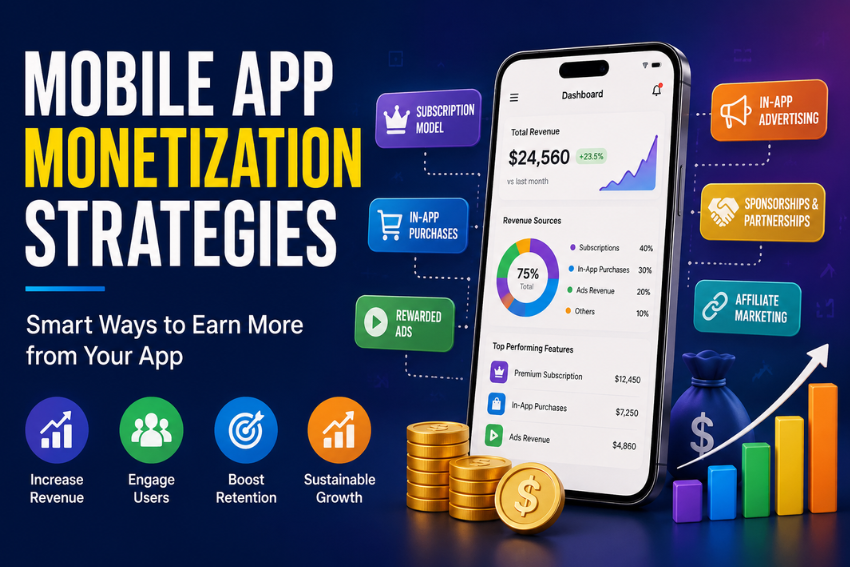
With the widespread adoption of smartphones, mobile app monetization strategies have emerged as one of the most significant factors that make or break whether an app lives or dies or even makes a sustainable amount of money for years. Who knows, if you’re not the first to build an amazing app, it won’t be enough as there are millions of apps fighting for the user’s attention on both platforms Android and iOS.
An application with thousands of active daily users can still have financial problems if it adopts the wrong business model! Good app businesses know that monetization isn’t about extracting all the dollars from users. Rather, it’s about the creation of value that gets users to pay of their own accord and have a good time. That’s the balance market leaders have that sets them apart from the rest.
Subscription and in app purchases as well as hybrid monetization strategies remain the most successful ones for app revenue on the global scale, according to recent market data. Developers are turning to several streams of revenue instead of relying on one stream. This approach not only lowers the financial risk but also improves customer lifetime value. With the competition it has increased year by year, selecting the proper monetization strategy is as critical as the product design itself.
What Are Mobile App Monetization Strategies?
Mobile app monetization strategy is the way to earn money from an app. Each application has a specific user base, a problem it can solve, and a set of behaviors that it will bring in. As a result, there is no standard monetization model applicable across all applications.
There are usually two ways for gaming apps to succeed – in app purchases and via rewarded advertising, whereas productivity applications tend to be more successful with subscriptions. News platforms can use high-value memberships to generate revenue and ecommerce apps can earn revenue from the sales of their products or via affiliate marketing. The primary step in choosing the right monetization model is to have a clear grasp of your audience.
The idea of monetizing applications is not limited to just displaying ads. Nowadays, developers have shifted their attention to maximizing the lifetime value of their users, providing ongoing value that leads to repeat transactions or re-subscriptions. Among the top apps, there are practices like data-driven pricing, personalized offers, loyalty rewards, premium features, and strategic upselling.
The aim is to create a revenue model that scales with user adoption, but doesn’t disrupt the user journey. If monetization is perceived as a useful enhancement rather than a barrier, subscribers are much more inclined to turn into consumers.
Why Choosing the Right Monetization Model Matters
Many developers are spending months developing an application, but only a few days to think about monetization. That mistake can dramatically reduce long term profitability. Revenue generation should be considered from the earliest planning stages because it influences feature development, user onboarding, retention strategies, pricing, and even marketing campaigns. Applications with a well-defined revenue model tend to perform well financially as all features are aligned to both user satisfaction and business growth objectives.
It is possible to annoy users and hurt retention if the monetization is not the right one. Now think about an app for meditation where you can find pop-ups for ads while meditating. Users would probably un-install it in a few minutes. In contrast, offering unlimited guided sessions provides a premium experience with recurring revenue through a well-designed subscription model. The suitable monetization models dovetail the aim of the application, rather than follow it. It is for this reason that today’s top mobile products have monetary considerations as part of the product design and development process.
User Experience and Revenue Go Together
For some developers, it seems that the more ads they serve, the more money they will make. In fact, this over monetization can sometimes have a negative impact on retention, which means that there are fewer long-term users and less lifetime value.
The most successful apps always do it first to ensure user satisfaction and engaged users will convert more revenues in the long term. Customized suggestions, upsell options, reduced advertising, and unique material contribute to a balanced mix of profitability and client satisfaction.
Happy customers are repeat customers, they like the features of the application and they are able to recommend it to their friends. Customer acquisition costs are significantly lower with organic referrals, while revenues are higher. This forms a positive growth cycle that leads to more user base, more positive experiences, more monetization opportunities, etc.
Common Monetization Mistakes
Several mistakes repeatedly prevent apps from reaching their earning potential.
- Displaying too many advertisements.
- Choosing subscriptions without delivering ongoing value.
- Offering confusing pricing plans.
- Ignoring user feedback.
- Depending on a single revenue stream.
- Failing to optimize conversion funnels.
- Neglecting retention metrics.
Avoiding these mistakes can dramatically improve both user satisfaction and revenue performance.
9 Mobile App Monetization Strategies That Actually Work
Below are the best mobile app monetization strategies to boost revenue with subscriptions, ads, in app purchases, and proven growth tips.
Freemium Model
The freemium model is one of the most successful mobile app monetization strategies for mobile apps as it tides over the primary hurdle of getting users to download an app, which is payment. Developers offer a working free version, reserving paid versions for premium users.
This method enables users to develop trust prior to their buy decision. It’s a tactic that has been effective with popular productivity, education, design and cloud storage applications for years without much effort, as it fits the customer’s natural behavior.
There is a challenge to create a successful freemium business model, and it needs to be well planned out. The free version should provide real value in the sense that there should be some reason for upgrading. In case too many features aren’t unlocked, users may abandon the application. When there are no costs associated, few users will become paying customers.
It’s crucial to get the balance right. Smart developers are constantly monitoring usage to discover what users love and make their premium upgrades accordingly. This data-driven approach can yield much better conversion rates and repeat sales, among other benefits.
Subscription Model
The subscription model is one of the fastest-growing mobile app monetization strategies, as it promises steady, recurring revenue and motivates developers to provide ongoing value.
Subscription apps are those that require a recurring fee – usually monthly, quarterly, or annual – to access high-quality features, special content, or services. It’s a great fit for streaming apps, fitness apps, meditation apps, productivity apps, language learning apps, and business software. Users will stay subscribed for months or more if they receive new features and content.
Financial stability is the greatest benefit of the subscription. By accurately predicting revenue, developers can make informed decisions about allocating resources for product development, customer support, and marketing efforts.
A major importance of successful subscription apps is on retaining customers, not just on gaining new ones. They frequently roll out feature enhancements, unique content, tailored suggestions, and improved user experiences to keep customers happy and curbing churn.
Having flexible billing options like monthly and annual plans also boosts conversions, as customers may opt for the payment method that suits their financial means best.
Price is key to subscription success. If users understand clearly the value they get when they use the asset, they will be willing to pay. The free trials, limited feature preview and introductory discounts give users a chance to taste the best features of the product without paying a penny.
Consistent messaging, straightforward pricing pages, and transparent cancellation terms are crucial for fostering trust, which is key to sustaining long-term member relationships.
Best Practices for Subscription Apps
- Offer a free trial without hiding important features.
- Clearly explain premium benefits.
- Add new content and features regularly.
- Use annual plans to improve customer retention.
- Analyze churn rates and optimize onboarding.
- Personalize user experiences whenever possible.
In App Purchases
In app purchases continue to be one of the top revenue streams mobile app monetization strategies, especially in game apps. Rather than charging the user for purchasing the app, developers will instead offer users a way to buy digital goods, upgrades for the app, virtual currency, cosmetic changes, and/or productivity enhancements as they require. This approach is effective because the users don’t buy anything without getting value from the application.
The most obvious examples of in app purchases are gaming apps. Players enthusiastically purchase character skins, guns, virtual coins, expansion packs, and battle passes to improve their gaming experience. Aside from games, productivity applications offer high-end templates, extra storage, AI-driven functions, and higher-stage collaboration features. One-time purchases enable access to specialized courses or certifications on educational platforms, or to downloadable materials.
The essence of a successful in app purchase is to make sure that it actually adds to the user’s experience and doesn’t cause any aggravation. Users should never be pressured to purchase in order to continue to use app. Optional upgrades are more effective than required upgrades, since they instill a feeling of empowerment, rather than of obligation.
Purchasing behavior should be closely tracked and the pricing, promotions and product positioning constantly fine-tuned to yield the high revenues possible without compromising customer satisfaction.
In App Advertising
Advertising remains one of the most popular ways to monetize mobile apps, especially for free apps that have lots of users. The developers make money from the ads whenever the user clicks on them or watches them, instead of him paying for them directly. The model does not require users to make any investment, thus avoiding any risk, and gives developers the potential for continuous revenue from advertising networks.
There are some of the popular mobile ads formats.
| Ad Format | User Experience | Revenue Potential | Best Use Case |
|---|---|---|---|
| Banner Ads | Low interruption | Low | News and utility apps |
| Native Ads | High engagement | Medium | Content based apps |
| Interstitial Ads | Moderate interruption | High | Casual games |
| Rewarded Ads | Positive engagement | Very High | Mobile games |
| Video Ads | Medium interruption | High | Entertainment apps |
The biggest challenge in advertising is keeping a positive user experience. The abundance of ads can also quickly irritate users, boost uninstall rates, and cut down on long-term revenue. Smart developers position ads in between normal user activities and not in the critical workflows. The ability to seamlessly fit into the app content and still be marked as an ad generally makes native advertising very successful.
Key advertising metrics for the developer to watch include effective cost per thousand impressions, click through rate, fill rate, and average revenue per daily active user. These insights are used to make sure that ads are placed optimally without compromising user retention.
Rewarded Video Ads
Rewarded video ads have revolutionized mobile ads by making it a win-win for the user and advertiser. Apps give users the freedom to watch short videos and earn rewards as a result – rather than being forced to watch ads. These can take the form of virtual currency, extra lives, extra content, bonus points, special items, or unlocking of certain features.
Rewarded ads are a favorite for users, as they know they can receive a reward for interacting with the ad, but the content is still optional and under their control. These ads don’t cause any frustration because it is optional to join them. There are much higher engagement rates than its traditional advertising because the users are getting value right after they finish the video. Advertisers also realize increased ad revenues since they are willing to pay premium rates for complete views of their ads.
While rewarded ads are primarily found in mobile games, there are plenty of non-gaming apps that are succeeding with rewarded ads. Rather, educational websites might be offering extra practice sessions, or fitness apps might be offering premium fitness after watching a sponsored video. This is best achieved when the rewards are usable in ways that enhance the user experience, and not the premium subscription service.
Paid Apps
Charging customers ahead of the download of an application is still a monetization possibility for products that offer up-front, immediately apparent value. Products that are of a technical nature, for a specific business, creative software, niche productivity and education programs are often more successful through paid downloads, because users can see the value before they download it.
The foremost benefit of paid apps is simplicity. You will be able to revenue right after every installation, without having to be concerned about difficult advertising integrations or recurring purchase systems. Developers can also concentrate on the product quality alone, rather than juggling multiple monetization options. Paid apps generally offer better user experiences, as they don’t have to rely on advertising to drive revenue.
However, with all these advantages, there’s been a growing difficulty to convince users to buy the new and unknown app, since they have alternatives that can be used for free. Successful paid apps typically have one or more of the following advantages.
- Strong brand recognition.
- Excellent user reviews.
- Proven reputation.
- Unique features unavailable elsewhere.
- Professional audience with specific needs.
Many developers have started to offer premium subscriptions or upgrades after installation to add extra revenue streams which are paid for the download.
Affiliate Marketing
Another viable method of monetizing mobile applications without charging users is affiliate marketing. The developers are recommended relevant products or services in the app; they get commissions if the users make a qualifying purchase. This is a good option for travel, shopping, financial, fitness, educational, and content-based applications.
For instance, a travel planning app can suggest an hotel, travel insurance, or transportation from the airport, or even sightseeing tours. A fitness app could suggest workout gear, nutrition supplements or sporting apparel by means of strategic affiliate promotions. Users tend to welcome these suggestions, rather than make them a nuisance, as long as they are actually useful.
The key to a successful affiliate marketing is trust. Developers should only suggest products that are of genuine utility to users, and be clear about their relationship with the individuals that they are promoting. Low quality recommendations can create immediate revenue, but can hurt credibility and cause loss of users over time.
Sponsorships and Brand Partnerships
Sponsorships can be a way for developers to monetize their products through direct partnerships with brands that have comparable audiences. In contrast to automated advertising networks, businesses pay for the product, service, or campaign to be seen in a natural way within the application. This method can generate greater earnings since the sponsorship deal is negotiated between the developer and the brand.
Health applications may partner with nutrition companies. Sports apps frequently work together with the gear producers. In most cases, financial applications will build relationships with banks or investment platforms. Sponsored challenges, exclusive discounts and branded content can be part of the lifestyle applications depending on user interests.
Effective sponsorships are genuine and not promotional. Genuine value should be provided, rather than aggressive advertising, through educational content, exclusive offers or useful resources for users. Typically, long term partnerships based on mutual interests in customers generate higher engagement and revenue than short term promotional efforts.
Hybrid Monetization
Typical highest revenue mobile apps do not rely on just one source of income. Rather, they mix together a number of mobile app monetization strategies to make best use of profits whilst catering to various user preferences. This is a strategy referred to as hybrid monetization, and it’s the preferred strategy of many successful app publishers.
A hybrid model might include:
- Free app downloads.
- Subscription plans.
- In app purchases.
- Rewarded video advertisements.
- Limited native advertising.
- Affiliate partnerships.
Each revenue stream complements the others instead of competing against them. The free version includes advertising and is available for casual players; the premium version is available for subscription, or users can buy extra content. This flexibility enables developers to monetize diverse groups of users, without requiring all users to adopt the same payment scheme.
Hybrid monetization is helpful in lowering the risk of businesses as well. Subscription or in app purchases can help to keep the finances steady if there are any market changes and there is a decline in advertising revenue. Similarly, if one income stream drops significantly during one season, it is likely that it will rebound during another. That’s why, a lot of experts say that hybrid monetization is the most sustainable long-term approach to mobile apps monetization.
Comparison of the Best Mobile App Monetization Strategies
Your app’s monetization strategy will depend on your app type, user base, user engagement, and future business objectives. Each method has its advantages but no single one will work for all applications. The table below provides a comparison of the most popular options, giving developers a reference to help them identify the most suitable option.
| Monetization Strategy | Best For | Revenue Potential | User Experience | Long Term Growth |
|---|---|---|---|---|
| Freemium | Productivity, SaaS, Education | High | Excellent | Excellent |
| Subscription | Fitness, Streaming, Business, Learning | Very High | Excellent | Excellent |
| In App Purchases | Gaming, Lifestyle | Very High | Excellent | Excellent |
| In App Advertising | Free Apps, News, Utilities | Medium | Good if balanced | Good |
| Rewarded Video Ads | Gaming, Entertainment | High | Very Good | Very Good |
| Paid Apps | Professional Tools | Medium | Excellent | Moderate |
| Affiliate Marketing | Shopping, Travel, Finance | Medium | Good | Good |
| Sponsorships | Large User Communities | High | Good | Very Good |
| Hybrid Monetization | Most Modern Apps | Very High | Excellent | Excellent |
The comparison above shows why many successful mobile apps use monetization. This means they do not just use one way to make money. Mobile app developers use a mix of things like subscriptions and in-app purchases and ads that are placed in a way. They do this to appeal to kinds of people who use the app.
Some people who use the app do not pay anything. They can still use the app for free. People who really like the app can pay for extra things, like premium features or they can make one-time purchases.
The result is that the app makes money without making the people who use the app unhappy. Over time this way of doing things also helps keep people using the app. It increases the value of each customer who uses the mobile app.
How to Choose the Right Monetization Strategy
Selecting the way to make money from your app is not just about picking the option that makes the most money. It starts with knowing your audience. You need to know how they use your app and what makes them come back. You also need to know what they think your app is worth.
A way of making money that works well for a mobile game might not work for an app that helps people get work done or feel better. When the way you make money from your app is what your users expect it does not feel like you are bothering them. This makes your users happy. They use your app more. It also makes it more likely that your app will be successful for a time.
Gaming Apps
Gaming apps can make a lot of money when they let people buy things inside the app and also show them video ads that give them rewards. This way people can play the game for free. Also buy things, like special items or extra money if they want to.
These ads that give rewards work well because they give people something extra for watching them. They do not stop people from playing the game. They actually give people something they want. This makes people like ads more. When there are events or limited time offers people are more likely to buy things from your app again and again throughout the year.
Productivity Apps
Productivity apps usually perform best with freemium and subscription-based models. Users can test essential features without paying, then upgrade when they need advanced capabilities such as:
People really like using productivity apps when they can try out the features for free and then pay for more advanced features when they need them. These advanced features can include things like:
- Cloud storage
- AI-powered automation
- Team collaboration
- Premium templates
- Advanced reporting and analytics
Regular feature updates, dependable customer support, and continuous improvements help reinforce the value of a subscription. When users see ongoing benefits, they’re much more likely to remain subscribers.
When the people who make these apps keep updating them and help their users when they have problems it makes the users want to keep paying for the app.
Ecommerce Apps
Most of the time ecommerce apps make money when people buy things from them.. They can also make more money by partnering with other companies offering special memberships and letting other companies advertise their products on the app.
Features like discounts, faster delivery rewards for buying things and personalized suggestions make people want to buy more and like the app better. When the app does not bother people with ads when they are trying to buy something they are more likely to come to the app.
Health and Fitness Apps
Health and fitness apps are a fit for subscription-based models because people want to keep using them to stay healthy. They want to be able to access workout plans, nutrition advice and track their progress over time.
Additional revenue can come from optional purchases such as:
- Personalized coaching
- Custom meal plans
- Specialized workout programs
- Premium wellness challenges
When new content and training routines are added all the time people are more likely to keep using the app and not cancel their subscription.
Best Practices to Maximize Mobile App Revenue
Even the strongest monetization model won’t deliver its full potential if it’s poorly implemented. Successful app developers continuously analyze user behavior, gather feedback, and optimize their strategies over time.
Here are several proven best practices:
- Know your target audience before choosing a monetization model.
- Prioritize user experience over short-term profits.
- Test pricing strategies with A/B testing.
- Track important metrics such as retention rate, conversion rate, Average Revenue Per User (ARPU), and Customer Lifetime Value (CLV).
- Personalize offers based on user behavior.
- Continuously improve premium features to justify subscription pricing.
- Keep advertisements relevant, minimal, and non-disruptive.
- Use analytics to identify opportunities for optimization.
- Listen carefully to customer feedback.
- Combine multiple monetization methods whenever it makes sense.
One of the smartest long-term strategies is focusing on user retention before user acquisition. While it is important to get users it is usually cheaper to keep the ones you already have. Apps that always add things and help their users are more likely to keep people using them.
When people like your app they will tell their friends and family about it which helps your app grow without you having to spend a lot of money on advertising.
It is also very important to make decisions based on what’s really happening not just what you think is happening. Looking at how people are using your app and what they are buying can help you figure out how to make your app better.
Sometimes making changes can make a big difference. Making it easier for new users to get started changing how you offer premium features or trying out pricing strategies can increase the number of people who pay for your app without you having to make major changes.
Conclusion
Choosing the right mobile app monetization strategies is a decision for any app developer or business owner. A good monetization plan does more than just make money. It helps build relationships with users supports ongoing product improvement and creates a business model that can grow over time. Whether you go for subscriptions in-app purchases, ads, affiliate marketing or a mix the key is to give users something they really value.
The best mobile apps keep changing to meet user needs. They check their performance regularly try out ideas and adjust their monetization strategies without ruining the user experience. Of just focusing on making a quick profit they work on building trust, loyalty and long-term engagement, with users. When making money from apps aligns with what users want growth becomes steady and sustainable. Mobile app developers focus on mobile app monetization strategies to achieve this. They prioritize mobile app monetization to make their business grow.
Frequently Asked Questions
What are the most effective mobile app monetization strategies?
Some effective strategies include subscriptions, freemium models, in-app purchases rewarded video ads, affiliate marketing and hybrid monetization. The best option depends on what your app does who uses it and how they engage with it.
Which monetization model generates the highest revenue?
Subscription and hybrid models usually make the most money because they give you regular income and let you have multiple income streams.
Is advertising still an effective monetization strategy?
Yes. Advertising still works well for apps that people use a lot. Native ads and rewarded video ads are better than banner or interstitial ads because they are less annoying.
Can I combine multiple monetization strategies?
Yes. Many top apps use subscriptions, in-app purchases, ads and affiliate marketing. This helps them make money and please different users.
How can I increase app revenue without losing users?
Make your app valuable before asking users to pay. Improve the app add premium features set fair prices and use data to understand users. Happy users will pay, stay and tell others about your app.