








The discussion on the traditional education vs online learning has come a long way from the pandemic times. It has become a part of our educational paradigm. For some, it is hard to decide on which option to use, whether it is the “join class” button on a laptop or a physical classroom – especially if you are a parent, a high school student or a working professional. The road to knowledge is two ways, one good and the other bad, but the end of both is knowledge.
Let’s help you understand the differences, the ups and downs, and the surprising facts that could very well be a gamechanger as far as your next educational move is concerned.
What is Traditional Learning?
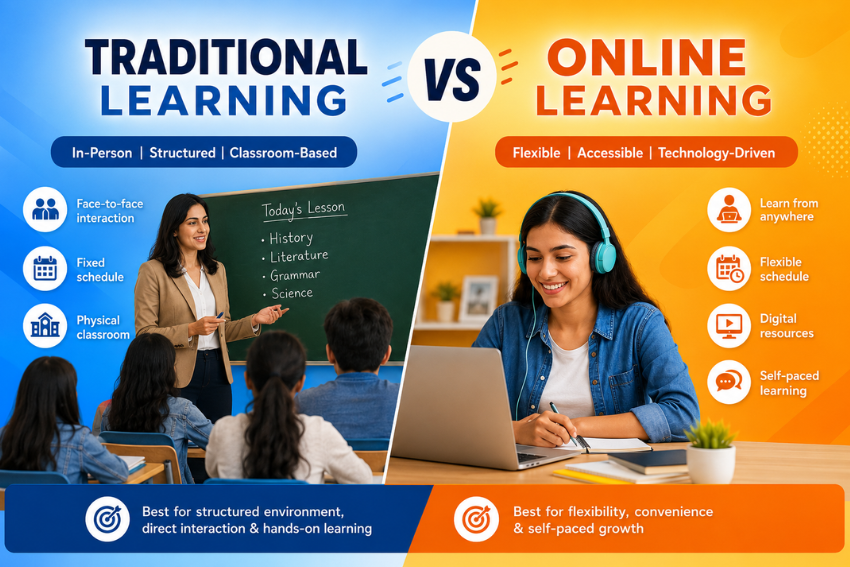
The framework of traditional learning is the one that we are familiar with. It is an instruction that is conducted in a classroom or a brick-and-mortar school, college or university. Students and teacher have a set time to meet and learning takes place in a classroom. This type focuses on structured settings, peer interaction and experiential learning. It’s a system of education that has been around for centuries and is known for its commitment to providing dedicated professors, physical libraries, lab spaces, and a vibrant campus culture.
What is Online Learning?
Online learning involves instruction through digital platforms. Courses may be offered asynchronously (self-paced) or synchronously (virtual classes conducted live). As there have been many platforms that have come into existence, students are now able to go through courses online, and this is not necessarily at a high cost, and neither is it necessarily on a fixed timetable. Today’s online courses feature more than just lectures that can be recorded and played back at a later time—they have interactive simulations, online tutoring, and discussion boards.
Traditional Learning vs Online Learning: Key Differences
To truly understand which model fits your life, you need to look at how they operate day-to-day. Here is a quick snapshot of how they compare side-by-side before we dive deeper.
| Feature / Aspect | Traditional Learning | Online Learning |
|---|---|---|
| Schedule & Structure | Fixed class times with a rigid daily routine and mandatory attendance. | Highly flexible schedules; options for self-paced or live virtual sessions. |
| Learning Environment | Physical classrooms with a social, group-driven dynamic. | Digital platforms requiring a quiet space; often an independent activity. |
| Interaction & Feedback | Face-to-face interaction with real-time, immediate feedback from instructors and peers. | Digital communication via email, forums, or video calls; feedback is often delayed. |
| Cost & Expenses | High tuition fees plus added costs for commuting, housing, meals, and physical materials. | Generally lower tuition with significant savings on transportation and housing. |
| Accessibility | Restricted by geographic location; you can only attend institutions within commuting distance. | Accessible from anywhere in the world with a stable internet connection. |
| Pacing | Group-paced; the entire class moves forward at the average speed of the group. | Individual-paced; you can speed up through easy topics or slow down for difficult ones. |
| Hands-On Experience | Excellent for lab sciences, performing arts, and physical activities requiring equipment. | Limited practical exposure; relies heavily on simulations and VR alternatives. |
| Accountability | High external accountability due to physical presence of teachers and classmates. | Requires strong self-discipline and internal motivation to stay on track. |
Now, let us explore these differences in greater detail.
Structure and Scheduling
This is perhaps the most obvious difference. In traditional classrooms, there is a set daily routine of set times for lecture, discussion and group activity. There are no excuses for absence and the flow of the day is standardized. This is a great format for students who need structure and have an accountability partner outside of them to keep them focused.
This changes with online learning. It provides much greater flexibility with pause and rewind and faster/slower options. Some online programs offer live (synchronous) sessions, while others have the option to log in at any time of the day or night.
The Learning Environment
Learning is an inherently group activity in a traditional classroom. You have peers around you, and the teacher is in your presence physically. This sets the groundwork for a social dynamic that is motivational and engaging. Most of the time, however, the pace is determined by the group – sometimes that’s a problem if you learn too fast or too slowly compared to the rest of the class.
On the other hand, online learning is typically a more autonomous task. You’re often studying alone, in front of the screen. This demands more self-direction and self-discipline. It has the unfortunate side effect of personalization, though. If you understood something right away, you can skip it, but if you still need a bit more time, you can re-watch the lecture without anyone being held up.
Interaction and Feedback
Interaction is very uneven in quality and speed. The traditional setting provides you with feedback as you are doing it. Raise your hand, ask a question and receive an answer immediately. Interactive discussions and learn to receive non-verbal instruction from the instructor. This direct feedback loop is very strong when it comes to comprehending difficult concepts.
That face-to-face relationship is something that’s not as easily found in online learning. Some professors may be available to email, and there are discussion boards, but the feedback may not be immediate. This can make it difficult to get “hooked” into a particular game. In addition, with no daily contact with peers or professors, it can be isolating.
Cost and Accessibility
This is where online learning can have an advantage. The expenses involved in traditional education are high: tuition fees, transportation, housing, lab fees, and materials can all quickly add up. Geography also puts limitations on you. Attending of schools in commuting distances or living near the school is possible only if the school is within the reach of the student.
The cost of an online program may be cheaper than the cost of on-campus programs, particularly when you consider housing and nutrition costs. They also overcome geographical barriers. A student residing in a rural area can be admitted to a specialized program taught by specialists from around the globe.
Hands-On Experience
Certain topics just lend themselves to a face-to-face approach. There is a need for hands-on practice and physical presence in science labs, art studios and in performing arts classes. There’s no way to easily recreate the experience of conducting chemistry experiments or rehearsing a play in a virtual environment.
Here, online learning is a problem. There are tools and simulations, which improve, but which may not be a 100% replacement for the real thing.
Traditional Learning vs Online Learning: Key Advantages
Advantages of Traditional Learning
- Real-Time Interaction: The ability to interact with teachers and peers instantly is a massive benefit. It keeps you engaged and helps you understand complex topics faster.
- Structure and Routine: A fixed schedule provides consistency and reduces distractions, especially for younger students.
- Hands-On Learning: Certain subjects like lab sciences, art, and performance arts require physical presence and equipment.
- Social and Networking Opportunities: Classrooms naturally build relationships. These connections often become part of a student’s long-term support system and professional network.
- Built-in Accountability: Having a teacher physically present and classmates nearby creates a system of accountability that encourages participation.
Advantages of Online Learning
- Flexibility: You can learn on your own time, making it ideal for those with jobs or families.
- Accessibility: You can access programs from anywhere in the world, breaking down geographical barriers.
- Affordability: Online programs often cost less, and you save on commuting and housing.
- Self-Paced Options: Many courses allow you to move faster or slower depending on your needs.
- Broader Choices: You can access specialized programs that might not be available locally.
Traditional Learning vs Online Learning: Disadvantages
Disadvantages of Traditional Learning
- High Costs: Tuition, commuting, and housing can be prohibitively expensive.
- Less Flexibility: Fixed schedules make it difficult for working adults or parents to balance responsibilities.
- Group Pacing: The class moves at the speed of the group, which may be too fast or too slow for individual students.
Disadvantages of Online Learning
- Less In-Person Interaction: It is common to feel isolated without daily engagement with peers and professors.
- Technology Barriers: You need reliable internet, devices, and digital literacy to succeed.
- Self-Discipline Required: Without a structured schedule, you must stay motivated and manage your time effectively.
- Limited Hands-On Opportunities: Majors like lab sciences or performing arts are harder to replicate online.
What Does the Research Say?
Studies on effectiveness are mixed. A few studies suggest that traditional classroom teaching is still more effective in enhancing students’ language production and improving their writing accuracy, because the teacher-led discussion is conducive to students’ language production. Other studies indicate that students enrolled in fully online learning courses may perform lower than in the traditional classroom setting.
The story doesn’t stop there though. Students who learned in an AI and VR enhanced online environment with the support of technology showed much higher comprehension scores and engagement rates in a study performed in 2025. In particular, the mean comprehension scores were 3.85 out of 5 for tech-enhanced online learners and 2.92 out of 5 for face-to-face learners.
What does this imply? It implies that the online experience is hugely important. A poorly thought out online course will fail, but a well-designed online course that uses technology can actually be more effective than the traditional course.
The Verdict: Which One is Right for You?
There is no right or wrong solution. There is no definitive right or wrong answer in regards to distance or traditional learning, as it depends on your own situation, learning style and goals.
Choose Traditional Learning if:
- You thrive on structure and routine.
- You learn best through face-to-face interaction and hands-on activities.
- You value the social and networking aspects of campus life.
- You need the external accountability that comes with a physical classroom.
Choose Online Learning if:
- You need flexibility to balance work, family, and education.
- You are a self-motivated learner who can manage your own time.
- You want access to specialized programs that are not available locally.
- You are looking for a more affordable educational path.
The Future: Blended Learning
The future of education isn’t about one or the other. The use of blended learning has been gaining momentum, with various studies and research projects demonstrating that it is the most effective model for learning. There is increasing evidence to support blended learning as the most effective model for learning as it is the best of both worlds in delivering the most effective learning. Blended learning mixes online educational materials and opportunities for interaction online with traditional place-based classroom methods.
The blended approach gives students the best of both worlds: online learning and in-person interaction and real-world experience. It’s the optimal of two worlds.
Final Thoughts
The argument for traditional learning vs. online learning is not simply a question of “better. It’s the question of what’s a better option. The educational scene has grown, and now you have a greater choice than ever of what to do in order to fit your life! Going into a lecture hall or a virtual classroom, the key is that you are committed to learning!