











Generative AI API vs Chat Interfaces is no longer just a technical comparison for developers. It has become a strategic business decision that influences customer experience, product scalability, operational efficiency, and long-term AI adoption.
Generative AI has moved beyond experimentation. Organizations are deciding whether AI should remain a conversational tool employees open in a browser or become infrastructure embedded into products and workflows. Enterprise AI usage continues to expand rapidly, with AI becoming increasingly integrated into business processes rather than isolated productivity experiments. Recent enterprise data shows dramatic growth in AI workflow adoption and API consumption patterns.
Some teams launch quickly with chat tools because they require almost no setup. Others invest in APIs to create AI powered experiences inside websites, apps, CRMs, internal systems, and automated workflows.
So which path makes sense?
The answer depends on whether your goal is conversation or capability.
Understanding Generative AI Consumption Models
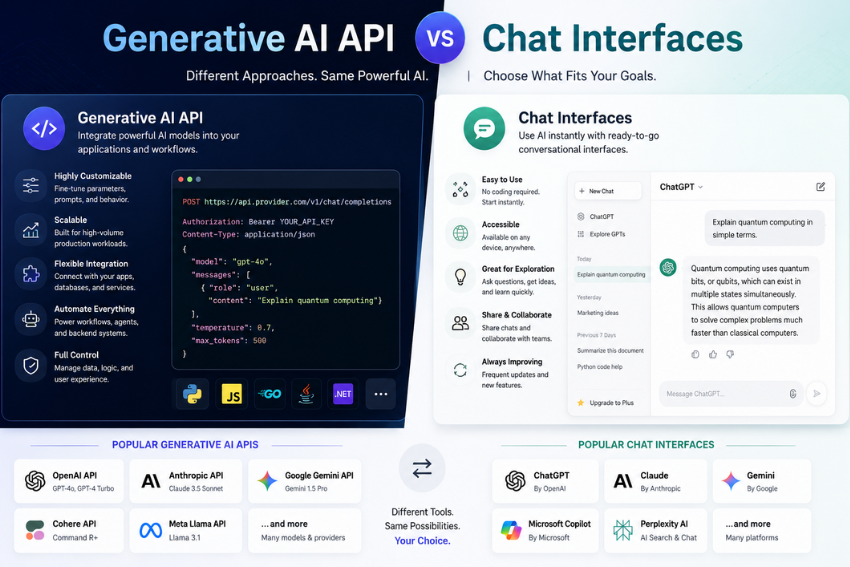
Generative AI reaches users in two primary ways. The first is through chat interfaces, where people interact directly through a conversation window. The second is through APIs, where software applications send requests to AI models and receive outputs programmatically.
Think about the difference between eating at a restaurant and buying ingredients to cook at home. A chat interface is the restaurant. Everything is packaged, prepared, and served. An API is the ingredient supply chain. You build the final experience yourself. This distinction changes everything from implementation effort to business outcomes.
What Is a Chat Interface?
A chat interface provides direct interaction between humans and AI. Users type prompts and receive responses inside a ready-made interface. These platforms often include memory, file uploads, formatting, and multi turn conversations.
Examples include:
- AI assistants
- Customer support chat experiences
- Internal employee copilots
- Knowledge retrieval systems
Chat interfaces prioritize usability over architecture.
What Is a Generative AI API?
A Generative AI API exposes AI capabilities through code. Developers connect applications to models using structured requests and receive outputs that software can process automatically. Instead of opening a chat window, the user may never realize AI exists behind the scenes.
Examples include:
- AI search
- Content generation platforms
- Customer service automation
- Document analysis
- Coding assistants
- Embedded recommendation engines
Why This Decision Matters More Than Ever
AI strategy used to begin with experimentation. Today, the conversation has shifted toward operational value.
Enterprise reports indicate organizations are increasingly embedding AI directly into workflows, while developer usage of APIs has accelerated significantly year over year. API reasoning token consumption has shown substantial growth as businesses move from testing to production systems.
The implication is clear. Companies that only provide chat access may improve personal productivity. Companies that operationalize AI through APIs can redesign products and business processes.
AI Adoption Trends
Recent enterprise analysis shows that AI is becoming infrastructure rather than an isolated productivity tool. Organizations are increasingly measuring success through integration depth instead of user counts.
That shift is creating a dividing line between interface users and platform builders.
Core Differences Between APIs and Chat Interfaces
| Category | Chat Interfaces | Generative AI APIs |
|---|---|---|
| Setup | Immediate | Development required |
| Users | Humans | Applications |
| Output | Conversational | Structured |
| Integration | Limited | Extensive |
| Scale | Team level | Enterprise level |
| Automation | Low | High |
| Customization | Moderate | Deep |
User Experience
- Chat interfaces are designed for humans.
- APIs are designed for systems.
- A marketing manager opening an AI assistant wants answers immediately.
- A software company building AI search wants responses routed directly into its application.
Integration
- Chat tools generally operate beside existing workflows.
- APIs operate inside workflows.
- That difference determines long term value.
Scalability
- Chat scales users.
- APIs scale outcomes.
- One employee can generate one report.
- An API can generate one million reports.
Customization
APIs allow:
- Custom prompts
- System instructions
- Workflow orchestration
- Structured outputs
- Database connectivity
- Tool execution
Chat tools usually expose only a subset of those controls.
How Chat Interfaces Work
Chat interfaces remain the fastest entry point into generative AI.
- Users ask.
- AI responds.
- The interaction resembles messaging another person.
Studies of workplace AI behavior show conversational tools are increasingly used for writing, information retrieval, analysis, and communication tasks across knowledge work environments.
Benefits
Chat interfaces deliver value quickly.
Advantages include:
- Minimal setup
- Fast onboarding
- Lower technical barrier
- Flexible exploration
- Easier adoption
Teams can experiment without waiting months for implementation.
Limitations
Chat systems also introduce constraints.
Common limitations include:
- Manual interaction
- Limited workflow automation
- Reduced control
- Difficult scaling
- Context fragmentation
Organizations often discover these limits after initial excitement fades.
How Generative AI APIs Work
APIs turn AI into infrastructure.
- Applications collect input.
- The system sends requests.
- AI processes information.
- Structured output returns.
- That output can trigger actions automatically.
- APIs enable orchestration instead of conversation.
Research into enterprise AI architecture increasingly highlights APIs as the foundation for autonomous workflows and intelligent system interactions.
Benefits
API driven systems unlock capabilities impossible through standalone chat.
Advantages include:
- Workflow automation
- Product embedding
- Large scale execution
- Data connectivity
- Consistent governance
- Better observability
Challenges
APIs also require investment.
Challenges include:
- Engineering resources
- Monitoring
- Cost optimization
- Security controls
- Prompt governance
- Reliability testing
Organizations that skip these layers often struggle to generate measurable business outcomes.
Cost Comparison: Which Model Is More Economical?
Cost is rarely as simple as subscription versus usage. Chat interfaces generally offer predictable pricing. APIs introduce variable costs tied to volume.
| Factor | Chat | API |
|---|---|---|
| Entry Cost | Low | Medium |
| Growth Cost | Moderate | Usage based |
| Automation ROI | Limited | High |
| Maintenance | Minimal | Moderate |
| Flexibility | Medium | High |
For small teams, chat often wins. For software businesses and enterprise operations, APIs usually become more economical at scale. The important metric is not cost per request. It is cost per completed business outcome.
Security and Governance Considerations
Security changes dramatically depending on access model. Chat environments centralize governance. API environments distribute responsibility.
Questions organizations should ask:
- Where is data processed?
- How is access controlled?
- What logs exist?
- How is retention managed?
- What compliance standards apply?
Enterprise AI leaders increasingly emphasize visibility and governance as prerequisites for scaling AI safely across organizations. Without governance, AI becomes another disconnected software layer.
Real World Business Use Cases
The easiest way to understand the difference is through examples.
When Chat Interfaces Win
Best scenarios:
- Brainstorming
- Writing support
- Internal productivity
- Research assistance
- Training
When APIs Win
Best scenarios:
- AI search
- Customer support automation
- Personalized recommendations
- AI document processing
- AI powered SaaS features
Software engineering studies also show organizations increasingly integrate AI directly into implementation, testing, maintenance, and developer workflows instead of using standalone conversational tools alone.
Choosing the Right Approach
Use this decision framework.
Choose Chat Interfaces if:
- You need results immediately
- Technical resources are limited
- Users require flexibility
- Adoption is experimental
Choose Generative AI APIs if:
- AI becomes product infrastructure
- Automation matters
- Scale matters
- Governance matters
Choose Both if:
- Employees need productivity tools
- Customers need embedded AI experiences
This blended strategy is becoming increasingly common across enterprise environments.
Future Outlook: AI Is Becoming Invisible
Chat interfaces introduced the world to generative AI. APIs are quietly moving AI into products.
Industry observers increasingly expect AI to disappear into workflows and become less visible to end users while becoming more operationally important behind the scenes.
The future is unlikely to be API versus chat. It will be chat plus orchestration plus embedded intelligence. People will speak to AI. Systems will execute through APIs. That combination creates the next generation of software.
Conclusion
The debate around Generative AI API vs Chat Interfaces is not about which technology is better. It is about choosing the right delivery model for your objective. Chat interfaces maximize accessibility. APIs maximize capability.
If your goal is experimentation, communication, and quick productivity gains, chat interfaces create fast wins.
If your goal is automation, scale, product innovation, and durable competitive advantage, APIs create a stronger foundation.
The organizations creating lasting value are increasingly combining both approaches into one connected AI strategy.