










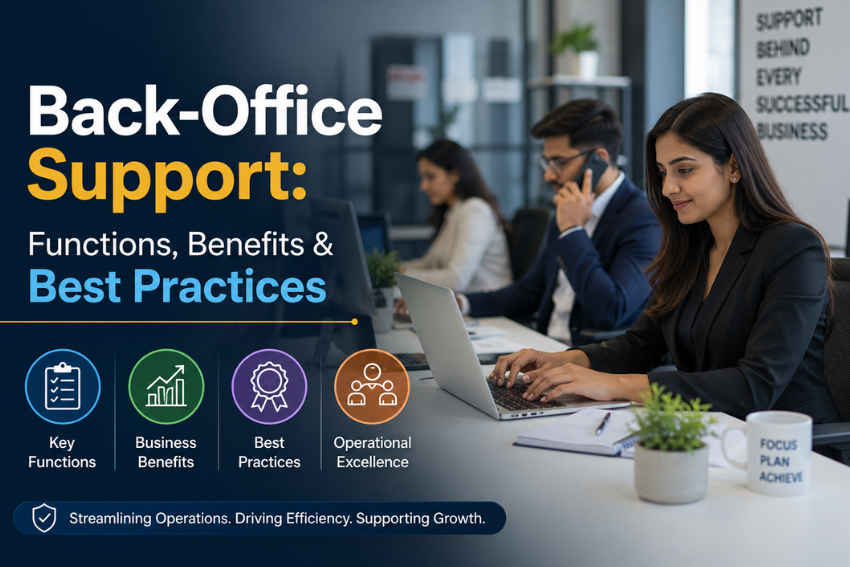
Just think of a visit to McDonald’s. You order French fries, a burger, and a Coke. The order arrives hot and fresh in just a few minutes without a hitch. What you see actively is the front counter, the POS, the smiling staff, the menu boards, the sizzling grill, etc. But behind the counter, there is a whole world of activity taking place that is not visible to you. From payroll processing and invoice delivery to compliance documentation, data entry, and management into systems—everything is going on. That invisible world is called back-office support.
Think of back-office support as unseen warriors who navigate all challenges involved in data entry, conversion, mixing, research, mining, technical support, and administrative responsibilities. The backend staff makes it all smooth by adeptly handling paperwork, technology, data, and organizational things, so the frontline members can smoothly do their jobs.
Though your eyes cannot see them directly happening, they continue to take place. It’s like the roots of a tree, which you cannot see growing. The only visible things are the leaves and branches, which are similar to customer-facing work. So, visible things are not the whole world. The backend activities keep it strong and fostering.
Today’s hyper-connected world makes it necessary for companies to turn to professional back-office support services so managing those critical operations efficiently, cost-effectively, and at scale becomes possible.
What is Back-Office Support?
The term “back office” was originally coined from the physical layout of the old financial firms where the customer-facing staff sat at the front of the corporate office and administrative staff continued to work at the back. Today, this very term refers to business operations that support front-office staff without directly addressing customers’ requests.
Functions Back-Office Support
Considering the functions of back-office support, it spans a wide range of departments and complementary tasks. Here is a breakdown of the most vital ones:
Data Entry and Data Management Is the Need
Every business generates a pool of data from departments like sales, customer support, inventory, HR, and marketing. Someone must keep these records along with their verification, management, and cleansing. It is like keeping your notebooks aligned to find your homework. Companies cannot take risks by keeping millions of pieces of information scattered. The data input team does it adeptly.
Real-world example: Think of a renowned store like Walmart, which sells products to over 1 million people every single hour. Managing data related to these massive transactions is challenging. A special team makes sure that the POS and stocks know exactly what was sold, how many items are left, and that the transactions went to the right place. Properly managed data prevents products from going out of stock.
Accounting: The Money Experts
Just as we manage our piggy bank, every entrepreneur must track incoming and outflowing money. The back-office team stays alert while handling bill payments, ensuring employees get their pay cheques and all records remain neat and flawless.
Real-world example (Procter & Gamble): P&G made a groundbreaking decision to consolidate all its money-tracking teams into a shared services model. This decision broke out tradition, and they noticed a significant cost savings increment of over $300 million every year, while ensuring zero cases of non-compliance across every country they operate in.
HR Administration: The People Helpers
The human resource (HR) team takes care of hiring new talent and retaining employees. Its role is to screen everyone from new workers to trainers, while monitoring who is off and who has received incentives.
Real-world example: Hiring seems like a free service, but indeed it costs a lot of money—about $4,700 on average per hire, according to the Society for Human Resource Management (SHRM). As companies know the costs involved, they use smart tools to handle boring paperwork for new hires. Instead of spending time on forms, this support helps employees boost themselves up and succeed.
IT Support and Infrastructure Management for Remote Working
IT teams also work in the backend, contributing to maintaining the servers, software, cybersecurity systems, and internal networks that a business requires as an absolute must-have. When a system goes down or computers crash at work, this team fixes it as part of back-office support.
Customer Data and Order Processing for Effortless E-Commerce
Managing orders placed online, processing them, checking inventory, arranging shipping, and updating accounts are common responsibilities of the back-office support team. You never see this, but it quietly goes on to ensure your order is delivered on time.
Real-world case: Amazon’s smart back-office system is an epitome for the world, acting like a giant digital brain able to handle over 37.6 million orders every single day. Behind the scenes, it leverages advanced tools to coordinate warehouses, payments, courier partners, and customer records, so customers get their packages on time. Although those busy processes are not visible, they quietly ensure millions of orders stay trackable every second.
Compliance and Legal Support for Ethical Corporate Activities
Just as a school has its own set of rules to ensure safe education, businesses must follow laws strictly. The compliance team is like a referee in a football match who ensures every department adheres to ethical practices so that not even a single incident of violating the rules occurs, even by accident. Some of the major guidelines that help companies stay aligned with compliance are:
- Money Rules (Tax Laws): Ensuring the company pays its fair share of money to the government.
- Secret-Keeping Rules (Data Privacy): Keeping personal information invulnerable. Companies must keep all sensitive records within an encrypted environment to avoid malicious hacking attempts.
- Fair Play Rules (Labor Regulations): Ensuring all employees are treated nicely, get paid properly, and have a safe, hygienic place to work.
Benefits of Back-Office Support
Certainly, if the front office is the face, the back office is the soul or backbone of the company. Without it, the face cannot stand.
Saving Money and Staying Focused
A business has multiple things going on behind the scenes, which require investments in office desks, fancy computer software, staff salaries, and employee training. This pushes companies to think about outsourcing that work, meaning the company contracts with a third-party business that specializes in those tasks.
Why do they do it? This option saves millions of dollars a year for companies. Surveys and studies by firms like Deloitte Global Outsourcing Survey 2023 show that businesses can accumulate savings between 20% and 40% of operational costs by delegating these tasks to a third party.
Doing What You Do Best
When a top leader of a company does not have to stress completing boring tasks like typing, rectifying errors in data, managing pay cheques, and checking rulebooks, they have sufficient time to focus on what they are really great at. Spending their day on paperwork can be eliminated, allowing them to focus on:
- Spending quality time coming up with new ideas for the growth of the company.
- Creating cool new products to drive overwhelming sales.
- Strengthening relationships with customers.
This is like a student who gets help organizing their desk, so they can focus entirely on getting excellent grades.
Scalability
With efficient back-office support services, businesses earn golden opportunities to scale quickly. A startup that suddenly lands big clients can delegate its non-customer-facing projects to a specialized company without having to hire, train, or house a big team overnight.
Real-world case: Airbnb gained momentum, growing from a small startup to a multinational company in less than a decade. A lion’s share of this success goes to outsourcing back-office support services, which prevents them from getting bogged down by the hassles involved in payment processing, tax compliance, and host verification. Building all of this from scratch at that speed might have otherwise remained a distant dream (Forbes, 2021).
Accuracy and Quality
Outsourcers are professionals. A team that only focuses on data mining will naturally make fewer errors than a general employee.
Research by the Data Warehousing Institute (TDWI) estimates that poor data quality costs U.S. businesses over $600 billion per year. Outsourcing companies hire dedicated professionals and rigorously follow quality control processes, which dramatically reduce these costly errors.
Real-Life Case Studies in Back-Office Transformation
Case Study 1: JP Morgan Chase – Automating Back-Office Finance
JP Morgan Chase, one of the world’s largest banks, embraced Robotic Process Automation (RPA) to automate its back-office operations. This smart move helped them hand over tasks like loan document review, compliance checking, and account reconciliation to software robots for automatic processing.
JP Morgan Chase used to follow a traditional approach, with workers spending hours doing boring computer chores like checking loan paperwork and double-checking math. To save that time, they switched to smart RPA—software bots inside the computer that efficiently do repetitive tasks in a fraction of the time. Because they don’t get tired or make mistakes, completing massive tasks is easy. This saves the bank precious hours and frees up human workers to focus on helping real customers instead.
The result? A task that previously took 360,000 hours of human labor annually was completed by software in just a few seconds per transaction (JP Morgan Annual Report 2017). Employees were redeployed to higher-value roles, and error rates dropped to near zero.
Case Study 2: Infosys BPM – Serving Global Giants
Infosys BPM (Business Process Management), based in India, delivers high-impact back-office support services to some of the world’s top-rated companies, including Sony, Harley-Davidson, and Deutsche Bank. This renowned company has expertise in sailing across barriers in tasks related to finance and accounting, HR administration, procurement, and supply chain management.
With this stunning portfolio, thousands of global customers from over 50 countries define its clientele. Its popularity and success rate show that its BPM models are next level, complemented by precision and consistency.
Best Practices to Follow for Back-Office Support
Whether you hire a third party to outsource or harness the talent of your own internal back-office support team, these best practices are core to maximizing efficiency and results.
Standardize Processes Before Automating or Outsourcing
Before entrusting any project to an external team or Agentic AI, write exactly how the process works. Inconsistencies in workflows and blurry guidelines leave everyone confused. You need well-defined, comprehensive Standard Operating Procedures (SOPs) detailed step-by-step for whatever back-office task you perform.
Switch to Investing in the Right Technology
Imagine you have a secret vault to keep all your sensitive documents safe. It’s where you keep records of how much money you have and your customers’ secrets.
Instead of manual management, you can hire smart helpers like AI and specialized software to do heavy lifting, like streamlining files and handling payroll automatically. Tools like SAP, Oracle, QuickBooks, and Salesforce are popular for leveraging smart algorithms to streamline operations.
Spending money on these smart tools helps you win back your investment quickly; according to Gartner, companies investing in back-office automation software see an average ROI (Return on Investment) of 250% within three years.
Show No Leniency in Maintaining Data Security
Let’s reconsider the vault example. You have to protect that secret vault like a fortress. It needs a digital lock secured by secret codes and regular checkups, so hackers cannot sneak in. If you don’t take this step, bad guys can steal your sensitive records—such as contact details, salaries, client contracts, and financial records. According to IBM Cost of a Data Breach Report 2023, the average cost of a data breach globally is $4.45 million to fix.
Set Clear KPIs (Key Performance Indicators)
Improvement is only possible when you evaluate performance. Back-office teams must measure common metrics like:
- Processing time per transaction
- Error rate in data entry
- Invoice turnaround time
- Payroll accuracy rate
- Compliance audit results
The evaluation of these metrics reveals to companies whether the back office is performing well or needs improvement.
Choose the Right Back-Office Support Services Partner
While selecting a partner, ensure that your outsourcing provider has concrete answers to these questions:
- Do they know your sector’s compliance regulations?
- Do they use modern tools like AI agents and secure systems?
- Is it possible for them to scale up deliveries at any point in time?
- Do they keep you updated with regular reports?
- Can they show proven results or case studies for clients in similar sectors?
Train and Retain Your Back-Office Team
To adapt to the future; training is a must. As regulations, software, and processes evolve, people need training sessions to guide them forward. Offering fair compensation alongside training helps companies retain the best talent, which provides a massive cost advantage.
Review and Optimize Regularly
The best setup for back-office operations is never to “set and forget”. Expert teams frequently review workflows, which help businesses discover bottlenecks, outdated processes, and valuable prospects for automation. Always integrate cutting-edge new technology.
The Future of Back-Office Support
Three major forces are shaping the future of the back office:
- Artificial Intelligence (AI): Deploy AI tools to capture data automatically from invoices, flag anomalies in transactions, screen job applicants, and answer internal HR queries. According to PwC, the world will see up to 45% of back-office tasks automated by AI by 2030.
- Cloud Computing: The cloud is a virtual ecosystem that allows remote operations, enabling teams to work from anywhere in the world while keeping data up-to-date and accessible. Microsoft 365 is a prime example.
- Robotic Process Automation (RPA): AI agents can now efficiently handle repetitive tasks—like copying data between systems, generating reports, and processing standard forms—at speeds no human can match. Forrester Research predicts that the global RPA market will reach $22 billion.
Conclusion
Back-office support is something that never makes headlines. Customers never see it, and the support team rarely gets the credit it deserves. But for companies, it can be a total gamechanger. It leaves your think tanks alone to focus fully on innovation and creative, constructive strategies to thrive instead of constantly correcting data and supporting juniors.
Nothing works smoothly without back-office work. Think wisely and choose the best alternatives if you truly want to grow. Agentic AIs and outsourcing companies are ready to lift this load from your shoulders at a price that internal teams often cannot match, making it incredibly affordable.