











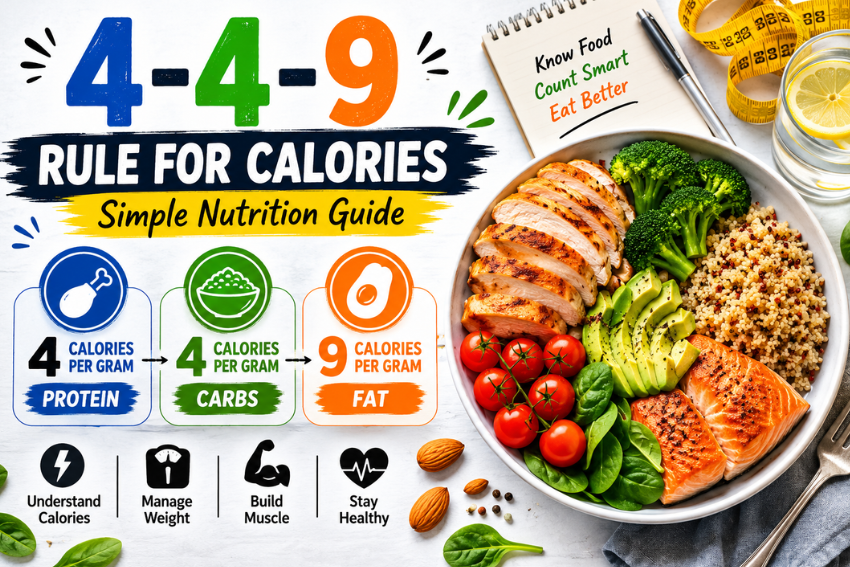
One of the simplest methods of understanding how food is converted into energy and why some foods have more calories than others is the 4-4-9 Rule for Calories.
If the nutrition panel seems like a jumble of information or the idea of counting calories intimidates you, this simple guideline will help you see the light. It is not a complicated app or advanced nutrition knowledge that is required. Read this rule once and you’ll be able to estimate calories more precisely, choose the right foods, and know the consequences of proteins, carbs and fats on your body.
The 4-4-9 rule can serve as a practical guideline, whether you’re focused on weight management, muscle growth, or boosting your energy levels. The 4-4-9 rule can be a great starting point for anyone looking to achieve weight management, muscle growth, increased energy, and better eating habits.
Here, you will see exactly how the rule works, understand its importance, know how to calculate your calories by hand and know how to use the rule in daily life.
What is the 4-4-9 Rule for Calories?
The 4-4-9 Rule for Calories is a simple nutritional formula that will help you figure out how many calories your diet is getting from each macronutrient.
The rule states:
- Protein provides 4 calories per gram
- Carbohydrates provide 4 calories per gram
- Fat provides 9 calories per gram
That is where the numbers 4, 4, and 9 originate.
If you know how much protein, carbohydrates and fat is in a food, then you can estimate the total calories of that food easily.
Formula
Total Calories =
(Protein × 4) + (Carbohydrates × 4) + (Fat × 9)
This method appears throughout nutrition science, food labeling, meal planning, and dietary tracking.
Why Calories Matter More Than Most People Think
Calories represent energy.
Every action your body performs requires energy.
Your body uses calories to:
- Maintain breathing
- Support heart function
- Digest food
- Build and repair tissue
- Power movement and exercise
- Regulate body temperature
- Support brain activity
People often focus only on total calories, but calorie sources matter too.
For example:
300 calories from protein affect your body differently than 300 calories from processed sugar.
Understanding the source of calories helps improve nutrition quality.
Understanding the Three Macronutrients
Before applying the rule, you need to understand macronutrients.
Protein: 4 Calories per Gram
Protein supports growth and recovery.
Functions include:
- Muscle repair
- Hormone production
- Enzyme creation
- Immune support
- Tissue maintenance
Common protein sources:
- Chicken
- Fish
- Eggs
- Greek yogurt
- Tofu
- Beans
- Cottage cheese
Example:
25 grams protein × 4 = 100 calories
Protein often increases fullness and may help manage hunger.
Carbohydrates: 4 Calories per Gram
Carbohydrates serve as the body’s preferred energy source.
They fuel:
- Exercise
- Daily movement
- Brain function
Sources include:
Healthy carbohydrate options:
- Oats
- Brown rice
- Fruits
- Vegetables
- Whole grains
Higher processed sources:
- Sugary drinks
- Candy
- Refined baked goods
Example:
50 grams carbs × 4 = 200 calories
Not all carbohydrates deliver equal nutritional value.
Fiber rich sources generally provide additional benefits.
Fat: 9 Calories per Gram
Fat contains more than twice the calories per gram compared with protein and carbohydrates.
Fat supports:
- Hormone production
- Nutrient absorption
- Cell structure
- Brain health
- Long lasting energy
Healthy fat examples:
- Avocados
- Olive oil
- Nuts
- Seeds
- Fatty fish
Example:
20 grams fat × 9 = 180 calories
Because fat is calorie dense, portions can influence total intake quickly.
How to Calculate Calories Using the 4-4-9 Rule
Learning the calculation takes only a few minutes.
Imagine a meal contains:
- Protein: 30 g
- Carbohydrates: 40 g
- Fat: 15 g
Step 1: Calculate protein calories
30 × 4 = 120
Step 2: Calculate carbohydrate calories
40 × 4 = 160
Step 3: Calculate fat calories
15 × 9 = 135
Step 4: Add totals
120 + 160 + 135 = 415 calories
That meal contains approximately 415 calories.
This approach works for packaged foods, recipes, and homemade meals.
Real Life Examples of the 4-4-9 Rule
Example 1: Peanut Butter Sandwich
Nutrition:
- Protein: 14 g
- Carbs: 32 g
- Fat: 18 g
Calculation:
- Protein = 56 calories
- Carbs = 128 calories
- Fat = 162 calories
Total:
- 346 calories
Example 2: Chicken Rice Bowl
Nutrition:
- Protein: 40 g
- Carbs: 50 g
- Fat: 10 g
Calculation:
- Protein = 160
- Carbs = 200
- Fat = 90
Total:
- 450 calories
Example 3: Smoothie
Nutrition:
- Protein: 25 g
- Carbs: 45 g
- Fat: 8 g
Calculation:
- Protein = 100
- Carbs = 180
- Fat = 72
Total:
- 352 calories
These examples show how calorie totals shift depending on macro composition.
Why Fat Contains More Calories
People often ask why fat equals 9 calories while protein and carbohydrates equal 4. The answer lies in chemistry. Fat molecules store more chemical energy. That makes fat an efficient long term energy reserve.
Historically, this characteristic helped humans survive periods of food scarcity. Today, it simply means calorie totals can rise quickly when dietary fat intake increases. That does not mean fat is unhealthy. Quality and quantity both matters.
How Nutrition Labels Use the 4-4-9 Rule
Food manufacturers commonly estimate calorie values using the same principle.
Look at a nutrition label:
- Protein: 10 g
- Carbohydrates: 20 g
- Fat: 5 g
Calculation:
- 10 × 4 = 40
- 20 × 4 = 80
- 5 × 9 = 45
Estimated total:
- 165 calories
The label may show slight differences because of:
- Fiber adjustments
- Rounding rules
- Sugar alcohols
- Testing variations
Still, the formula remains highly practical.
Common Mistakes People Make
Many people misunderstand calorie calculations. Avoid these mistakes.
- Ignoring Fat Intake: Healthy fats remain important, but portions matter because fat contains more calories.
- Assuming Low Calorie Means Healthy: Some foods contain fewer calories but offer little nutritional value.
- Counting Only Calories: Calories matter, yet nutrient quality matters too.
- Forgetting Serving Sizes: Many labels list multiple servings per package.
- Overestimating Exercise Burn: Exercise helps, but food intake often influences results more directly.
Can the 4-4-9 Rule Help Weight Loss?
Yes, but indirectly. The rule does not cause weight loss. Instead, it improves awareness.
Benefits include:
- Better portion control
- More accurate tracking
- Improved meal balance
- Reduced hidden calories
For example:
Two lunches may each contain 600 calories.
- Lunch A: High protein and moderate fat
- Lunch B: High refined carbs and processed fat
The body may respond differently in hunger, energy, and satisfaction. Understanding macros helps improve decisions.
Can You Use the Rule Without Tracking Apps?
Absolutely. You can estimate manually.
Simple process:
- Read nutrition labels
- Identify protein, carbs, and fat grams
- Multiply using 4-4-9
- Add totals
Over time, patterns become familiar. You start recognizing approximate calorie values naturally.
Is the 4-4-9 Rule Always Exact?
Not perfectly. The rule provides estimates. Some foods vary.
Examples include:
- Fiber digestion differences
- Alcohol calories
- Food processing effects
- Cooking methods
- Individual metabolism
For example, Alcohol provides: 7 calories per gram
That falls outside the standard 4-4-9 framework. Even so, the rule remains extremely useful for everyday nutrition.
Who Benefits Most from Learning This Rule?
The 4-4-9 Rule is a helpful guideline for nearly anyone who wishes to gain some understanding of nutrition and make better food choices. The method is easy and convenient, and can be adapted to fit a variety of lifestyles and health goals.
People Trying to Lose Weight
Knowing the sources of calories can help develop healthy serving sizes. People do not have to only think about eating less, but can try to prepare meals that are satisfying yet still on track for their calorie budget.
Individuals Building Muscle
Muscle growth depends heavily on sufficient protein intake and overall calorie balance. The 4-4-9 Rule helps estimate whether meals support recovery and muscle development.
Fitness Enthusiasts
Regular exercisers tend to focus on macronutrient balance. This rule helps to easily modify meals for training days, recovery days and performance goals.
Students Learning Nutrition
The 4-4-9 formula provides an easy introduction to how food energy works and helps simplify nutrition concepts that may otherwise feel complicated.
Parents Planning Family Meals
This can be a way for parents to actually make healthier food choices when they are eating at home, and make a balanced meal without having to count calories.
Health Professionals and Coaches
Calculating calories and macros are used by nutrition coaches, personal trainers, and wellness professionals to help educate their clients and promote realistic nutrition goals.
Busy Professionals
People with limited time can use the rule to make quicker food decisions when shopping, meal prepping, or eating at restaurants.
Anyone Reading Food Labels
If you’re not trying to lose weight or make your food choices for fitness, the protein, carbohydrate, fat and calorie relationship with food labels is easier to understand.
Simple Daily Tips to Apply the Rule
There’s no need to follow a strict diet or track your meals closely to apply the 4-4-9 Rule. Being mindful of calories can seem intuitive and manageable in the long-run if you establish small habits. Here are some actionable habits:
Include Protein at Every Meal
Protein contributes to satiety and may help to increase the pleasure of eating. Ensure that breakfast, lunch and dinner include a high-quality protein source like eggs, chicken, fish, yogurt, beans, tofu or cottage cheese.
Measure Calorie Dense Foods Occasionally
Healthy fats are likely to provide a higher calorie density in a lower volume of food. There is no need to measure everything, but sometimes it is helpful to have a serving size reference for things such as nut butter, oils, nuts, and dressings.
Read Labels Before Purchasing
Take a few seconds to check nutrition labels. Consider protein, carbohydrates, fat and serve size before making a choice. This can then develop into a habit over time, and it can help you make better decisions.
Focus on Whole Foods
Whole foods tend to be more nutritious and easier to control calorie intake with. Create meals around fruits and vegetables, lean proteins, whole grains and healthy fats as much as possible.
Balance All Three Macronutrients
Don’t view one macronutrient as a “good” or “bad. Protein, carbohydrates, and fats make a balanced meal, which can promote a good energy level and satisfaction during the day.
Keep Expectations Realistic
Don’t be a perfectionist when it comes to calculations every day. The aim is not to get to a specific number, but to grasp patterns. Good habits are more effective in the long-run than tracking.
Estimate Calories When Eating Out
Few restaurants show the exact quantities of nutrition on the food. Estimate quantities and ingredients using the 4-4-9 Rule.
Plan Simple Meals Ahead
Preparing meals or snacks in advance reduces guesswork and makes it easier to stay aware of calorie intake throughout busy days.
Track Trends Instead of Individual Meals
There is no such thing as one meal that makes you or breaks you. Examine your weekly food choices and take incremental steps toward better eating than perfect daily.
Final Thoughts
There will always be a rule in nutrition that you find most useful and the 4-4-9 Rule of Calories is one of them.
It renders the information on nutrition labels easy to understand and provides an understanding of why foods vary in energy content.
There’s no need to make calculations for all meals forever. It is not about perfection, it’s about awareness.
When you understand that protein and carbohydrates provide 4 calories per gram while fat provides 9, food choices become easier to evaluate.
Use the rule as a guide, combine it with balanced eating habits, and focus on consistency over strict tracking.
Nutrition becomes much simpler once you understand where calories actually come from.
Frequently Asked Questions
What does 4-4-9 means in calories?
Protein equals 4 calories per gram, carbohydrates equal 4 calories per gram, and fat equals 9 calories per gram.
Does fiber follow the 4-4-9 rules?
Fiber contributes fewer digestible calories than standard carbohydrates in many cases.
Is counting macros better than counting calories?
There is no universal answer as to which is “best.” When used together, it can enhance the understanding of nutrition.
Do all foods fit the formula?
The vast majority of foods do, but alcohol and some processed foods are exceptions.
Is the rule useful for athletes?
Yes. Macronutrient calculations are used by athletes to aid in performance and recovery.