









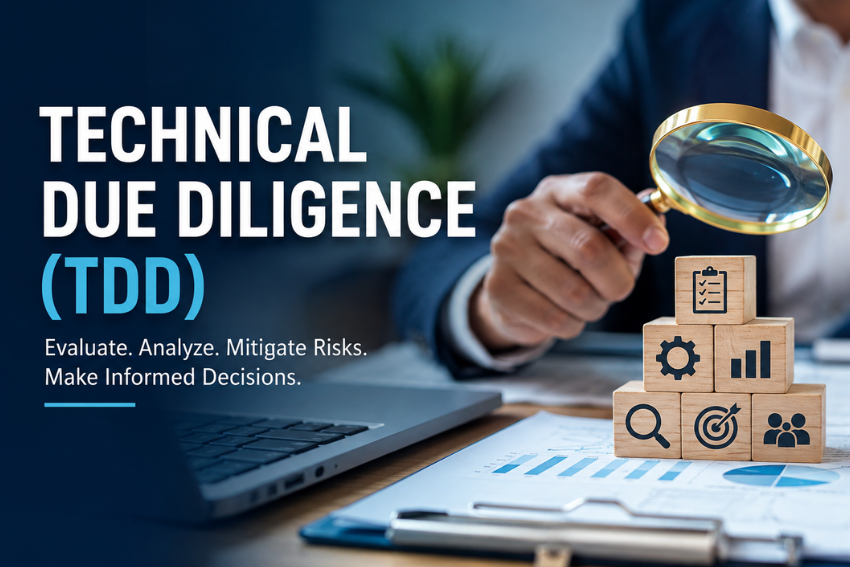
Technical Due Diligence (TDD) is the thorough examination of a company’s technology infrastructure, codebase, architecture and IT capabilities. This evaluation is usually done prior to a merger, acquisition or investment round. While financial due diligence deals with numbers, TDD zooms in on the digital backbone of an organization.
With the digital first economy being the norm today, you don’t want to ignore the technical aspect of a prospective acquisition. Though it may appear like a clean financial sheet, the software could be a ticking bomb. Technical Due Diligence provides you with the insights needed to discover potential hidden risks, verify technical statements in the product and gain insight into the actual costs of scaling your product after acquisition.
Why Technical Due Diligence Matters
We live in an era where software runs the world. If you are buying a company, you are effectively buying its technology stack. Technical Due Diligence ensures you are not inheriting a digital nightmare.
Consider this scenario: You acquire a company with a stellar reputation and growing revenue. Six months later, you discover the codebase is unmanageable, the server costs are ballooning, and the only developer who understood the core architecture has left. Now, your “profitable” acquisition is costing you millions in technical debt.
This process provides a clear snapshot of the technical landscape. It answers critical questions about scalability, security, and maintainability. For investors, it is a risk mitigation tool. For the acquiring company, it is a roadmap for integration.
The Core Components of a TDD Assessment
A good TDD is not just a matter of examining the code. It’s an investigation that has several layers to it. The following are important aspects that make up a comprehensive evaluation.
Architecture and Infrastructure Review
This is where the rubber meets the road. Knowing how the system is constructed and where it resides is important. Do they go with a monolithic or microservices architecture? Will the infrastructure be able to cope when the number of users increases rapidly?
A strong review examines cloud infrastructure, database setups, and load balancing capabilities. If this is done on old infrastructure or manually scaled, then this is an indicator for future failure points.
Code Quality and Maintainability
You don’t have to read all the code, but you do have to judge the overall health of the code base. This includes code complexity, code duplication, compliance with industry standards.
Do you have automated tests? How is the test coverage? Coverage is good; but it is also the quality of the coverage that’s important. You’re curious whether the engineering team can simply add the features without breaking anything else.
Security Posture and Compliance
Security is non-negotiable. A security audit is part of Technical Due Diligence. This scans for common vulnerabilities, data encryption methods and access control.
You’ll also have to ensure compliance with pertinent regulations such as GDPR, HIPAA, or SOC2. In the case of acquiring a company that stores sensitive user information, any security breach can be a complete loss of value.
Team Capabilities and Organizational Structure
Technology is created by humans. Do the existing engineers fit the bill for the product’s future? It’s important to see how technically deep the team is, and how innovative they are.
Key engineers and CTOs are essential to interview in the diligence. This will help you to appreciate the culture and to spot single points of failure. When this is heavily reliant on one “rockstar” developer, there is a serious risk to manage.
Operational Processes and DevOps
How to move code from development to production? Operational processes are efficient and are a sign of a mature engineering organization.
Analyze their CI/CD (Continuous Integration/Continuous Deployment) pipelines. Are deployments automated? What is the time required to rollback a bad release? The questions provide insight into engineering speed and stability.
When Should You Conduct a Technical Due Diligence?
Timing for a TDD is important. It is typically quite late in the merger or acquisition process, but shouldn’t be an after-thought.
- Mergers & Acquisitions (M&A):This is the most common scenario. You need to verify the technical assets before signing the final paperwork.
- Venture Capital Investment:If a VC is putting money into a startup, a TDD ensures the startup can actually deliver on its promises.
- Partnerships:A TDD determines technical compatibility and integration costs prior to integrating a partner’s API or system.
- Internal Audits:For mature companies, TDD can be used internally to measure the health of their technical state and to plan for future improvements.
The Process of Technical Due Diligence (TDD)
Knowing the methodology makes it not as scary. The majority of experts have a step-by-step method that involves four steps.
Step 1: Discovery and Documentation Review
This is the preparation time. Target company provides documentation, architectural diagrams and access to code repositories.
Your first point of contact is with high level documents. This includes product roadmap, technical details and cloud hosting bills. What’s important here is to create a full list of their technology.
Step 2: Technical Interviews and Workshops
Next, you sit down with the engineering team. This is not to be an examination. Rather, it’s a cooperative workshop in which you approve the documentation.
In these sessions have open-ended questions about the challenges they are most likely to be having. Look out for areas of tension. If the engineers are not happy how fast things develop, they’re saying a lot about the quality of the code.
Step 3: Code Review and Security Analysis
Time to get dirty hands now. We use automated tools to look for security vulnerabilities and quality problems in the codebase.
This step shows the level of technical debt. It also points out places where the company could possibly be skirting the truth. We search for obvious “code smells” or anti-patterns in the architecture that might be a problem for scalability.
Step 4: Reporting and Risk Assessment
Finally, we combine the findings in an easy-to-understand and actionable report. This report is not a list of problems, it prioritizes them.
Risks are classified as “Critical”, “High”, “Medium” and “Low”. A “Findings Matrix” is also part of the report. This matrix will give the acquirer insight into the amount of effort and money that will be needed to correct problems, which can help them to negotiate a more favorable deal.
The Major Risks Uncovered by TDD
What is a good goal to have? Typically, the type of Technical Due Diligence will reveal four core areas of risk.
- Technical Debt: The cost associated with having to redo work because it was done in a quicker and easier way, but it wasn’t done the best way. All codebases incur some debt, too much debt hampers innovation.
- Scalability Bottlenecks: It should be able to scale along with the number of users. Bottlenecks can occur when the databases are unable to cope with the query load or if the application architecture is hard to scale horizontally.
- Security Vulnerabilities: Data breaches are devastating. We search for vulnerabilities that are known and have an exploit, such as exposed secrets, SQL injections etc.
- Personnel Dependency: If the knowledge of the system is in one person, then there is a “bus factor” risk. If that person goes out of the business, the continuity of the business is in danger.
How Technical Due Diligence Drives Business Value
A comprehensive TDD can safeguard your investment as well as create opportunity. If it’s done right, it’s a glimpse into the true potential of the target company.
- Negotiating Power:The technical debt discovered by the TDD can be used to negotiate a reduced purchase price.
- Integration Planning:You have a clear blue print of how to integrate the new team and technology into an existing ecosystem.
- Product Acceleration:Identifying bottlenecks enables you to advance the product roadmap post-acquisition, and not be stuck in remediation.
Common Mistakes to Avoid During TDD
Many companies conduct Technical Due Diligence incorrectly. To make sure your assessment is correct, steer clear of these potential problems.
- Focusing only on the code: Code is important, people and processes are more. Whether the best code in the world, it’s worthless without a culture of deployment and maintenance.
- Relying solely on automated tools: Automation is good at discovering vulnerabilities, but it is not a replacement for good ole common sense. A static analysis tool cannot tell you that the database schema is not well designed for those features.
- Overlooking the product roadmap: Ensure you ask the question about the direction of the technology. In this case, you may have to rewrite the entire product architecture, depending on the product roadmap, if you’re moving from a monolithic architecture to microservices.
The Future of Technical Due Diligence
As technology evolves, so does TDD. There is a trend towards more niche areas. AI specific diligence is becoming more common, as professionals assess the quality of data and machine learning models.
Eco-friendliness is a consideration too. The “greenness” of the tech stack is now being addressed by companies. Do they use energy efficient servers? Is the architecture free of any superfluous computational redundancy? This is a special perspective that will enrich the evaluation.
Conclusion: Make TDD a Standard Practice
Technical Due Diligence (TDD) isn’t an item in the legal box. It’s a strategic play that could determine whether a high-stakes deal succeeds or fails. Knowing the technical situation of a target company guarantees the protection of your investments, facilitates integration, and paves the way for future development.
Make sure you aren’t walking in blind. Make a points investment in a thorough technical assessment. It will reap rewards in clarity, leverage and long term success. As a founder, investor or board member, incorporating TDD as part of your workflow will help you ensure that the technology you are purchasing is as good as it sounds on the paper.