










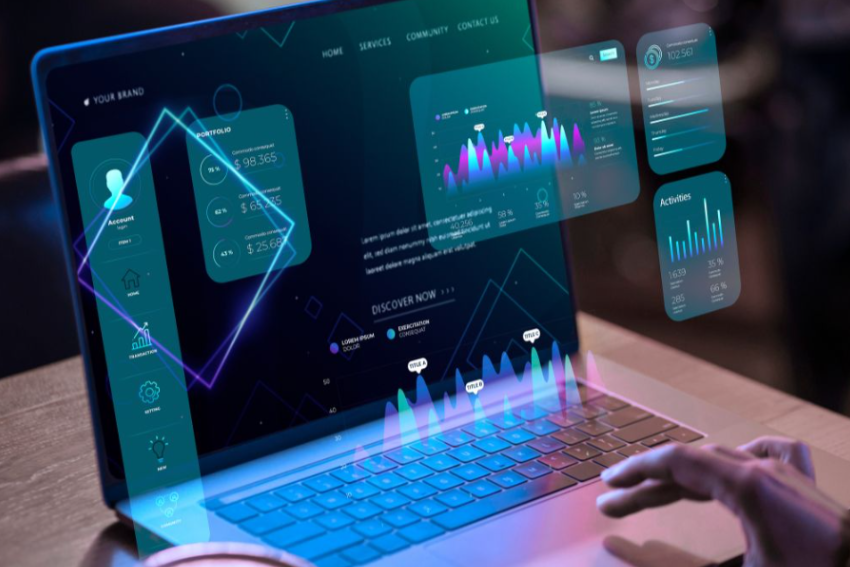
AI analytics is fundamentally changing how businesses understand their data. If you have ever stared at a dashboard full of numbers and wondered what actually caused that dip or spike, you already know the problem that AI analytics solves. Traditional analytics tells you what happened. AI analytics tells you why it happened and what to do about it before the moment passes.
Let me walk you through what this technology actually does, how it works under the hood, and why it matters for your business.
What Is AI Analytics?
AI analytics is the application of artificial intelligence—including machine learning, natural language processing, and pattern recognition—to automatically process, analyze, and interpret business data.
Think of it as giving your data a brain. One that can learn, adapt, and even predict future outcomes.
But here is what most definitions miss. The real shift is about who can ask questions and how fast they get answers. Traditional analytics requires someone to build a report before you can read it. Someone has to anticipate your question, design a dashboard, and keep it updated.
AI analytics flips this model. You ask a question in plain language. The AI figures out where the data lives, how to query it, and how to present the answer. No SQL. No dashboard building. No waiting.
Why AI Analytics Matters Right Now
Most teams do not lack data. They lack time. The average team takes one to three days just to gather data to answer a single business question. By the time you get the answer, the opportunity has passed. The campaign you could have paused kept spending. The opportunity you could have seized went to a competitor.
AI analytics closes that gap. It automates the busywork: scanning dimensions, spotting patterns, identifying anomalies, and narrowing massive datasets into a few likely drivers. Instead of spending days exploring every segment variation, you get a short list of what changed with supporting evidence.
Here is what that means in practice:
- Faster decisions. AI analyzes changes as they happen, not weeks later.
- Better questions. Traditional analytics depends on you asking the right question. AI analytics is designed to surface the question you should be asking.
- Real impact. AI connects changes to business outcomes, helping you focus on what actually moves revenue, retention, or satisfaction.
How AI Analytics Actually Works
Understanding how AI analytics works helps you see why it is so powerful. The technology operates through several layers that work together seamlessly.
The Core Technologies
- Machine learning (ML)is the engine. ML algorithms automatically scan your data for patterns and trends, build predictive models, and improve over time through feedback loops. This is what enables AI to forecast customer churn, identify shifts in consumer preferences, or predict which leads are most likely to convert.
- Natural language processing (NLP)handles the messy stuff. A lot of valuable information exists in unstructured formats—customer reviews, social media posts, support tickets, call transcripts. NLP allows AI systems to understand and interpret this kind of text data, extracting meaning and sentiment from language that was not specifically formatted for computer analysis.
- Large language models (LLMs)make it conversational. LLMs can summarize dashboards, answer plain-language questions about your data, and explain what is driving a spike in signups in terms your stakeholders can understand.
- Data integrationties it all together. AI systems need to connect to all your data sources—your CRM, your ad platforms, your finance system, your marketing tools. Without this integration, the AI cannot see the full picture.
The Analytics Lifecycle
AI enhances every stage of the analytics lifecycle:
- AI automatically collects data from APIs, logs, sensors, and files. It classifies sources and detects schema changes without manual intervention.
- This is where the real time savings happen. AI cleans, deduplicates, enriches, and transforms data. It infers missing values and standardizes formats across systems. What used to take data engineers days now happens in minutes.
- AI discovers patterns, builds predictive and prescriptive models, detects anomalies, and segments cohorts. It can analyze across more variables than any human could reasonably evaluate.
- AI auto-generates dashboards, narratives, and explanations. It highlights changes and recommends actions.
- AI provides decision support with risk scores, forecasts, and scenario analysis tailored to roles and objectives.
- AI triggers workflows, alerts, and interventions. It integrates recommendations directly into business systems.
The Three-Layer Interaction Model
When you ask an AI analytics system a question, it routes your request through three layers:
- Intelligence. The system interprets your question, understands the context, generates the appropriate queries.
- Querying. It executes those queries against live, governed data.
- Action. It synthesizes insights and can even trigger actions in downstream systems.
This happens in seconds. And the system works on live data, not stale extracts. That matters because stale data compromises both accuracy and governance.
AI Analytics vs. Traditional Analytics
Let me be clear about something. AI analytics is not a replacement for traditional analytics. It is a complement. Here is how they differ:
| Traditional Analytics | AI Analytics |
|---|---|
| You have to know what questions to ask | Surfaces the questions you should be asking |
| Depends on predefined dashboards and queries | Discovers patterns you did not know to look for |
| Analyzes historical data in batches | Analyzes in near real time |
| Requires manual data preparation | Automates data preparation and cleaning |
| Works primarily with structured data | Processes structured and unstructured data |
| Human-led and hypothesis-driven | Discovery-led and pattern-driven |
Traditional analytics is foundational. It is where teams define KPIs, standardize reporting, and keep everyone aligned on performance. But it depends on people deciding what to track and which questions to ask.
AI analytics starts with a change in outcomes and works backward to identify likely causes across hundreds of variables. It finds relationships you would never think to look for.
The strongest teams use both together—traditional analytics for measurement discipline, AI analytics for speed, scale, and pattern finding.
Types of Insights AI Analytics Delivers
AI analytics provides insights at multiple levels:
- Descriptive insights:What happened? AI summarizes trends, performance across segments, and changes over time—faster and across more variables than a human-built report.
- Diagnostic insights:Why did it happen? AI identifies and explains the drivers behind changes. It can pinpoint which segments, behaviors, channels, or features correlate with changes in outcomes.
- Predictive insights:What is likely to happen next? AI models forecast demand, churn risk, conversion likelihood, and service volume so teams can act earlier.
- Anomaly detection:What is unusual right now? AI continuously monitors and proactively alerts teams when something deviates from baseline, even when the shift is subtle or distributed across segments.
- Sentiment and text analytics:What are people saying and how do they feel? AI classifies and summarizes themes in reviews, surveys, call transcripts, and support tickets.
- Automated insights:What should I look at next? Some AI analytics systems proactively surface the most important changes and opportunities without you having to ask.
Real-World Applications of AI Analytics
AI analytics is not theoretical. Companies across every industry are using it right now.
- Sales and service.Sales reps autogenerate personalized emails tailored to customer needs. Service teams autogenerate personalized chat replies and case summaries using sales data.
- Marketers autogenerate personalized content, charts, and data visualizations to engage customers across email, mobile, web, and advertising.
- Teams autogenerate product descriptions, recommend relevant products, and create seamless buying experiences.
- Fraud detection.Financial institutions use AI to detect and mitigate fraud in real time, strengthening customer trust and improving regulatory compliance.
- Supply chain.AI systems analyze data on inventory levels, demand forecasts, and shipping conditions to optimize stock levels and reduce costs.
- Customer experience.Companies use AI agents to monitor data continuously, detect issues before customers notice them, diagnose root causes automatically, and execute responses.
The Rise of Agentic Analytics
The most exciting development in AI analytics right now is the shift toward agentic analytics. This is AI that does not just answer questions but takes action.
Here is the difference. Assisted analytics uses AI to support human-driven analysis. It generates summaries, suggests queries, and helps interpret results, but still relies on users to guide each step.
Agentic analytics goes further. It uses autonomous systems to continuously monitor data, investigate changes, and surface explanations and recommended actions without requiring manual analysis.
The market divides into three segments:
- General BI platforms with AI layers(ThoughtSpot Spotter, Sigma)
- AI-native analyst toolsbuilt around autonomous data exploration (Hex, Julius.ai)
- Embedded analytics platformsdesigned to deliver governed, customer-facing analytics at scale (Embeddable, Luzmo, Sisense)
Genuine agentic AI systems do more than answer a single question. They plan across multiple steps, call tools or APIs, and act on the results. They can autonomously build dashboards, monitor for anomalies, and even trigger actions in downstream systems.
The Challenges of Implementing AI Analytics
Let me be honest with you. AI analytics is powerful, but it is not magic. Many AI analytics initiatives fail to deliver expected value.
Here is why.
- Data quality issues.AI amplifies existing data quality problems. Organizations with weak data foundations risk generating faster but inaccurate insights. The AI might be sophisticated, but garbage in means garbage out.
- Missing business context.AI may be able to access the data, but it does not always understand how the business operates. This limits its ability to deliver trusted insights or take autonomous actions that align with how the organization actually works.
- Fragmented data landscapes.As data is copied and transformed across platforms and clouds, the definitions and relationships that once gave it meaning are often lost. Metrics conflict across dashboards and trust breaks down.
- Validation challenges.The real challenge is not building better models. It is validating outputs, defining ownership, and preventing high-confidence errors from propagating.
- The semantic layer gap.This is the single most important architectural prerequisite for accurate AI analytics. A semantic layer improves natural language query accuracy on complex queries from 0% to 70%. Without one, your AI is essentially guessing.
How to Get AI Analytics Right
The companies getting AI analytics right are not shopping for a single tool. They are building a stack where any AI can talk to their data.
Here is what that looks like in practice.
- Start with a semantic layer.This is not optional. A semantic layer preserves shared definitions, quality signals, lineage, and context. It is what separates reproducible answers from hallucinated ones.
- Govern your data.AI consumes semantic models, metrics, business calculations, and analytical logic at enterprise scale. To ensure reliable insights, you must govern not only your data but also the analytical logic that interprets it.
- Think about trust from day one.Can you trace what the AI queried, when, and on whose behalf? Regulated industries and enterprise procurement teams will ask for this.
- Balance speed with governance.Set up procedures, follow best practices, complete checklists before automated deployment, and use compliance reports to detect inconsistencies.
- Keep humans in the loop.The goal is not to replace analysts. It is to augment them. AI handles the busywork. Humans provide oversight, strategy, and context.
Final Thoughts
AI analytics is not about replacing human judgment. It is about removing the friction that keeps you from making better decisions faster. It automates the tedious work of data preparation, pattern discovery, and anomaly detection so you can focus on what actually matters: understanding your business and taking action.
The technology is mature enough to deliver real value. The question is not whether you should adopt AI analytics. The question is whether you will set it up correctly—with clean data, a semantic layer, and the right governance—so it actually works.
Because when it does work, it changes everything. You stop staring at dashboards wondering what happened. You start knowing why it happened and what to do about it. And you do it before the moment passes.
That is the promise of AI analytics. And it is finally within reach.