










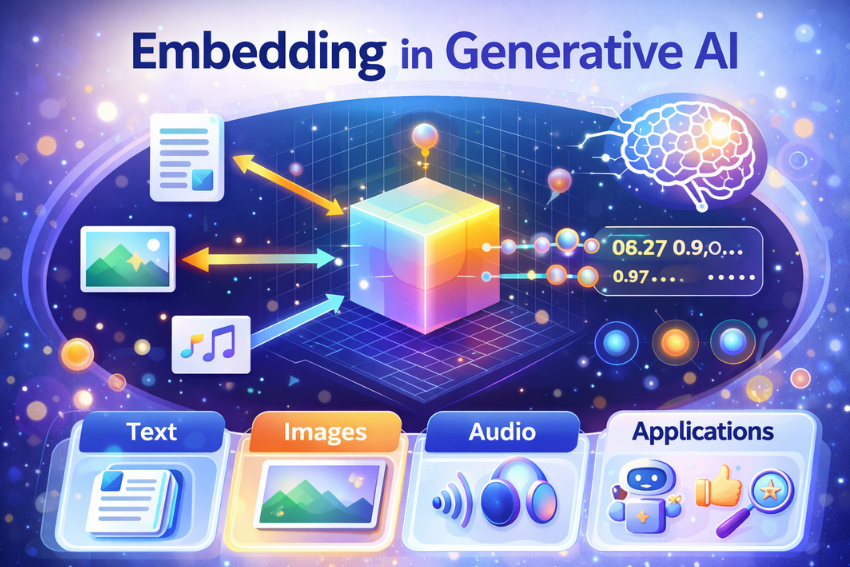
One of the most significant concepts that propel the intelligence of modern machine learning systems is that of embedding in generative AI. Embeddings are the representation behind the scenes that enable AI models to understand text, images, or even audio, in case you have ever wondered how the models do it. They serve the role of converting raw data to meaningful machine interpretation. Generative models, such as ChatGPT, DALL·E, or Stable Diffusion would fail to understand context, semantics, and relationships between various forms of data without embeddings.
In this article, we will delve into embeddings. We will deconstruct their nature, how they operate, types, their use in generative AI, and their use in various industries. By conclusion, you will understand clearly why embeddings are the core of current AI systems and how they will develop.
What is Embedding?
Embedding is a numerical description of data in a continuous vector space. Embeddings do not operate on raw words, pixels or audio signals but on dense vectors that represent semantics. As an example, the term king could be shown as a vector that is close to queen but far away from the car. The spatial relationship enables AI models to think in terms of meaning and similarity. The most important features of embedding:
Key characteristics of embedding:
- They are dense vectors, usually with hundreds or thousands of dimensions.
- They capture semantic relationships between data points.
- They allow models to perform tasks like similarity search, clustering, and classification.
How Embeddings Work
The idea of embedding is to transform discrete data into a continuous space. This is accomplished by training neural networks which teach us to encode data in a manner that maintains relationships. In the case of text, such models as Word2Vec, GloVe, or transformer-based embeddings are trained on large corpora to ensure that words with similar meanings are close to each other in a vector space. In case of images, convolutional neural networks extract features and store them in vectors.
The process involves:
- Input encoding: Raw data is tokenized or processed into a machine-readable format.
- Vector transformation: Neural networks map the input into a dense vector.
- Training objective: The model learns embeddings by optimizing tasks such as predicting the next word, classifying images, or reconstructing missing data.
- Semantic space: The resulting embeddings form a space where proximity reflects similarity.
Types of Embedding
Embedding types can be summarized into three broad categories: text embeddings that encode the meaning of language, image embeddings that encode visual characteristics, and multimodal embeddings that code a combination of multiple data types into one space.
Text Embeddings
The text embeddings are vectors of words, sentences or documents. They capture syntax, semantics, and context. Contemporary transformer architectures such as BERT and GPT generate contextual embeddings, or the encoding of a word as a result of the surrounding words.
Image Embeddings
Image embeddings are visual features. Convolutional neural networks or vision transformers identify patterns such as edges, textures, shapes and encode them into vectors. Such embeddings enable models to compare images, classify objects or even create new ones.
Multimodal Embeddings
Multimodal embeddings encode text, image, audio, or video into a common space. As an illustration, CLIP by OpenAI is a model that is trained to find embeddings matching text descriptions and images. This allows cross-modal activities such as text query searching of images or captioning images.
Role of Embeddings in Generative AI
Embeddings are at the core of generative AI since they are what enables models to comprehend and relate to one another and generate meaningful output.
Building Contextual Understanding
Generative AI is a matter of context. Embeddings do this by projecting words, images or audio into a vector space where relationships are maintained. As an example, in text generation it can be seen that the embedding of words like apple will have different meanings when applied in contexts of fruit and technology. Contextual awareness is what contributes to the relevance of AI outputs and makes them human-like.
Connecting Different Modalities
Modern generative AI can operate on various types of data. Embeddings allow the text to be aligned with images, audio with video, or even text with 3D models. Embeddings enable AI to create captions to images, create images to text prompts, or match audio to video by creating a common space of representation. Probably the most transformative facet of generative AI is this cross-modal capability.
Driving Creativity in Generation
Embeddings do not merely involve understanding. They also stimulate creativity. In a generative model, such as when generating a poem, a painting, or a piece of music, embeddings steer the process to make sure that the result of the generation process contains significant patterns and not noise. They enable the AI to mix ideas, styles, and contexts in a manner that does not seem uninspired but, at the same time, makes sense.
Enhancing Personalization
Generative AI systems may frequently require them to be tailored to a particular user. This is done through embeddings that are used to model user preferences, behaviors, and histories as vectors. These custom embeddings enable the AI to make offers, customize content, or modify the tone and style to fit certain audiences. Such personalization plays a crucial role in such areas as e-commerce, entertainment, and digital marketing.
Improving Efficiency and Scalability
The raw data is simplified into dense vectors through embeddings. This renders the generative AI models more efficient since they are able to process and produce faster. It is also scalable and enables systems to use huge amounts of data without accuracy or relevance being lost.
How Embeddings are Created
This is the process of generating embeddings that enable generative AI models to comprehend meaning, context, and relationships both in text and images and other modalities. To deconstruct the process of embeddings, we will start by breaking it down.
Data Preparation
The initial stage is to prepare raw data. In the case of text, it implies breaking up words or sentences into smaller segments. For images, pixels are converted into structured inputs. In case of audio, signals are transformed into spectrograms or frames. The preprocessing will be done properly so that the model can work with data.
Neural Network Training
Neural networks are used to learn embeddings, which are optimized with respect to certain goals. For example:
- Language models are trained to learn embeddings by making predictions based on the next word in a sequence.
- Image models are trained in embedding by classifying objects or filling in missing components of an image.
- Multimodal models learn embeddings by aligning text with images or audio.
The training process modifies weights in the network such that similar inputs are placed near each other in vectors space.
Loss Functions
Embeddings are made using loss functions. They gauge the relationship capturing ability of the model. Common approaches include:
- Contrastive loss which pushes dissimilar items apart and pulls similar items closer.
- Cross-entropy loss which helps in classification tasks.
- Triplet loss that comparisons anchor, positive and negative examples to optimize embeddings.
Dimensionality of Vectors
Embeddings are commonly modeled as vectors, and they have hundreds or thousands of dimensions. The dimensionality is selected to ensure that there is a trade-off between representation richness and computational efficiency. Higher dimensions are more detailed whereas lower are faster to process.
Pretraining and Fine-tuning
Most of the embeddings are initially trained on large datasets. This provides them with overall knowledge. They are then narrowed down to smaller domain-specific datasets to specialize in specific tasks. As an example, a language embedding trained on text can be fine-tuned to legal or medical text.
Visualization and Validation
Once embeddings are created, researchers often visualize them using techniques like t-SNE or PCA. This helps confirm that similar items cluster together. Validation ensures that embeddings truly capture semantic meaning and are useful for downstream tasks.
Applications of Embeddings
Embeddings are used across industries:
- Search engines: Improve relevance by embedding queries and documents.
- Recommendation systems: Match users with products or content based on embeddings.
- Healthcare: Embed medical records for predictive analytics.
- Finance: Detect fraud by embedding transaction patterns.
- Creative industries: Power generative art, music, and storytelling.
Advantages of Embedding
Embeddings are among the most effective artificial intelligence innovations. Embeddings are not mere technical tools in the world of generative AI. We shall examine the benefits of embedding in more detail.
Capture Semantic Meaning
Embeddings are highly effective in getting the underlying meaning of data. Embeddings do not view words or pictures as independent entities; they instead embed them in a vector space where similarities are represented by proximity. This enables the AI systems to learn that doctor and hospital are similar terms whereas doctor and mountain are not. With the integration of context, generative AI generates outputs that are natural and coherent.
Enable Efficient Similarity Search
One of the most practical advantages of embedding is their ability to support similarity search. Models can easily find the items that have the same meaning when represented as vectors. This is necessary to recommend systems, search engines and personalization. To illustrate, when a user inquiry about healthy breakfast, the embeddings allow the system to recommend oatmeal or smoothies, rather than irrelevant information.
Support Multimodal Learning
It is possible to unify various kinds of data by embedding. A shared embedding space can represent text, images, audio and video. This multimodality opens up the ability of generative AI to complete tasks such as generating captions on images, generating images based on textual cues or matching audio to video. These cross-modal interactions would not be so effective without embedding.
Improve Generalization Across Tasks
Embeddings enable models to transfer between domains. A text embedding trained model can be customized to new settings with little retraining. This flexibility minimizes the effort required to have large volumes of labeled data and speeds up the implementation of AI solutions into industries.
Reduce Dimensionality While Preserving Relationships
Raw data is frequently of high-dimensional representations, like a thousand words or millions of pixels. Embeddings reduce this data to manageable vectors without losing critical relationships. This dimension-reduction simplifies the calculation and saves time and effort without loss in accuracy.
Enhance Personalization
Embeddings may capture user preferences, behaviors and histories. With the incorporation of these signals, AI systems provide personalized recommendations, customized search results, and personalized content. This benefit comes in handy especially in electronic commerce, streaming services as well as digital marketing.
Drive Innovation in Generative AI
Generative models are based on embeddings to generate creative outputs. Embeddings ensure the contextual backdrop whether it is creating realistic images, writing like a human, or writing music. They make sure that the outputs are not arbitrary but they are directed by meaning and purpose.
Limitations and Challenges
Despite their power, embeddings face challenges:
- Bias: Embeddings may inherit biases from training data.
- Interpretability: Dense vectors are hard to interpret directly.
- Scalability: Large embeddings require significant computational resources.
- Domain adaptation: Embeddings trained on one domain may not transfer well to another.
Future of Embeddings in Generative AI
The future of embeddings will focus on:
- Dynamic embeddings: Representations that adapt in real time.
- Multimodal universality: Embeddings that unify text, image, audio, and video seamlessly.
- Bias mitigation: Techniques to reduce harmful biases.
- Personalized embeddings: Tailored to individual users for better recommendations and interactions.
- Explainable embeddings: Making vector spaces more interpretable.
Conclusion
The secret machine behind machine learning today is embedding in Generative AI. Embeddings enable AI models to perceive, generate, and relate modalities by converting raw data to meaningful vectors spaces. They hold the key to search engine application unlocking to creative content generation. Embeddings will keep on influencing the future of AI and make the systems smarter, more personalized, and more trusted.
FAQs
Why are embeddings important in generative AI?
Embeddings enable models to preserve semantic meaning, facilitating consistent and context-dependent generation of text, images and multimodal problems.
How do embeddings differ from raw features?
Raw features are direct representations like pixels or words, while embeddings are dense vectors that capture deeper semantic relationships.
Can embeddings be used across different domains?
Yes, but they should be often fine-tuned to fit into particular areas such as healthcare, finance, or creative industries.