










The way software is produced has significantly changed in the past decade. No longer do businesses generally release only a few new versions per calendar year; they are constantly releasing new versions of applications. Customer demand is increasing, and the number of development teams producing quality products has grown rapidly as well.
The rapid increase in the frequency of new software releases and machinery releases has resulted in the need for managing software and machinery development through various new methods. The two most common areas being talked about in this area of software manufacturing are DevOps and Platform Engineering; however, these two words are often confused, and thus lead to inefficiencies when implementing new software and hardware processes due to a lack of clarity with respect to responsibility.
There are people who feel that Platform Engineering is the “next” method of DevOps, while others see Platform Engineering as a separate entity from DevOps. In reality, both are similar in that their goal is to deliver superior quality software (and hardware) at quicker times and with improved productivity from developers and operational efficiency; however, their processes are distinct.
Organizations identifying transformation through technological innovation, migrating to a new Cloud service, and/or improving their individual developers’ performance will find it very important to know how DevOps and Platform Engineering differ. If you are a company that is beginning to build your first cloud-based software application, or if you’re a very large corporation that is managing large and complex systems, understanding and differentiating between the two will help your success.
What is DevOps?
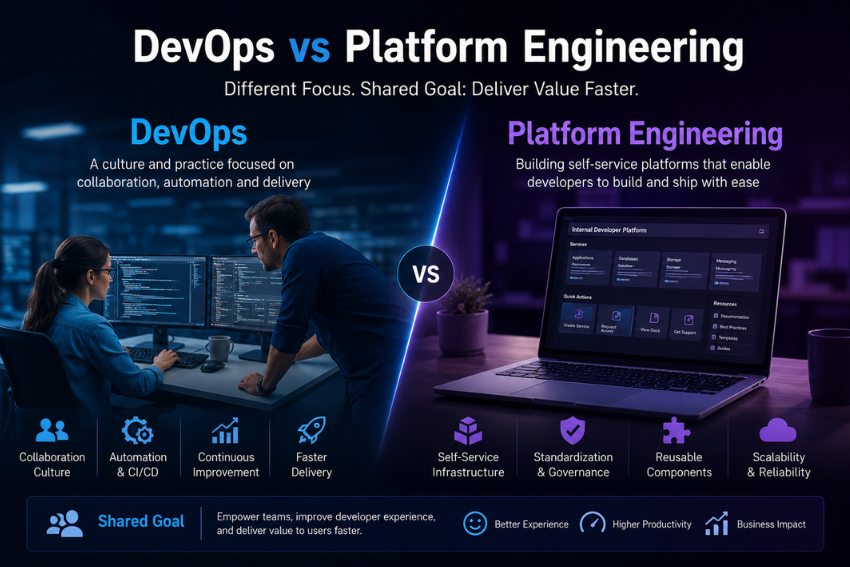
DevOps is made up of the words Development and Operations, which expresses a cultural/operational model/procedure wherein Development/software developers have access to IT Operational teams and vice versa. In the past, Development teams have only developed/built software while Operation teams have controlled/deployed/maintained/managed the infrastructure; therefore, these departments were typically separate with no interaction, creating miscommunication, delays in deployment, and Deployment failures due to no shared understanding.
In order to eliminate these separate departments creating ‘silos’, Developers and Operations Engineers will work collaboratively through all phases of software development from Planning to Coding to Testing to Deployment to Maintenance.
COR meeting the objective of DevOps is simply to accelerate the speed and increase the reliability of Software Development.
DevOps relies heavily on automation to facilitate successful Code Integration, Testing, Deployment, and Infrastructure provisioning. Automation provides businesses with faster and more consistent completion of repetitive tasks than they could have achieved prior to implementing regarding reducing the number of human resources that were necessary to complete the same tasks manually, which ultimately gives organizations the ability to push more frequent updates out with fewer mistakes.
Below are examples of regular occurrences that involve DevOps practices:
- CI
- CD
- IaC
- Automated testing
- Monitoring & logging
- Collaboration/shared ownership
Popular DevOps tools include Jenkins, Docker, Kubernetes, GitLab CI/CD, Terraform, Ansible, and Prometheus.
More importantly, DevOps is not just about tools. It is primarily a mindset and culture focused on collaboration, speed, and continuous improvement.
What is Platform Engineering?
Platform engineering focuses on the creation and upkeep of internal developer platforms for software delivery with self-service tools, infrastructure, workflows and environments. “Golden path” is a simple way to express this.
Each dev team is not responsible for cloud infrastructure, deployment pipelines, K8s clusters, security policies, or monitoring on their own; a platform engineering team will have a reusable system that can be easily consumed by the dev teams.
Building in reusable systems, it reduces complexity and allows the developer to put more effort and time into writing code rather than spending time managing infrastructure.
Common deliverables of platform engineering teams include:
- Self-Service Infrastructure
- Internal Developer Portals
- Standard Deployment Pipelines
- Pre-Configured K8s Environments
- Automation of security & compliance
- Monitoring & Observability Solutions
As there are many complexities to the modern cloud-native environment, there has been an increased importance placed on Platform Engineering. Developers continue to face many challenges with infrastructure, container orchestration, cloud configuration, and security, and the role of platform engineers is to provide abstraction from complexity through an internal platform that is easy to use.
When DevOps helps to collaborate between the dev teams and ops teams, platform engineering allows the ability for easier and better scaled collaboration.
Why Platform Engineering Became Popular
The creation of Platform Engineering is directly related to increasing the complexity of cloud-based technologies. As companies continue to use Containers, Kubernetes, Microservices, Multi-cloud architecture, & other Cloud-native technologies, developers now have a new challenge. While these technologies allow developers to scale and be flexible with their code base, they also add more work to manage the operational overhead.
In many cases, developers will now have to learn about:
- Container orchestration
- Networking
- Security Policies
- Cloud Infrastructure
- CI/CD Pipelines
- Monitoring/Observability
Due to the variety of learning opportunities available to new developers, they often become overwhelmed and face too much cognitive drain from learning various new technologies. Developers have also been spending more time managing infrastructure than creating applications. Operations teams have become overburdened, supporting multiple development teams as more teams try to use a set of technologies.
Therefore, the idea of Platform Engineering was created to help developers simplify their experience while maintaining security, governance, and operational consistency in what they build.
Many of the world’s largest technology companies (such as Netflix, Spotify, and Airbnb) have continued to prove the efficacy of this concept of an Internal Platform long before the phrase “Platform Engineering” became widely used. Today, businesses of all sizes are continuing to adopt similar methods for improving developer efficiency.
DevOps vs Platform Engineering: The Core Difference
DevOps is a collection of processes designed to enhance collaborative working efforts between development (dev) and operations (ops). These aimed at developing both the culture and processes required for successful collaboration. Platform engineering is concerned with developing tools and platforms that enable dev teams to take advantage of reusable software artifacts (such as CI/CD pipelines or repositories).
Although DevOps emphasizes improving collaboration through communication, it also provides developers with self-service access to their own infrastructure using a reusable infrastructure model developed by Platform Engineering.
The two areas/models serve different purposes but work together to create a complete lifecycle for delivering applications; they are not mutually exclusive, as many organizations use their platform engineering initiatives to enhance their DevOps efforts.
Team Structure Differences
Typically, DevOps organizations prompt very close working relationships between developers and operations engineers who work together in similar workflows, sharing many of the responsibilities for the deployment, monitoring, and managing incidents.
The aim is to reduce barriers between teams.
In a Platform Engineering approach, there is typically a separate platform team dedicated to providing internal tooling and developer platforms for all development activity in the organization.
The platform team functions as almost an internal product team, with “customers” being the developers within the organization.
The platform team collects feedback from the development team(s) regarding the tooling used within the development teams, uses this information to enhance the tooling, automate the management of infrastructure, and ensure that the systems being utilized are both secure and can scale.
This results in a more structured environment within which developers can use standardized tools without having an in-depth understanding of infrastructure.
Approach to Infrastructure
Infrastructure management is another major difference between DevOps and Platform Engineering.
Developers and operations teams often share responsibility for the infrastructure in DevOps, with developers connecting directly to cloud services, deployment pipelines, and Kubernetes config files.
While this adds flexibility, it also adds complexity.
Platform Engineering eliminates much of the complexity associated with this architecture.
Instead of configuring infrastructure components manually, Developers use simplified user interfaces and/or self-service platforms to interact with those components.
Developers are able to create Kubernetes clusters through the Internal Portal by selecting deployment options and having the Platform configure the underlying components automatically.
This increases productivity and minimizes operational errors.
Developer Experience Matters More in Platform Engineering
The experience that developers have while developing products and software has become one of the most important considerations in the world of software development, particularly since it can have a dramatic impact on productivity. By spending too much time fixing problems with infrastructure, developers will become frustrated, have slower onboarding, and also not be able to innovate at the same rate that would be normal.
Platform Engineering is focused on the developer experience.
If an internal platform is well-designed, then the developer will be able to perform many common tasks quickly, simply, and consistently. This allows developers to provision environments, deploy applications, monitor services, and access documentation – without having to waste time and effort figuring out how to get the job done.
DevOps improves developer workflows, but Platform Engineering goes one step further than DevOps in treating developers as if they are the end-users of an application or internal product.
This mindset of treating developers as users seems to be one of the main reasons why Platform Engineering is growing in popularity.
Automation in DevOps and Platform Engineering
The primary focus of DevOps and Platform Engineering is on automating functions; however, there is a difference in the goals for automating through DevOps compared to automating in Platform Engineering.
In DevOps, automation is utilized to expedite software release.
The process of automating DevOps falls under six categories:
- Automated testing of code
- Automated integration of code
- Automated deployment of code
- Automated provisioning of infrastructure
- Automated monitoring of application performance
- Automated incident response
The goal in DevOps automation is to minimize the need for manual work to increase the pace of delivering software releases.
In Platform Engineering, automated processes are focused on building reusable systems and simplifying the complexity for developers.
For example, a platform engineering team may automate the development of secure cloud-based environments, deployment templates, or observability dashboards.
Utilizing these resources allows developers to spin up resources immediately without requiring any operational knowledge to gain access to them.
Security Considerations
Security has become increasingly important in the world of modern software development.
With the evolution of DevOps over the years, there came the introduction of DevSecOps, where security practices are included as part of the overall process, versus being treated as a separate “phase” in the process of developing software.
Often, DevSecOps consists of automated security scanning, vulnerability testing, and policy enforcement.
In addition to all of this, Platform Engineering brings additional security capabilities through the ability to build out standardized environments and workflows.
By embedding security controls directly into platforms versus each team implementing their own security controls, Platform Engineering ensures security controls are implemented consistently across all teams and reduces the chance of misconfiguration.
By embedding security policies, access controls, and compliance requirements into automated deployment templates, developers are able to better govern their deployments while also simplifying compliance.
Tooling Differences
Both DevOps and Platform Engineering use many of the same tools, but how those tools are used can differ significantly.
DevOps teams often work directly with infrastructure and automation tools such as:
- Jenkins
- GitHub Actions
- Terraform
- Docker
- Kubernetes
- Ansible
- Prometheus
Platform Engineering teams may use these same tools to create internal platforms and workflows.
Additionally, they often use platform-focused tools such as:
- Backstage
- Crossplane
- Argo CD
- Internal developer portals
- Service catalogs
The key difference is that platform teams package these tools into simplified developer experiences.
Scalability and Organizational Growth
As organizations grow, assuring operational uniformity becomes ever more difficult.
DevOps practices, therefore, are more likely to work with smaller teams where communication is manageable.
As engineering organizations expand, infrastructure complexity tends to burgeon very rapidly.
Different teams may create different deployment processes, different security configurations, and different operational workflows.
This fragmentation tends to slow development down and increase operational risk.
Platform Engineering helps address this challenge by putting in place standardized systems that scale across teams.
This is particularly ideal for large organizations, as internal platforms reduce duplication and enhance consistency.
Benefits of DevOps
DevOps provides several important benefits for modern organizations.
Quicker software delivery is one of the biggest advantages. With automation and collaboration, teams can provide updates more often, respond to customer requests faster, and deliver higher quality as a result.
DevOps has also contributed to improved team communication, which in turn helps to eliminate team conflicts and improve operational bottlenecks – resulting in lower delivery timeframes compared with traditional development.
Other key benefits include:
- Faster deployment cycles
- Improved software quality
- Better collaboration
- Reduced downtime
- Increased automation
- Continuous feedback and improvement
DevOps is particularly effective for organizations aiming to increase agility and innovation.
Benefits of Platform Engineering
Platform Engineering offers a different set of advantages.
One of the biggest benefits is reduced developer complexity. Developers can focus more on building applications instead of managing infrastructure.
Other major benefits include:
- Improved developer productivity
- Standardized infrastructure
- Better scalability
- Enhanced security consistency
- Faster onboarding
- Reduced operational overhead
- Improved governance
Platform Engineering is especially valuable for organizations managing large-scale cloud-native environments.
Challenges of DevOps
While DevOps has many advantages, there are also some significant challenges.
Cultural resistance is a frequent challenge, and breaking through established silos does require an organizational shift.
Tool complexity is another issue, and managing CI/CD pipelines, automating infrastructure, and maintaining monitoring systems can be very difficult.
Many organizations also have a hard time defining the scope of support they will provide across the organization to the different teams that will work together.
If a team fails to establish a solid method for communicating and processing DevOps initiatives, it will likely lose traction until it can begin again.
Challenges of Platform Engineering
There are several challenges associated with Platform Engineering as well. It requires a lot of commitment in terms of time and expertise as well as resources. Developers may opt not to use a platform if it becomes too complex (meaning it has too much functionality). Additionally, there is also the possibility that the platform will become highly rigid, thus limiting the flexibility of the development team.
To be meaningfully successful with Platform Engineering, you must have ongoing improvement, developer input, and strong product-oriented thinking. A Platform team must understand its developers’ needs, rather than just enforcing technical standards.
Are DevOps and Platform Engineering Competing Approaches?
There are many who seek to know if Platform Engineering is a substitute for DevOps. The answer is “No.” Platform Engineering is not meant to replace DevOps but rather, it is often viewed as an evolution or expansion of DevOps principles. DevOps has laid the groundwork for collaboration, automation, and shared responsibility.
Platform Engineering builds on these concepts by developing scalable infrastructures and support for cloud-native development. Many companies utilize both methodologies at the same time; DevOps supplies the cultural foundation while Platform Engineering supplies the tools and infrastructure to enable teams to work at scale and efficiently.
Which Approach is Right for Your Organization?
Choosing the right approach for your organization is going to depend on how big and complex it is, as well as what its goals are.
In many cases, smaller organizations with fewer development teams will find they are able to get by with just implementing DevOps practices. In addition, having a direct collaboration model combined with ownership of software development assets can also work very well for smaller organizations.
Organizations that are larger in scale (many teams), have complex infrastructure, and leverage cloud native architectures generally find that they can achieve a greater advantage by integrating platform engineering into their planning processes.
If your development team is spending an excessive amount of time managing infrastructure or you see significant inconsistencies within your operational processes, you will find that by investing in internal platforms, your entire operation improves greatly.
By leveraging the advantages offered by both methods of operation, many organizations can simplify and enhance their operations, and become better able to scale as well as adopt a DevOps culture throughout their organization through building Platform Engineering capabilities.
The Future of Software Delivery
The software industry is evolving at a fast pace. Cloud Native technologies, artificial intelligence-driven operations, edge computing, and rising demands for security are changing the way applications are created and deployed today. Organizations are looking for ways to improve developer productivity while ensuring reliability and security as systems grow increasingly complex. This is one reason why Platform Engineering is experiencing such rapid growth.
However, many of the foundational elements of DevOps still apply today. Successful software delivery requires a collaborative environment, an automated approach to change, continual improvement, and collaborative accountability; all of these components play a role in achieving successful software deliveries.
As organizations develop their ability to use modern infrastructure effectively, Platform Engineering will continue to provide support for adapting the principles of DevOps. Ultimately, organizations will find success through a combined approach to both disciplines.
Conclusion
Although DevOps and Platform Engineering are closely related, they are distinct from one another.
DevOps aims to enhance collaboration among development and operations teams while accelerating software delivery using automation and shared ownership of responsibility.
On the other hand, Platform Engineering seeks to build internal platforms to simplify infrastructure management and improve the developer experience.
While both practices are designed to increase efficiency, scalability, and reliability, they address different problems.
DevOps addresses cultural and workflow challenges.
Platform Engineering focuses on managing the complexity of infrastructure and enabling developers to do their jobs efficiently.
As the complexity of modern software environments continues to grow, many organizations are finding that combining DevOps and Platform Engineering provides the most effective results.
Companies that capitalize on the strengths of both DevOps and Platform Engineering will be able to build faster, scale faster, and deliver superior developer and user experiences, ultimately enabling them to provide timely, reliable software to their customers in an increasingly complex digital ecosystem.