







Portable solar panels are among the most discussed travel accessories over the past years. Campers, hikers, and digital nomads alike have been intrigued by the idea of a clean and renewable energy source that can be carried in a backpack or RV. But are they really worth it to travelers or are they another piece of paper that shines well on a similar paper?
Here we discuss their advantages and drawbacks, brand reviews, prices, installation, and maintenance and will provide you with a full tutorial on whether or not portable solar panels should be included in your list of travel activities.
What Are Portable Solar Panels?
Portable solar panels are mini-sized versions of conventional solar panels that have been made to be portable. They are folded, rolled or packaged in light weight frames making them easy to carry. These panels are conveniently constructed and erected easily as opposed to rooftop solar systems. They are used by travelers to charge smartphones, laptops, cameras, GPS gadgets, and even small appliances. They are portable and, therefore, can be a convenient option to someone who is spending time without access to stable grid power.
Why Travelers Consider Portable Solar Panels
One of the most significant challenges that travelers have to encounter is the availability of quality electricity. This has been addressed by portable solar panels which convert the sun energy to usable energy no matter where you are.
Key reasons travelers consider them:
- Independence from grid power
- Ability to charge devices in remote locations
- Eco friendly energy source
- Cost savings compared to disposable batteries
- Peace of mind during emergencies
Advantages of Portable Solar Panels
Travelers desire to have freedom, flexibility and reliability in terms of charging their gadgets. We should discuss the main benefits of portable solar panels.
Energy Independence
Portable solar panels enable the person who is traveling to produce electricity at any place where the sun is shining. You do not have to depend on campsite shops, car batteries, or charging stations. This feature is most useful when you are camping in isolated locations or when you are walking long distances with no access to civilization.
Eco Friendly Travel
Solar energy will save the use of fossil fuels and disposable batteries. Green travelers will find the idea that portable solar panels will enable them to reduce their environmental footprint and remain able to enjoy modern conveniences appealing.
Cost Savings
The initial price of portable solar panels may be substantial, but it is cost-saving in the long term. You do not have to purchase disposable batteries, pay to charge stations or deplete your car battery. The savings will accumulate overtime, thus a good financial decision.
Emergency Preparedness
Solar panels that are movable give one a sense of security in times of crisis. You might be experiencing power outages, may get stuck during a road trip or may have to deal with some unforeseen weather and in all these situations, a good source of energy will see you through keeping communication devices charged and keeping in touch.
Versatility
The current portable solar panels can be used to charge several devices simultaneously. Most of them have USB ports, DC outlets and adapters, enabling you to charge phones, cameras, laptops and even small appliances. This flexibility has seen them be applicable to both individual travelers and groups.
Lightweight and Practical
Design has seen improvements that have seen the portable solar panels to be lighter and more convenient to carry. Foldable and flexible models can be placed in backpacks, whereas bigger rigid panels are appropriate to RVs and long road trips. Tourists are given the option of the size and the style that best suit them.
Limitations of Portable Solar Panels
Before making a purchase, travelers need to be aware of these limitations to make realistic expectations and select the appropriate panel to match their lifestyle.
Weather Dependency
Solar panels use direct sunlight to produce electricity. Their performance is diminished by cloudy skies, heavy rain or shaded environments. Visitors who spend some time in the forest or areas with unpredictable weather conditions might experience slower or unstable charging.
Slower Charging Speeds
Portable solar panels are usually slower in charging devices compared to traditional wall outlets. A mobile phone that can be charged for one hour at home can be charged in two or more hours under the sun. This reduced speed may be annoying should you be dependent on fast power surges on your journey.
Higher Initial Cost
Portable solar panels are expected to be heavily invested to bring quality. Although they end up paying less in the long run, the initial cost of buying one may seem high, particularly to passengers who make a few journeys. There are budget models, which might not be durable or efficient.
Bulk and Weight
Though most of the panels are lightweight, bigger panels, which produce more wattage, may be heavy. Backpackers can experience the burden of extra weight and RV owners can find it difficult to get space to store. It is crucial to select the appropriate tradeoff between portability and power output.
Maintenance Requirements
Solar panels that are carried around require routine maintenance to work. Scratches, dust and dirt make efficiency lower. To prevent damage, travelers should always clean panels and put them in place. It is possible to reduce the life of the panel by not maintaining it.
Types of Portable Solar Panels
Portable solar panels are more than ever before, and travelers have a variety of options. Knowing the various kinds of solar panels can help you in choosing the right panel during your adventures.
Foldable Solar Panels
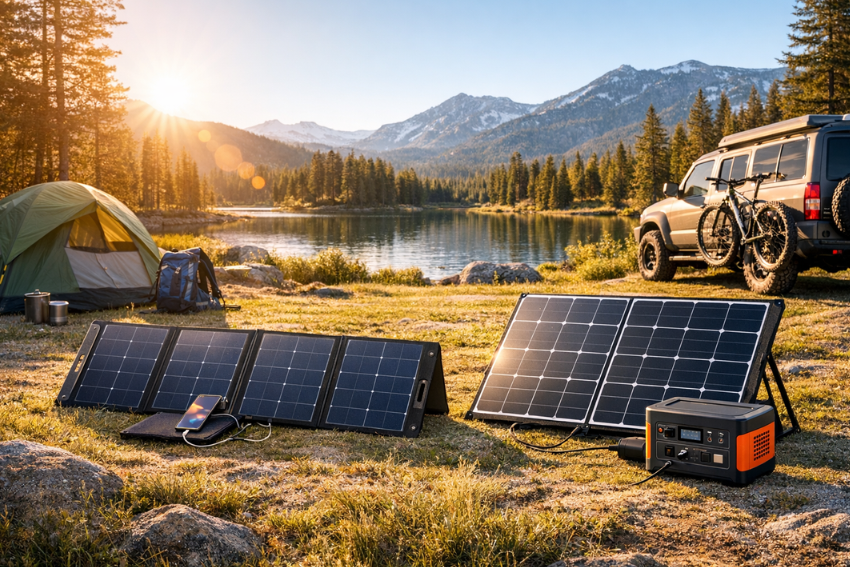
Foldable solar panels are small and can be carried easily. They are made like a book and can be put on the ground, in a backpack or in a tent. They can be carried anywhere and hence suit hikers and campers who require a lightweight solution. Despite their small size, several foldable panels can provide sufficient energy to charge phones, cameras, and GPS devices.
Rigid Portable Panels
Rigid panels are constructed using strong frames and are commonly used by RV owners or travelers who spend a long period of time on the road. They are more powerful (wattage) and last longer than foldable models. Their weight and inconvenience of transportation are compensated by their higher usefulness in the long run, and their ability to withstand harsh conditions.
Solar Chargers with Built-In Batteries
Other portable solar panels have inbuilt batteries. These models save energy throughout the day and enable you to charge the devices at night or when it is cloudy. They are ideal for travelers who require constant power without having to worry about access to sunlight. The panels and battery combine to ensure their versatility and reliability.
Flexible Solar Panels
Flexible panels are lightweight, bendable and thin. They may be fitted on backpacks, tents or even curved surfaces on cars. It can be easily used by any traveler who wishes to charge gadgets on the go. They do not offer as much power as rigid panels, but are perfect when traveling light.
Best Use Cases for Travelers
By understanding the best use cases, you can decide whether investing in a portable solar panel makes sense for your lifestyle.
Camping Trips
Campers are usually disadvantaged with limited access to electricity. Solar panels come in portable size, enabling you to power lanterns, charge cell phones and keep GPS devices going. They offer some level of comfort like when you are in the wilderness and away from shops.
Hiking Adventures
The advantage of lightweight foldable or flexible panels that can be attached to backpacks is seen by hikers. These panels produce electricity as you walk along, so that your phone or camera will be charged all the way. In the case of long walks, it can mean the difference between staying connected and dying.
Road Trips
Car batteries are frequently used to charge road trippers and can run out easily. Another source of energy is portable solar panels. They can charge laptops, cameras and small appliances without additional strain to your vehicle.
International Travel
Portable solar panels are valued by travelers who come to countries with other voltage standards. You do not need converters or adapters to use solar energy; you can use it directly to charge your gadgets. This makes it easy to travel and minimizes the chances of destruction of electronics.
Emergency Situations
Solar panels that can be carried around will be useful in case of a sudden power outage or natural calamities. They make sure that you can charge communication devices, see maps, and keep in touch with loved ones. This is a significant benefit to travelers who are concerned with safety.
Traveler’s Buying Guide
Choosing the right portable solar panel can feel overwhelming with so many options on the market. The following are the key considerations that you should take with the aim of making an investment in a panel that is keen on supporting your adventures.
Power Output
The wattage of a solar panel determines how quickly and effectively it charges your devices.
- Panels with 20 to 60 watts are suitable for phones, cameras, and GPS units.
- Panels with 80 to 120 watts can handle laptops and tablets.
- Panels above 150 watts are ideal for RVs or travelers who need to power multiple devices at once.
It is always important to ensure that the panel you are using is matching the actual amount of energy you need and not the maximum panel you can purchase.
Portability
The weight and size are important particularly to backpackers. Foldable and flexible panels are more portable whereas rigid panels are suitable in the RVs or long road journeys. Consider how much equipment you already have and select a panel that fits well into your traveling lifestyle.
Durability
Traveling outdoors subjects the panels to dust, moisture, and harsh treatment. Find models that are made of water-resistant material, reinforced edges and protective cases. Durability makes your panel perform even in harsh conditions.
Battery Integration
Panels with built in batteries or compatibility with power banks provide flexibility. They can store energy during the day and enable you to charge the devices at night or when the sun is not bright. This is of great use to those who travel a lot and are in shaded places or need unpredictable weather.
Device Compatibility
Test ports and adapters that come with the panel. USB ports are standardized however some panels provide DC outputs or laptop and camera specific connectors. It is compatible so that you do not need to carry additional adapters as you can charge all your key gadgets.
Price vs. Value
Solar panels come in a variety of cheap and expensive ones, which are portable. A cheaper panel can be cost effective in the short term but will not be efficient or may not last long. Better long-term value is normally achieved through investing in an average or quality panel. Think about how frequently you travel and how dependent you are on your devices when creating a budget.
Comparison of Top Portable Solar Panel Brands
| Brand | Best For | Key Features | Price Range |
|---|---|---|---|
| Goal Zero | Campers and RV travelers | Rugged build, modular systems, battery packs | $150–$500 |
| Jackery | Digital nomads | High efficiency, integrated power stations | $200–$600 |
| Renogy | Long road trips | Reliable rigid panels, wide wattage options | $100–$400 |
| Anker | Backpackers and hikers | Lightweight, foldable, affordable | $50–$200 |
| EcoFlow | Tech savvy travelers | Fast charging, smart app integration | $250–$700 |
Step by Step Setup Guide
The process of installing portable solar panels is simple yet when it is done properly, it is most efficient and will last longer. By doing so, travelers will have a dependable energy source wherever they go.
Step 1: Unpack and Inspect
Start with unpacking your solar panel. Test dust, scratches, or other damage. Check the cables and connectors to ensure that they are firmly in place and are not worn out. A fast check eliminates minor problems before they escalate into major problems in future.
Step 2: Position the Panel
In the direct sunlight place the panel. The positioning is important due to the fact that the slightest shading can decrease efficiency. Tilt the panel to the sun and ideally tilt it up and down with the movement of the sun. This easy modification can considerably enhance charges’ velocity.
Step 3: Connect Devices or Battery Pack
Directly attach your devices to USB or DC ports on the panel. To be more flexible, first attach a power bank or an in-built battery pack. This will enable you to save the energy at the best times of the sunshine and utilize it at a later time when the sun is not around.
Step 4: Monitor Charging
Monitor indicator lights or digital displays (assuming that your panel has them). Monitoring will help you to understand the level of energy that is produced and whether your devices are being charged correctly. There are even sophisticated panels that are linked to real time tracking apps.
Step 5: Adjust Throughout the Day
With the changing of the sun, adjust the panel to ensure the maximum exposure. This step is often missed by travelers, and it can contribute to overall performance significantly. Minor modifications can increase the energy harvested twofold.
Step 6: Store Safely
After using the panel, you can fold it or put it back into its cover. It should be kept in a dry and cool place not near excessive heat or moisture. The correct storage will lengthen your panel and it will be there at your disposal when you going out next time.
Maintenance Guide
To ensure long lasting performance, travelers should follow these tips:
- Keep panels clean with soft cloth.
- Store panels in protective cases to avoid scratches.
- Inspect cables and ports regularly.
- Dry panels thoroughly after rain.
- Keep panels in a cool, dry place.
- Reposition panels for better sunlight if charging slows.
Conclusion
Portable solar panels are more than a trendy gadget. They symbolize freedom, sustainability and practicality to the traveler who is concerned with being independent. Although they are not completely free, they can be of great benefit to outdoor lovers, road travelers, and digital nomads. The right side will allow you to have fun and not think about losing power.
FAQs
Can portable solar panels charge laptops?
Yes, more wattage panels can be used to charge laptops, though the speed of charge varies based on the amount of sunlight and the size of the panel.
Do portable solar panels work at night?
No, they require sunlight, although panels with embedded batteries can store power to be used when it is dark.
Are portable solar panels waterproof?
Most are not completely waterproof but just water-resistant, meaning that they are not exposed to heavy rain or to being soaked.
How long do portable solar panels last?
They are expected to last 10 to 15 years with proper care but efficiency declines as time goes by.
Do portable solar panels work on cloudy days?
Yes, but efficiency decreases. Panels continue to provide power however, they are slower to charge.
Can portable solar panels replace traditional power sources?
They do not substitute but complement traditional sources. To travelers, they offer backup power and autonomy, although not necessarily complete replacement of grid power.
Do portable solar panels work indoors?
No, they require direct sunlight. Use indoors is restricted unless very close to a strong source of windows.
Can portable solar panels power large appliances?
Most portable models are focused on small electronics. Light bulbs or mini fridges can be powered on high wattage panels, but not heavy appliances.
Which type of portable solar panel is best for backpacking?
The best panels that can be used in backpacking are the foldable or flexible ones, as they are lightweight and simple to carry.
Are rigid portable panels suitable for camping?
Yes, but they are more RV camping or long stay where durability and higher wattage is more valued than portability.
Are portable solar panels useful for short weekend trips?
Yes, even when you are heading on short journeys, they are convenient and self-sufficient, particularly when you are camping or hiking in the powerless regions.
Can portable solar panels be used while traveling in cities?
They are best utilized in the outside environment but may also be applicable in an urban environment in case you spend some time in parks or places with fewer charging possibilities.
How do I know what wattage I need?
Add up the power requirements of the devices you plan to charge. When you use a laptop and phone every day, strive to get at least 80 watts. In the case of small equipment, 40 watts can suffice.
Are expensive panels always better?
Not necessarily. More expensive panels may be more advanced or more powerful, however a medium range panel may be ideal, as long as it fits your travel requirements.
Do I need special tools to set up portable solar panels?
No, most panels can be easily installed and do not need tools. You just unravel, place and assemble.
Can I leave portable solar panels outside overnight?
After use, it is preferable to keep them indoors. The panel may be damaged by the moisture, dew or unforeseen weather when left outside.