










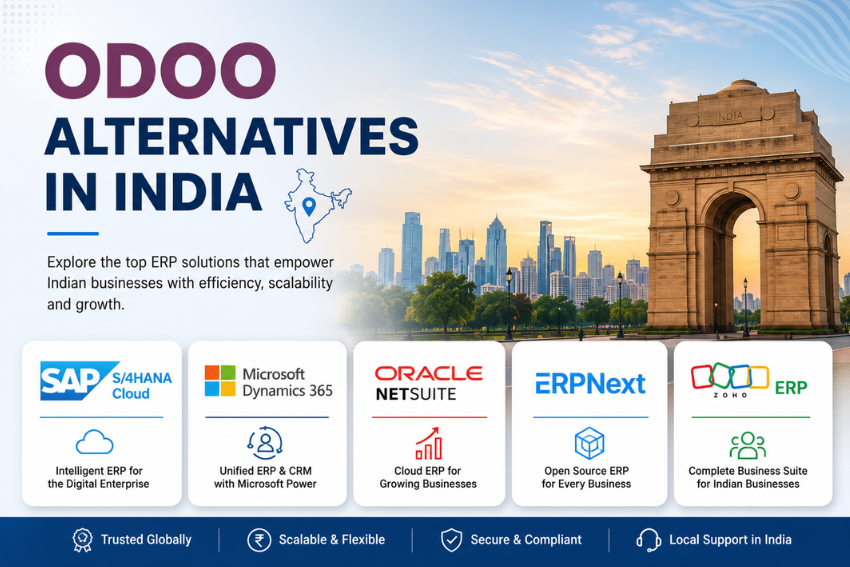
Odoo remains popular because of its modular structure and extensive customization options. However, growing organizations often explore Odoo alternatives that better align with their industry requirements, operational complexity, and expansion plans. The goal is not always replacement. In many cases, it is about identifying the platform that best supports long-term growth.
In this blog, we compare some of the best Odoo alternatives for Indian businesses and examine where each platform fits best. Factors such as AI-driven ERP solutions India, deployment models, customization flexibility, implementation effort, and long-term ownership costs will serve as the evaluation criteria.
Quick Comparison of Odoo Alternatives
This comparison examines Odoo Community Edition alternatives and other open-source ERP platforms available in India. It evaluates cloud ERP systems for SMEs, customization flexibility, and integration capabilities.
| Criteria | SAP S/4HANA Cloud | Microsoft Dynamics 365 | Oracle NetSuite | ERPNext | Zoho ERP (Zoho One) |
|---|---|---|---|---|---|
| Best For | Large Enterprises | Mid-size to Enterprise | Mid-market & Growing Businesses | SMBs & Startups | SMBs & Service Businesses |
| Deployment | Cloud | Cloud / Hybrid | Cloud | Cloud / Self-hosted | Cloud |
| Open Source | No | No | No | Yes | No |
| Core Strength | Enterprise ERP & digital transformation | Deep Microsoft ecosystem integration | Unified cloud ERP | Affordable open-source ERP | Broad business app ecosystem |
| Finance & Accounting | Excellent | Excellent | Excellent | Very Good | Very Good |
| CRM | Good | Excellent | Good | Good | Excellent |
| Inventory Management | Excellent | Excellent | Excellent | Very Good | Good |
| Manufacturing Support | Excellent | Very Good | Very Good | Good | Limited |
| HR & Payroll | Excellent | Very Good | Good | Good | Very Good |
| Customization | High (partner-led) | High | Medium–High | Very High | Medium |
| Implementation Complexity | High | Medium–High | Medium | Low–Medium | Low |
| Ease of Use | Moderate | Good | Good | Good | Excellent |
| Scalability | Excellent | Excellent | Excellent | Good | Good |
| Typical Implementation Time | Months | Weeks–Months | Weeks–Months | Days–Weeks | Days–Weeks |
| Pricing Model | Custom Enterprise Pricing | Subscription | Subscription | Free (self-hosted) / Subscription | Subscription |
| Ideal Company Size | 500+ employees | 100–5000+ | 100–2000+ | 10–500 | 10–500 |
Quick Selection Guide
- Choose SAP S/4HANA Cloud: If you need enterprise-grade ERP, global operations, manufacturing, and complex compliance.
- Choose Microsoft Dynamics 365: If your business already uses Microsoft tools and needs strong ERP + CRM integration.
- Choose Oracle NetSuite: If you want a mature cloud ERP with strong finance and inventory capabilities.
- Choose ERPNext: If you want an open-source, lower-cost alternative with flexibility.
- Choose Zoho ERP (Zoho One): If you prioritize affordability, ease of adoption, and integrated business apps.
5 Best Odoo Alternatives and Competitors in India
Below are some of the best Odoo alternatives and competitors in India, highlighting the leading ERP platforms to help businesses choose the right solution based on features, scalability, and budget.
SAP S/4HANA Cloud
For many enterprises, SAP is still among the strongest Odoo migration alternatives, especially when operations are complex across multiple business units. Its main edge is that it helps standardize processes across finance, procurement, manufacturing, and compliance functions.
Unlike many low-cost ERP solutions for Indian businesses, SAP is designed for organizations that require greater operational control and visibility at scale.
Where SAP Outperforms Odoo
- Provides enterprise-grade financial controls for large and regulated organizations.
- Supports multi-country operations with localization and compliance capabilities.
- Handles advanced manufacturing workflows with greater process depth.
- Simplifies global compliance management across business entities and regions.
AI capabilities have become a major differentiator in ERP selection. SAP continues to expand its embedded AI features across forecasting, reporting, and process management. SAP supports predictive analytics, financial automation, and data-driven recommendations across business operations.
Gartner expects AI-enabled cloud ERP adoption to increase significantly over the coming years, reflecting the growing demand for AI-driven ERP solutions in India.
Best Fit Organizations
- Large enterprises managing complex operational structures.
- Manufacturing companies with detailed production requirements.
- Multi-location businesses require centralized oversight.
- Export-oriented firms operating across international markets.
The trade-off is that SAP typically involves higher implementation complexity and longer deployment timelines. Initial investment requirements are also higher than many Odoo replacement solutions.
Businesses evaluating cloud ERP systems for SMEs or Odoo Community Edition alternatives may find SAP more complex than their current requirements.
The platform is best suited to organizations managing large-scale operations, multiple business units, and strict compliance requirements. Companies that have outgrown simpler ERP platforms often choose SAP for its depth, process control, and enterprise-level capabilities.
Microsoft Dynamics 365
Microsoft Dynamics 365 is one of the strongest alternatives to Odoo for organizations already using Microsoft products. Teams familiar with Microsoft applications often experience a smoother implementation process because the ecosystem is already part of their daily operations. Its cloud-first architecture and broad business application portfolio make it a practical choice for companies seeking operational consistency and long-term scalability.
Why Businesses Compare Dynamics 365 with Odoo
- Combines ERP and CRM capabilities within a single business platform.
- Integrates naturally with Microsoft 365, Teams, and Power BI.
- Supports cloud deployment with centralized data access across departments.
- Provides a connected environment for finance, sales, and operations teams.
- Reduces dependency on multiple standalone business applications.
A key advantage of Dynamics 365 is Microsoft’s expanding AI ecosystem. Copilot capabilities support reporting, forecasting, and routine business processes across departments. Predictive insights help teams identify trends earlier, while workflow automation reduces repetitive tasks and administrative effort.
These capabilities have strengthened Dynamics 365’s position among AI-driven ERP solutions in India focused on efficiency and data-informed decision-making.
Dynamics 365 is well suited to growing businesses, service organizations, and distribution companies managing multiple departments. It supports collaboration across finance, sales, operations, and customer service through a connected business environment.
Organizations evaluating Odoo migration alternatives often consider Dynamics 365 when scalability, Microsoft integration, and cloud readiness are higher priorities than open-source flexibility.
Organizations that have already invested in Microsoft’s ecosystem should evaluate Dynamics 365 carefully. It is a strong option for mid-sized and growing businesses that require integrated ERP and CRM capabilities, cloud-based operations, and advanced AI functionality.
Companies seeking greater standardization across departments may find Dynamics 365 a stronger long-term choice than Odoo.
Oracle NetSuite
Oracle NetSuite is widely recognized as one of the leading alternatives to Odoo for businesses planning long-term growth. Unlike many ERP platforms that evolved from on-premise systems, NetSuite was built as a cloud-native solution from the beginning.
This architecture makes it particularly attractive for organizations expanding across regions, subsidiaries, and business units.
What Makes NetSuite Different
- Built as a cloud-native platform rather than adapted from on-premise software.
- Offers strong financial management capabilities across multiple business functions.
- Supports multi-subsidiary operations from a unified environment.
- Provides centralized visibility across finance, inventory, and sales processes.
- Reduces complexity when managing business operations across different regions.
NetSuite is particularly valuable for businesses planning international expansion. It supports multi-subsidiary management while maintaining consolidated reporting across locations.
Operational visibility remains consistent as the organization grows, making NetSuite a practical option among Odoo migration alternatives for companies with ambitious expansion plans.
The ERP market is increasingly moving toward AI-assisted decision support. NetSuite supports this shift through advanced reporting, forecasting, and business intelligence capabilities.
Organizations evaluating AI-driven ERP solutions in India often consider NetSuite because it helps transform operational data into actionable insights for leadership teams.
Considerations Before Adoption
- Subscription costs are generally higher than many low-cost ERP solutions for Indian businesses.
- Successful implementation requires detailed planning and process alignment.
- Custom development may be needed for highly specialized business requirements.
- Internal teams should allocate sufficient resources for deployment and user adoption.
NetSuite is best suited to growing mid-sized businesses, multi-entity organizations, and companies preparing for international expansion. It offers strong financial management, centralized reporting, and scalable cloud infrastructure.
Businesses that have outgrown basic ERP requirements often view NetSuite as a practical long-term alternative to Odoo.
ERPNext
ERPNext has become one of the more talked about Odoo open-source alternatives, mainly for organizations that want flexibility without paying major licensing fees. Because it’s open-source at its core, it can appeal to teams that want more direct control over their ERP setup.
When companies start comparing lower cost ERP solutions for Indian businesses, ERPNext often shows up in the same breath as a few other well-known platforms.
Why ERPNext Gets Compared to Odoo
- Follows an open-source philosophy that allows greater transparency and control.
- Uses a modular architecture that supports gradual feature adoption.
- Benefits from a community-driven development approach.
- Provides flexibility for businesses with unique operational requirements.
- Offers an alternative path for organizations evaluating Odoo Community Edition alternatives.
ERPNext stands out because of its customization capabilities and ownership advantages. The open framework allows businesses to modify workflows according to operational needs.
Development flexibility also supports industry-specific requirements without excessive platform restrictions. These strengths make ERPNext one of the more practical Odoo migration alternatives for organizations seeking greater control.
Areas Where ERPNext Excels
- Suitable for cost-conscious organizations managing limited technology budgets.
- Works well for businesses with straightforward ERP requirements.
- Requires a smaller implementation footprint than many enterprise platforms.
- Supports gradual expansion as operational needs evolve.
- Appeals to organizations evaluating open-source ERP options India.
Businesses should also consider certain limitations before adoption. ERPNext operates within a smaller ecosystem than many global ERP vendors. Partner availability can vary depending on the region and project requirements.
Organizations with complex enterprise-scale operations may also require additional planning, customization, and development resources. These factors should be evaluated carefully when comparing ERPNext with other Odoo replacement solutions to ensure the platform aligns with long-term business needs.
ERPNext is best suited to small and mid-sized businesses that value flexibility, ownership, and cost control. It works well for organizations with straightforward operational requirements and limited ERP budgets. Companies seeking an open-source platform with strong customization capabilities may find ERPNext a suitable alternative to Odoo.
Zoho ERP
Zoho’s ERP expansion has become one of the most notable developments in India’s ERP market. The company has strengthened its ERP portfolio through embedded AI capabilities, predictive analytics, and banking integrations.
This focus on connected business operations has positioned Zoho among the best ERP alternatives to Odoo for organizations seeking a unified software ecosystem.
Why Zoho Is Gaining Attention
- Designed with the requirements of Indian businesses in mind.
- Offers a connected ecosystem across multiple business applications.
- Reduces operational complexity through a unified platform approach.
- Supports business growth without requiring extensive technology investments.
- Appeals to organizations evaluating practical Odoo replacement solutions.
Zoho continues to expand its AI capabilities across business workflows. Embedded AI supports routine decision-making through automated recommendations and contextual insights.
Analytics tools help organizations identify performance trends, while voice-enabled workflows simplify everyday tasks. Together, these capabilities help businesses improve efficiency and operational visibility.
These additions strengthen Zoho’s position among AI-driven ERP solutions India targeting operational efficiency.
Strengths for SMEs
- Easy for teams to adopt with minimal training requirements.
- Maintains lower operational complexity than many enterprise ERP platforms.
- Supports faster deployment timelines for growing businesses.
- Reduces the burden on internal technology resources.
- Fits organizations seeking cloud ERP systems for SMEs.
Areas to Evaluate Carefully
- Manufacturing functionality may not suit highly complex production environments.
- Advanced enterprise requirements can demand additional third-party solutions.
- Customization capabilities may differ from larger ERP platforms.
- Businesses should assess long-term scalability before implementation.
Zoho is often a stronger choice than Odoo when simplicity, deployment speed, and ecosystem integration are higher priorities than extensive customization. It is particularly well suited to small and mid-sized businesses seeking a practical ERP platform with modern cloud capabilities and expanding AI functionality.
Conclusion
The best ERP choice depends on business goals rather than feature comparisons alone. Each platform discussed in this guide addresses a different operational requirement and stage of growth. SAP is well suited to large enterprises that require strong governance and global process control.
Microsoft Dynamics 365 appeals to organizations already invested in the Microsoft ecosystem, while NetSuite is a strong choice for businesses planning expansion across multiple markets and entities.
ERPNext remains one of the more practical Odoo open-source alternatives for businesses that value flexibility and cost control. Zoho continues to attract attention from organizations seeking cloud ERP systems for SMEs with simpler deployment requirements.
As ERP buying priorities continue to evolve, businesses are placing greater emphasis on AI-driven ERP solutions, integration capabilities, and long-term scalability. The most effective Odoo replacement solutions are those that align with operational requirements, budget expectations, and future growth plans.
A careful evaluation today can reduce implementation risks and support better technology decisions in the years ahead.