









Understanding Christian denominations can feel like trying to navigate a massive family reunion where everyone shares the same last name but shows up with different customs, recipes, and inside jokes. You have the same core DNA, but the expressions of that shared identity vary wildly.
The truth is, Christianity isn’t one monolithic block. It’s a rich, diverse tapestry woven from centuries of history, theology, and cultural shifts. Today, over 2.3 billion people follow Jesus Christ, and they do so within thousands of distinct groups. But don’t let that number intimidate you. Almost all of these groups trace their roots back to just a few major traditions.
In this guide, we will walk through the major Christian denominations, exploring their origins, core beliefs, and what makes each one unique. Whether you are a curious seeker, a new believer, or a seasoned Christian wanting to understand your neighbor’s faith better, this guide is for you.
What is a Christian Denomination?
Before we dive into the different groups, let’s clarify what we mean by “denomination.”
A Christian denomination is a distinct religious body within Christianity. It is identified by specific traits like its name, organization, and doctrine. In simpler terms, it’s a particular branch of the Christian faith with its own emphasis on certain beliefs or practices.
A denomination is not a different religion. All genuine Christian denominations hold to the major tenets of the faith articulated in creeds like the Nicene Creed or the Apostles’ Creed. They all affirm the core truths: that Jesus is the divine Son of God, that He died for our sins, and that He rose from the dead.
So, why all the different names and traditions? Historically, these groups formed as believers united around Christ’s work but developed diverse expressions of worship, governance, and ancillary beliefs. Think of it like different dialects of the same language; a Texan and a Londoner speak English, but their slang and accents are quite different.
The Great Schisms: How We Got Here
To understand the current landscape of Christian denominations, you have to look back at history. The church didn’t start out divided, but over time, major fractures occurred.
The Early Church (1st–5th Centuries)
For the first few centuries, the church was a unified movement. Believers met in homes, and leaders gathered in councils to settle debates and clarify doctrine. Councils like Nicaea (AD 325) and Chalcedon (AD 451) established the foundational beliefs about Jesus’s divinity and humanity that virtually all Christians accept today.
The Great Schism (1054 AD)
The first massive split in church history is known as the Great Schism. The division was between the Western Church, centered in Rome, and the Eastern Church, centered in Constantinople (modern-day Istanbul).
- The Western Church became the Roman Catholic Church.
- The Eastern Church became the Eastern Orthodox Church.
The split happened over centuries of growing cultural and political differences, compounded by disagreements on theology. The main sticking points were the authority of the Pope and a subtle difference in the wording of the Nicene Creed. In 1054, mutual excommunications were pronounced, formalizing the division.
The Protestant Reformation (16th Century)
The next major shake-up happened in the 1500s. This was the Protestant Reformation. A German monk named Martin Luther grew deeply concerned about practices in the Roman Catholic Church, particularly the selling of indulgences (certificates that supposedly reduced punishment for sins).
On October 31, 1517, Luther nailed his 95 Theses to a church door, sparking a movement that would fracture Western Christianity forever. The reformers emphasized a return to Scripture and salvation by God’s grace alone through faith alone. This movement gave birth to Protestantism.
The Three Major Branches of Christianity
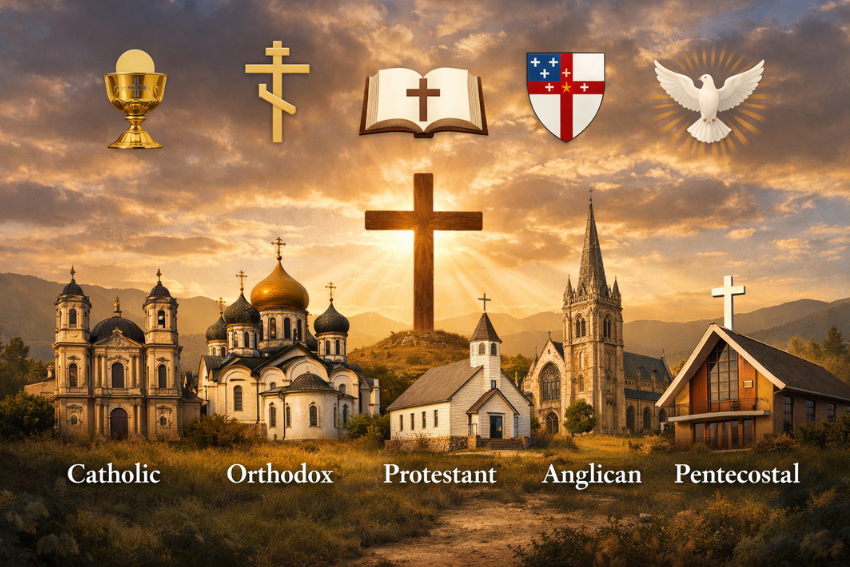
With that history in mind, we can now group nearly all Christian denominations into three main “families” or branches.
The Roman Catholic Church
With over a billion members, the Roman Catholic Church is the largest Christian denomination in the world.
- Authority: Catholics believe the Pope, the Bishop of Rome, is the successor to the Apostle Peter and the supreme authority on earth for the Church.
- Tradition and Scripture: They see both the Bible and sacred Church tradition as authoritative.
- Sacraments: Catholicism emphasizes seven sacraments as channels of God’s grace. These include Baptism, Eucharist (Communion), Confirmation, Penance (Confession), Anointing of the Sick, Holy Orders, and Matrimony.
- Mary and the Saints: Catholics hold a high view of Mary, the mother of Jesus, and the saints, believing they can intercede for us before God.
The Eastern Orthodox Church
Eastern Orthodoxy is a communion of self-governing churches (like the Greek Orthodox, Russian Orthodox, etc.) that share the same faith.
- Authority: Unlike Catholics, Orthodox Christians reject the authority of the Pope. They see him as “first among equals” (a primacy of honor, not of jurisdiction). They are led by patriarchs and councils.
- Tradition: They are known as the “guardians” of ancient tradition, placing a strong emphasis on the first seven ecumenical councils.
- Worship: Orthodox worship is famous for its beauty, mystery, and use of icons (religious images). The liturgy feels ancient and transcendent, connecting worshippers to the early church.
- Theology: They have a strong focus on theosis (becoming united with God) and the mystical encounter with the divine.
Protestantism
Protestantism encompasses a wide range of denominations that broke away from the Roman Catholic Church during and after the Reformation.
At its heart, Protestantism is defined by the “Five Solas” – Latin phrases that summarize the core convictions of the Reformers:
- Sola Scriptura (Scripture Alone): The Bible is the ultimate authority.
- Sola Fide (Faith Alone): We are saved by faith in Christ, not by good works.
- Sola Gratia (Grace Alone): Salvation is a free gift from God.
- Solus Christus (Christ Alone): Jesus is the only mediator between God and humanity.
- Soli Deo Gloria (To the Glory of God Alone): All of life is to be lived for God’s glory.
Protestants generally believe in the “priesthood of all believers,” meaning every Christian has direct access to God without needing a human priest as a mediator. This led to a radical shift in church structure and worship. Now, let’s look at the major Protestant traditions in detail.
A Closer Look at Major Protestant Denominations
The Protestant branch is the most diverse. Here are the most influential traditions you will encounter.
Lutherans
Lutherans are the direct spiritual descendants of Martin Luther.
- Core Beliefs: They hold firmly to the “Solas,” especially Sola Fide (faith alone). They believe that justification (being declared righteous before God) happens entirely through God’s grace.
- Worship: Lutheran worship often retains a formal, liturgical style similar to Catholicism but with reformed theology.
- Sacraments: They recognize two sacraments instituted by Christ: Baptism and the Eucharist (Communion). They believe Christ is truly present in the Eucharist, though they reject the Catholic doctrine of transubstantiation.
- Major Groups: In the US, you’ll find the Evangelical Lutheran Church in America (ELCA) and the more conservative Lutheran Church–Missouri Synod (LCMS).
Reformed / Presbyterians
This tradition traces its roots to the reformers John Calvin and Ulrich Zwingli in Switzerland.
- Core Beliefs: They emphasize the sovereignty of God. A key distinctive is Covenant Theology and, for some, the doctrine of predestination (the belief that God has eternally chosen who will be saved).
- Governance: Presbyterians are known for their form of church government. Power flows from the bottom up, with congregations electing elders (presbyters) to represent them at regional and national meetings.
- Worship: Worship is often simpler and less ornate than Lutheran or Catholic services, focusing heavily on preaching.
Anglicans / Episcopalians
Anglicanism finds its origins in the Church of England, which broke from Rome in the 16th century under King Henry VIII.
- The “Middle Way”: Anglicans often describe themselves as a via media (middle way) between Catholicism and Protestantism.
- Worship: They have a very liturgical and traditional style of worship, using the Book of Common Prayer.
- Theology: They accept the core Protestant doctrines but retain many Catholic structures like bishops. The Episcopal Church is the American branch of Anglicanism.
Baptists
Baptists emerged as a dissenting group from the Church of England.
- Core Beliefs: Their most defining belief is believer’s baptism. They reject infant baptism, arguing that only individuals who have made a conscious confession of faith should be baptized (usually by full immersion).
- Church Government: They are fiercely congregational. Each local church is autonomous and governs itself, not answering to a higher bishop or presbytery.
- Scripture: They hold a very high view of the Bible’s authority, often advocating for a literal interpretation.
- Major Groups: The largest Baptist group in America is the Southern Baptist Convention (SBC).
Methodists
Methodism began as a movement within the Anglican Church in the 18th century, led by John and Charles Wesley.
- Core Beliefs: Methodists share the core Protestant beliefs but are famous for their emphasis on practical holiness and social justice.
- Theology: They believe in prevenient grace (God’s grace that goes before us) and that believers can experience a “second blessing” of entire sanctification (being made perfect in love).
- Governance: They have a connectional system where churches are linked together in circuits and conferences, led by bishops.
Pentecostals
Pentecostalism is a relatively modern movement, born out of the Holiness movement in the early 20th century.
- Core Beliefs: They emphasize the work of the Holy Spirit and the “gifts of the Spirit,” such as speaking in tongues, prophecy, and divine healing.
- Worship: Pentecostal worship is known for being highly energetic, expressive, and emotional. Services often feature contemporary music and spontaneous prayer.
- Growth: This is one of the fastest-growing branches of Christianity globally. The Assemblies of God is a major Pentecostal denomination.
Anabaptists
The Anabaptists were part of the “Radical Reformation.” They felt the main reformers hadn’t gone far enough in separating the church from the state.
- Core Beliefs: They are known for their commitment to pacifism (non-violence), separation of church and state, and adult baptism (“re-baptism” – which is what “Anabaptist” means).
- Groups: Modern Anabaptist groups include the Mennonites, the Amish, and the Brethren. They are known for their simple lifestyle and emphasis on community.
Nondenominational Churches
In recent decades, there has been a surge in “nondenominational” churches.
- Core Beliefs: These are independent congregations that choose not to affiliate with a traditional denomination. They often hold evangelical beliefs but want to avoid the “baggage” of denominational labels.
- Worship: Their worship style is usually contemporary and seeker-sensitive, designed to be accessible to non-believers.
- Growth: Non-denominational churches represent a significant and growing portion of the Protestant landscape in the US.
Key Areas of Difference
So, how do these groups differ in practice? Here’s a quick look at the major points of divergence.
Baptism
- Catholics, Orthodox, Lutherans, Anglicans, Methodists: Practice infant baptism (paedobaptism), believing it incorporates the child into the Christian community and is a sign of God’s covenant.
- Baptists, Pentecostals, Anabaptists: Practice believer’s baptism (credobaptism), insisting that only professing believers should be baptized.
Communion (The Eucharist)
- Catholics: Believe in transubstantiation – the bread and wine literally become the body and blood of Christ.
- Lutherans: Believe in consubstantiation – Christ is truly, physically present “in, with, and under” the bread and wine.
- Reformed/Presbyterians: Believe in a spiritual presence – Christ is spiritually present to the believer through the sacrament.
- Baptists/Pentecostals: View communion as an ordinance or a memorial – a symbolic act of remembering Christ’s death.
Church Government
- Episcopal (Catholic, Orthodox, Anglican, Methodist): Governed by bishops.
- Presbyterian (Presbyterians): Governed by a hierarchy of elders (presbyters).
- Congregational (Baptists, many Nondenominational): Each local church is autonomous and governs itself.
Christian Denominations in America Today
To put this all in perspective, let’s look at the numbers in the United States.
According to recent data, about 66% of Americans identify as Christian. However, the landscape is changing.
- Protestants make up the largest group, with about 40% of U.S. adults. This includes Evangelical Protestants (23%) and Mainline Protestants (11%).
- Catholics account for about 19% of U.S. adults.
- Other Christian groups (including Orthodox, Latter-day Saints, and Jehovah’s Witnesses) total about 3%.
It’s also worth noting that the number of Americans with no religious affiliation (the “nones”) has been growing, now sitting at about 28%. Among younger Americans, this number is even higher.
Final Thoughts
Navigating the world of Christian denominations can be daunting. But hopefully, this guide has helped you see the forest for the trees. While there are many different branches, they all grow from the same root: faith in Jesus Christ.
The differences in worship style, church government, and secondary doctrines are important, but they are not what define a Christian. At the end of the day, a Christian is someone who has put their trust in Jesus. Understanding these denominations isn’t about deciding which one is “right” and which ones are “wrong.” It’s about appreciating the beautiful diversity within the body of Christ and finding a community where you can grow in your faith and serve others.