










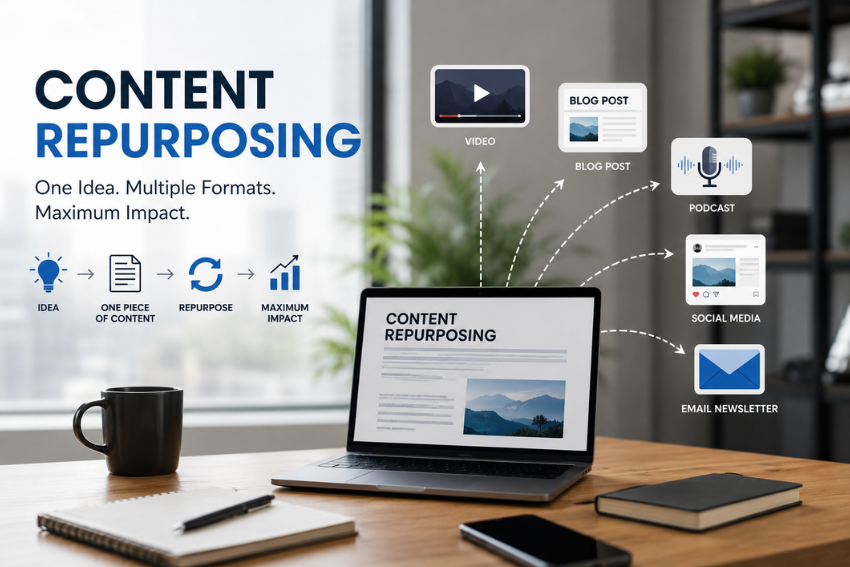
Let’s face it for now. The majority of content teams are caught in a vicious cycle. They spend hours on creating a great blog post, hit publish, post it a couple of times on social media and move on to the next thing. It seems like a good idea to produce content, but it’s actually one of the least productive ways to operate a marketing machine. This is all reversed with a smart content repurposing strategy. Rather than being on a search for new content ideas, you repurpose the material you’ve already created into blog posts, social media posts, newsletters, videos, and any other type of content that is relevant to your business. It’s not solely about content creation. It’s making better use of each and every thing that you already own.
With this done correctly, the outcomes are incredible. Schematic recycling teams gain up to 300% in reach and save 60-80% of the time they are otherwise occupied in developing original content. This is more than just an efficiency increase. This is a competitive edge. Let me show you how to create a content repurposing strategy, not just in theory, but in practice, with short attention spans and demanding algorithms.
What is Content Repurposing?
Content repurposing involves using a single piece of content and transforming it into various formats to reach multiple audiences in different channels. This is the definition in the books. However, most people don’t understand it at all in reality.
This is something I used to do, too. I would write a blog post, chunk it up into a few social media posts, perhaps make a paragraph a LinkedIn post and then I would call it a day. In theory, it seemed to me I was optimizing my existing content. The truth is that I was promoting the same message on various platforms and making virtually no difference.
Repurposing isn’t a copy and paste operation. It’s about change. You can take an idea and mold it to the way people actually consume content on each platform. Audiences, expectations, and formats are all different.
Think of it like this: Cross posting is sharing something as-is on another platform. Reposting is sharing the same post on the same channel. Repurposing is the creation of something truly new out of content. One is lazy. The other is a strategic approach.
Why Your Current Approach Is Failing
The majority of creators don’t have a content issue. They have a content problem with their life span. They’ve spent hours shooting a product review, writing a detailed guide, or recording a podcast episode. Content is published, runs for a few days and then gets lost in the feed.
The hard reality is that algorithms are increasingly favoring consistency, engagement with the audience, watch time, and repeat engagement as opposed to one-time viral hits. When you consider every content as a standalone production, you are going against the system.
They are not necessarily creating more content – the creators who are winning right now are the creators who are winning right now. They are learning to maximize value from each project that they complete. They realize that one project can be a week, if not months, of strategic content release.
How to Build Your Content Repurposing Strategy
Creating a successful content repurposing strategy is not difficult; it just takes some strategy. Here is a step by step plan that is effective.
Step 1: Find Your Source Content
The best material is likely the things that are not content that you didn’t even think of. The email you wrote to the new customer and received a reply “this is so helpful, thank you”? That is content. The consultation that you took someone through a very difficult decision and they finally understood? Content. The lengthy response you gave in a Facebook group when you disagreed with some comment you felt strongly about at 11 p.m.? Definitely content.
Allocate an hour and sift through all that you have produced in the previous year. Check blog posts, client consultation notes, podcast or video recordings, webinar material, or explanations in emails, course material, and/or training docs. You want 10-15 substantial items.
Not everything will be worth repurposing. Score each piece on three things:
- Could someone find this advice in the first Google result, or is this genuinely yours?
- Would your audience actually stop what they are doing to read it?
- Will it still matter in six months, or is it tied to a moment that has already passed?
Rate each one on a scale of 1 to 3. Your highest scorers are where you start.
Step 2: Map Your Content Across Channels
After determining where your best content is, you must have a strategy for each piece and how it may be adapted for various platforms. It’s a practical example:
Blog
Your hub is the original long-form content. Link to blogs from social posts, e-mails, and video descriptions and use them as a resource library. Optimize blogs for SEO to generate organic traffic and build the groundwork for repurposing later.
Social Media
- Instagram and Facebook: Turn blog insights into carousel posts, infographics, or short captions. Highlight key statistics or tips in visually engaging formats.
- LinkedIn: Post professional insights, quote highlights, or lessons learned. LinkedIn audiences value actionable advice and thought leadership.
- TikTok and YouTube Shorts: Repurpose single tips or case study examples into short video clips. Storytelling and demonstrations work well.
- X (Twitter): Share concise takeaways, ask questions based on your blog content, or create threads summarizing insights.
Email Marketing
Leverage blog snippets or video highlights for newsletters as learning resources. Have clear call-to-actions with links to the full blog or other related resources.
Also Read – 10 Email Marketing Tips to Increase Click-through Rates & Get Leads
Video and Visual Content
One long video may be broken down into several short clips each highlighting a single key moment or insight. Research, case studies, and tutorials are more effective when broken down into concise and easy-to-digest insights, proof points, visuals, or step-by-step posts.
Step 3: Think in Terms of the 1-to-20 Framework
One of the easiest ways to think about repurposing is through the 1-to-20 framework. A single project can generate:
- One YouTube video
- Three to five TikTok clips
- Three to five Instagram Reels
- Five Pinterest Pins
- One Amazon Idea List
- One livestream recap
- Multiple product-focused clips
- Several audiences poll
- Community discussion posts
- A blog article or newsletter
Suddenly, one filming session becomes 20 or more pieces of content. That is not about working harder. It is about working smarter.
SEO Benefits of Content Repurposing
Repurposing is not all about social media coverage. It offers real SEO benefits as well. By generating several pieces of content using the same keywords on various channels, you can build more of a digital presence and improve your search engine rankings.
Google is not interested in fresh content compared to repurposed content. It considers the type of content that it is answering the question. However, if the content you repurposed is the best answer, it will rank, whether it is brand new or adapted from an existing piece of content.
The key to success in AI search and traditional search results is understanding what AI models such as ChatGPT and AI Overviews value:
- Content freshness: Content published in the last five years receives 94 percent of LLM crawler hits. Update content with new data, stats, and examples to keep it current.
- Original data: Content that includes statistics and qualitative statements results in 30 to 40 percent higher citation rates. Incorporate first-party data, research, or internal analysis wherever possible.
How to Optimize for GEO and AEO
Search is changing. Ranking is no longer the only thing that’s important. Answer Engine Optimization (AEO) involves optimizing content to ensure that AI systems can easily pull the content out and provide it as an actual answer to the query. Generative Engine Optimization (GEO) is about AI engines being able to retrieve and cite content.
Here is how to optimize your repurposed content for both:
- Structure for answers: Use clear headings, direct definitions, and concise summaries. AI engines love content that gets straight to the point.
- Include expert quotes: Most AI tools prioritize content with subject matter expert quotes, complete with name, title, and credentials.
- Highlight key insights: Pull out one clear moment, answer, or insight from each piece of content and make it the centerpiece of your adapted format.
Common Mistakes to Avoid
After years of watching teams try to implement a content repurposing strategy, I have seen the same mistakes happen over and over. Here is what to watch out for:
- Repurposing without adapting: Content usually fails when it is reused without adjusting it to match how people consume content on each platform. A LinkedIn post should not read like a blog post. A TikTok video should not feel like a webinar.
- Starting from scratch every time: If you are constantly creating new content and never revisiting what you already have, you are leaving massive value on the table. The most successful marketers are not necessarily creating more content. They are extracting more value from every piece they create.
- Trying to be everywhere at once: You do not need to be on every channel. Focus on platforms where your audience is active and where you have the bandwidth to maintain quality.
- Ignoring the 5-to-1 rule: Aim to create at least five smaller social media posts from every single long-form piece of content. If you are not doing this, you are leaving reach on the table.
Making Repurposing a Sustainable Workflow
The key to successful long-term content reuse is to incorporate it into your work practices from the beginning. Consider reusing content early in the content development process. If you have a blog article to compose, make a video at the same time. If you’re shooting a tutorial, shoot B-roll and alternate shots of your subject.
Standardize templates, use automation tools and have defined collaboration checkpoints to be efficient and consistent. The aim is to provide an easy, realistic way to do repurposing, not another chore on your to-do list.
Final Thoughts
Content repurposing is one such strategy that seems easy on paper, but is a hard-to-follow one if not done well. It’s easy to just copy and paste and say, “done.It’s easy to do the copying and pasting and say, “done. But those who do not succumb to that temptation and invest in creating a content that is truly optimized for the various platforms are rewarded with the big returns.
Don’t consider each piece of content a one-off event. Consider your content as something that can continue to be useful for weeks, months or even years after you’ve created it. That’s the way to get the most reach. That’s how you save time. This is the way to create a sustainable content operation which really makes a difference.
Now check your content archive I tell you to that your seat is so much more valuable than what you think.