










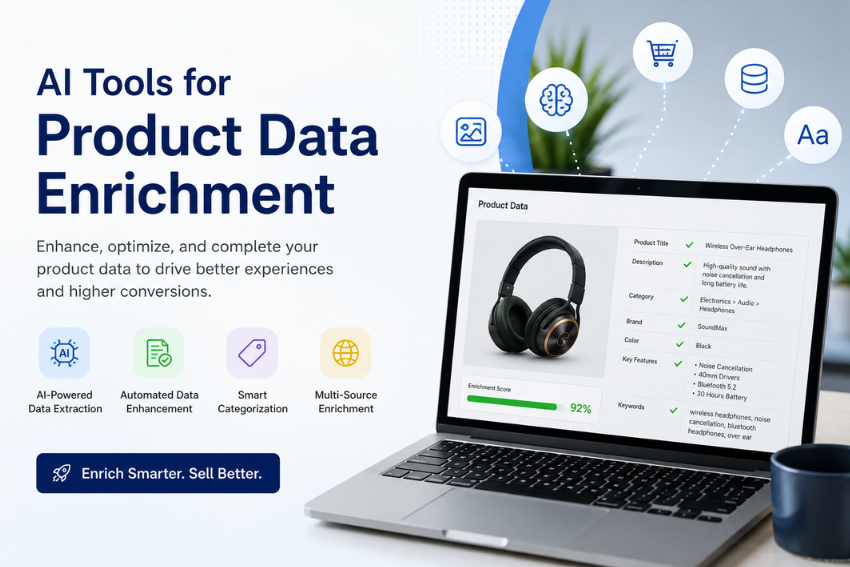
AI tools for product data enrichment have completely changed how online retailers manage their product catalogs. You no longer need a team of dozens manually filling in missing specs, rewriting boring descriptions, or fixing inconsistent size charts. Smart software now handles all that heavy lifting in minutes.
But here is the catch. Not every AI tool delivers the same results. Some just guess attributes poorly. Others integrate so smoothly you will forget they are even running. So which ones actually work for real ecommerce businesses?
I have tested dozens of platforms, talked to operations managers, and dug into the numbers. Below I break down the best AI tools for product data enrichment, what makes each one special, and how to pick the right fit for your store.
Let us get straight into it.
Why Your Ecommerce Business Needs AI for Product Data Enrichment
Think about your last product upload. Maybe you had a spreadsheet with 10,000 rows. Some rows had color as “Red.” Others said “Scarlet” or “Red color” or even “Rouge.” Your size options varied between “M,” “Medium,” and “Med.” That inconsistency kills your internal search and confuses customers.
Manual cleanup takes forever. A study from Gartner shows that poor data quality costs businesses an average of $12.9 million per year. For ecommerce, the damage shows up as lost sales, higher return rates, and terrible filter experiences.
AI fixes these problems by:
- Standardizing product attributes like color, size, material, and brand
- Generating SEO friendly titles and descriptions from raw data
- Categorizing products automatically into correct taxonomies
- Detecting and merging duplicate product listings
- Translating product content into multiple languages with local nuance
The best part? You set it up once, and the AI learns from your corrections. Over time, it gets smarter about your specific catalog quirks.
What to Look for in AI Tools for Product Data Enrichment
Before we jump into the top picks, let us talk about selection criteria. Not every tool suits every business. Here is what actually matters.
- Integration ease.Does the tool connect directly to your PIM, ERP, or ecommerce platform like Shopify, Magento, or BigCommerce? If you need custom API work for basic imports, walk away.
- Accuracy on edge cases.Test how the AI handles weird product types. A great tool will correctly identify “vegan leather” as material type “PU” and not just “leather.” Mediocre tools make embarrassing mistakes.
- Customizable rules.You need to override the AI when it gets things wrong. Look for a tool that lets you set manual rules like “always map ‘faux fur’ to material ‘synthetic.’”
- Some tools work fine for 5,000 products but crash at 500,000. Check their enterprise case studies.
- Pricing transparency.Beware of vendors that hide costs behind “request a quote” buttons. The best tools offer clear per product or monthly subscription tiers.
Now let us examine the top performers.
Top 5 AI Tools for Product Data Enrichment You Should Try
I have ranked these based on real world performance, ease of use, and value for money.
Syte – Best for Visual Product Enrichment
Syte stands out because it focuses on visual data. Instead of just reading text attributes, it analyzes product images to extract missing details. Upload a photo of a dress, and Syte will detect neckline style, sleeve length, pattern type, and even fabric texture.
This becomes invaluable when your suppliers send you only images without spec sheets. Syte’s computer vision fills the gaps automatically. The platform also includes a tagless enrichment feature that assigns up to 30 attributes per image.
Key features:
- Visual attribute extraction from product photos
- Automatic color palette detection (Pantone codes included)
- Out of stock product recommendations based on visual similarity
- Real time enrichment as you upload new inventory
Pricing: Starts at $499 per month for up to 10,000 product variants. Custom enterprise plans available.
Best for: Fashion, home decor, and any vertical where visual details drive purchase decisions.
Akeneo PIM with AI Enrichment Add On – Best for Mid Market Catalogs
Akeneo already dominates the product information management space. Their AI enrichment add on, called Akeneo Onboarder AI, automates the boring parts of data cleaning. You feed it a messy spreadsheet, and it suggests standardized values for each column.
What I love is the human in the loop approach. The AI flags uncertain matches and asks for your confirmation. Over time, it learns your specific mapping preferences. For example, if you always correct “ladies” to “women’s,” the AI remembers that rule permanently.
Key features:
- Smart category mapping across multiple sales channels
- Automated duplicate detection and merging
- Bulk editing with AI suggested corrections
- Connectors for Shopify, Amazon, and Google Shopping
Pricing: Starts around $1,000 per month for the PIM plus extra for AI features. Not cheap, but powerful for serious operations.
Best for: Companies already using or planning to adopt a PIM system. The AI feels like a natural extension.
Plytix AI – Best for Small to Medium Brands
Plytix offers a refreshingly simple take on product data enrichment. Their AI tool, called Attribute Assistant, lives inside their free tier PIM. Yes, free. You can enrich up to 500 products without spending a dime.
The AI focuses on two main jobs. First, it standardizes attribute values. So “XL,” “Extra Large,” and “X Large” all become “XL” in your catalog. Second, it generates SEO meta data from existing product descriptions.
Plytix does not have the fancy computer vision of Syte, but for basic text enrichment, it gets the job done without breaking your budget.
Key features:
- Attribute value normalization
- SEO title and description generation
- Bulk import from CSV or Google Sheets
- Integration with Canva for automated product image templates
Pricing: Free tier for up to 500 products. Paid plans start at $79 per month for unlimited products.
Best for: Bootstrapped brands and small teams who need a no fuss enrichment tool.
Edgecase (formerly Wiser) – Best for Competitive Enrichment
Edgecase takes a different approach. It does not just clean your data. It compares your product attributes against top competitors. You see exactly where you are missing specs that rivals provide.
For example, if you sell electronics, Edgecase scans competitor listings and tells you that most competitors list “battery life in hours” but your catalog omits that attribute. The AI then pulls probable values from public data and suggests you add them.
This competitive angle gives you an edge. You stop guessing what customers want to know. You just copy the winning playbook of market leaders.
Key features:
- Competitor attribute gap analysis
- Automatic enrichment from public product data
- Price and availability tracking with enrichment
- REST API for custom workflows
Pricing: Custom quote based on catalog size and competitor set. Expect $800+ per month.
Best for: Retailers in highly competitive niches like consumer electronics, home appliances, or auto parts.
DataFeedWatch by Cart.com – Best for Feed Optimization
DataFeedWatch started as a feed management tool for Google Shopping. Over the years, they added serious AI enrichment capabilities. Their Smart Mapping feature uses machine learning to match your product data to marketplace requirements.
Say you sell on Amazon, eBay, and Facebook Shop. Each platform wants different attribute formats. DataFeedWatch’s AI learns the mapping rules for each channel and transforms your master data on the fly. You never manually reformat anything again.
The tool also includes AI generated product titles optimized for each marketplace’s search algorithm. Amazon titles get keywords upfront. Google Shopping titles highlight price and brand.
Key features:
- Channel specific attribute mapping
- Automated product categorization
- Bulk find and replace with regex support
- Real time feed updates as you change source data
Pricing: Starts at $59 per month for up to 2,000 products. Scales to $299 for 100,000 products.
Best for: Multi channel sellers who need different data formats for each marketplace.
How to Implement AI Product Data Enrichment without Breaking Your Workflow
Throwing AI at your catalog sounds great, but bad implementation leads to frustration. Follow these steps for a smooth AI data enrichment.
- Start with a small sample.Pick 500 products from one category. Run them through your chosen AI tool. Manually review the output. You will catch weird errors before they infect your whole catalog.
- Set up a validation loop.Create a simple spreadsheet where you flag incorrect AI suggestions. Once a week, feed those corrections back into the tool. Most AI systems learn from your feedback.
- Enrich in stages.Do not try to fix everything at once. First, standardize color and size attributes. Next, generate missing descriptions. Finally, work on advanced attributes like material composition or warranty information.
- Keep your original data as a backup.Export your raw product data before enrichment. Store it somewhere safe. You will thank yourself later if an update goes wrong.
- Test search and filter performance.After enriching, check your site search. Type in synonyms like “trainers” for “sneakers.” See if the AI handled those mappings correctly. Also verify that filters show the right number of products for each attribute value.
Real Results: What AI Enrichment Can Do for Your Bottom Line
I have seen three types of measurable wins from proper AI enrichment.
- Search conversion lifts. When customers find what they want on the first search attempt, conversion rates jump by 30 to 50 percent. AI enriched attributes power faceted search and autocomplete.
- Lower return rates. Wrong sizes and colors cause returns. If your size chart data is clean and consistent, customers pick correctly the first time. One footwear brand reduced return rates by 22 percent just by standardizing size attributes across 15,000 SKUs.
- Faster time to market. Manual data enrichment takes hours per thousand products. AI does the same work in seconds. You launch new collections faster and beat competitors to seasonal trends.
Final Thoughts on Choosing the Right AI Tools for Product Data Enrichment
No single AI tool fits every situation. Start by auditing your current product data. Where do you see the biggest mess? Missing attributes? Inconsistent values? Bad product titles? That weakness guides your tool choice.
For visual heavy catalogs like fashion or furniture, pick Syte. For competitive intelligence, go with Edgecase. For small budgets, Plytix works wonders. And if you manage feeds for dozens of marketplaces, DataFeedWatch is your friend.
The worst move is doing nothing. Every day you delay enrichment; your customers suffer through bad search results and missing product details. Meanwhile, your competitors use these same AI tools to pull ahead.
Pick one tool from this list. Test it on 500 products this week. Measure the difference. I promise you will never want to manually clean another spreadsheet again.