









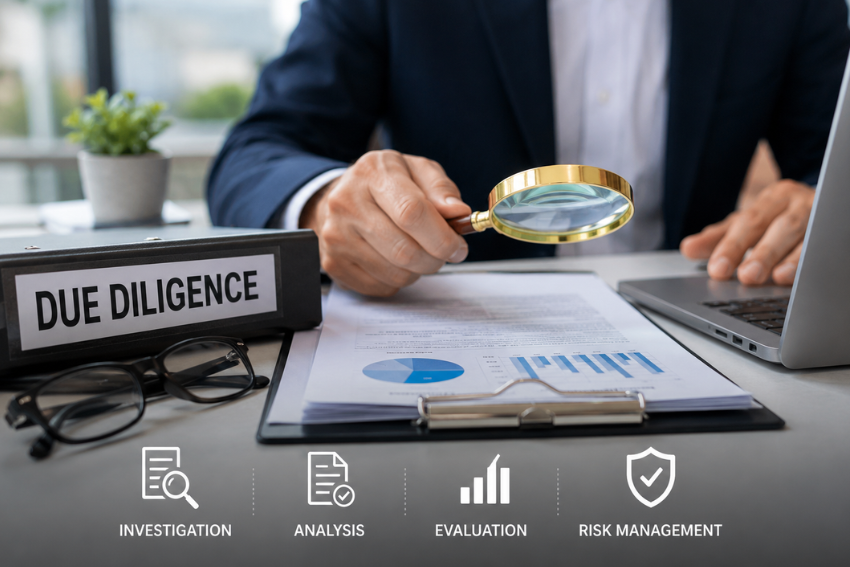
In the world of business, the key to a successful transaction is due diligence. This in-depth investigation process is designed to help you discover potential risks, confirm facts and make informed decisions—whether you are buying a company, entering into a strategic partnership or making a large investment. Due Diligence isn’t something just done for the sake of doing it, it’s a comprehensive process designed to safeguard your interests and get the best value.
We will be discussing in this guide the essential parts of due diligence, what its benefits are and showing you how to do it step-by-step. We’ll also explore how emerging trends such as AI and ESG are transforming this pivotal business practice.
What is Due Diligence?
Due diligence is the in-depth examination and evaluation that individuals and organizations undertake prior to a business deal. That involves looking through a target company’s legal framework, financial status, operations, and compliance record, among other aspects, to identify potential issues and ensure the transaction is a good fit.
This process is a vital aspect of mergers, acquisitions, investments, and partnerships. Its purpose is to provide decision makers with all of the facts before putting capital or resources to work. It is a general concept that applies to corporate law, private equity, real estate, and investment transactions.
Why Due Diligence Matters
It protects all parties in a transaction by:
- Identifying risks: Uncovering legal, financial, or operational issues before they become costly problems.
- Confirming value: Verifying that the target company is worth the proposed price.
- Supporting negotiation: Providing evidence to negotiate terms, pricing, or indemnities.
- Meeting regulatory requirements: Many jurisdictions and industries require due diligence as part of compliance obligations.
- Protecting against fraud: Surfacing discrepancies between what is represented and what the records show.
Types of Due Diligence
Typically, it is divided into several categories, each of which focuses on a specific component of the due diligence assessment for the target company or transaction.
Financial Due Diligence
Financial due diligence is the cornerstone of the DD process. It takes a detailed review of the company’s financial statements, such as its balance sheet, income statement, and cash flow statement. To validate reported numbers and ascertain financial risks.
Key areas of focus include:
- Analysis of earnings quality and sustainability
- Review of revenue, profit, and margin trends
- Assessment of assets, liabilities, and debt obligations
- Tax returns and related documentation
- Financial projections and budgets
Financial due diligence helps answer critical questions about hidden costs, legal dispute costs, and the investment required. It typically involves analyzing audited financial statements from the past three to five years, profit margins, ratio analysis, and internal control procedures.
Legal Due Diligence
Legal due diligence examines a company’s corporate records, contracts, litigation history, intellectual property, and regulatory compliance. It seeks to examine the legal basis of a transaction and ensure that a target business holds or can exercise the intellectual property rights it claims.
Key areas include:
- Articles of incorporation and bylaws
- Minute books and corporate resolutions
- Shareholder agreements and share records
- Material contracts and obligations
- Pending or threatened litigation
- Regulatory filings and compliance history
LDD also reviews the company’s corporate documentation, commercial contracts, intellectual property rights, and pending disputes. This helps buyers understand any potential liabilities they may be taking on.
Operational Due Diligence
Operational due diligence examines the company’s day-to-day operations, technology systems, key personnel, and organizational structure. This helps buyers understand whether the business can continue to operate effectively after a transaction.
Key considerations include:
- IT systems and infrastructure assessment
- Code reviews and assessment of code author rights
- IT architecture and applied technology analysis
- Software assessment
- Analysis of IT and security risks
ODD helps identify integration complexity, IT systems, key person dependency, and compliance risks. These factors directly affect post-merger integration costs and synergy realization timelines.
Commercial Due Diligence
Commercial due diligence is when a potential buyer audits a target company’s commercial activity, long-term viability, and potential. A commercial due diligence report provides detailed data on market demand, commercial positioning, revenue, and competitive dynamics.
Key areas include:
- Sales and margin analysis
- Key success factors analysis
- Market drivers and prices
- Market modeling
- Strategic customer analysis
- Business scalability and viability
Commercial due diligence aims to uncover the market position, potential opportunities, and competitive advantages. It helps identify if the business is viable and has long-term potential, looking at product-market fit, customer insights, and growth potential.
Compliance and Regulatory Due Diligence
Compliance due diligence focuses on whether the company meets regulatory requirements across all jurisdictions where it operates. This is especially important for companies with multiple subsidiaries or cross-border operations.
In the financial sector, this often includes Customer Due Diligence (CDD), which is a process where all of a customer’s credentials are collected to verify their identity and evaluate their risk profile for suspicious account activity. Financial institutions conduct customer due diligence throughout the account’s lifetime, keeping accurate records for compliance and investigations.
Technical Due Diligence
Technical due diligence encompasses far more than the assessment of a company’s security, scalability, and value of intellectual property. An industry standard due diligence assessment now includes detailed analysis of AI advantages, environmental, social, and governance (ESG) compliance, data governance, and integration economics.
ESG Due Diligence
ESG due diligence expands the scope of due diligence to include sustainability aspects that can directly or indirectly influence transaction value. It is not a passing trend but has become a new standard, already influencing financing aspects, contract design, and up to an estimated ten percent of transaction value.
The Due Diligence Process
The due diligence process follows a structured approach to ensure thorough investigation and assessment. While the specifics may vary depending on the transaction type, the core steps remain consistent.
Step 1: Define the Scope and Objectives
Every due diligence process begins with clear goals. This involves:
- Defining the due diligence intake process for new relationships based on inherent risk and criticality
- Scheduling the management of ongoing monitoring
- Determining the team and workflow
- Setting deadlines and the format of the final report
This initial stage ensures that all parties understand what the due diligence will cover and what outcomes are expected.
Step 2: Information Gathering
Based on an enterprise’s risk profile, additional information and evidence may need to be collected and validated. This stage involves:
- Requesting and preparing documents
- Setting up a virtual data room to share information
- Checking availability of assessment control data and evidence
- Connecting with the third party for collection of additional due diligence information
The quality and accessibility of corporate records directly impacts how smoothly due diligence proceeds. When records are organized in a centralized system, the process is faster and less disruptive.
Step 3: Assessment and Analysis
Next, it is necessary to evaluate the controls and information gathered. This requires understanding an enterprise’s required level of compliance across all relevant domains, including financial, legal and compliance, and information security.
During this stage:
- Conduct a high-level review of new due diligence information from the due diligence questionnaire (DDQ)
- Perform completeness and consistency checks
- Validate evidence using external sources
This assessment paints a broad picture of how strong a firm’s processes are and what protocols are appropriate and necessary.
Step 4: Risk Scoring and Decision-Making
After completing the assessment, apply it to a firm’s risk profile to understand the inherent risks and where these may have changed. This assessment can be combined with internal risk scoring and risk management policies for a complete understanding of the residual risk.
The residual risk refers to the level of risk that remains after security measures and controls have been applied. This is fundamental for making informed risk-based decisions.
Step 5: Reporting and Negotiation
Investors will have a more solid basis for discussing terms and conditions, due to the extensive due diligence results. The results inform pricing, deal structure, and can be a critical component of the transaction documents to ensure a buyer is adequately protected.
Key Benefits of Due Diligence
A comprehensive due diligence process delivers significant value to all parties involved.
Risk Mitigation
Through the process of due diligence, investors can discover possible risks involved in a potential investment, including financial liabilities, operational inefficiencies, or market vulnerabilities. Investors can benefit from understanding these hazards, and create strategies to reduce them.
The main objective is to uncover all of the hidden liabilities, potential legal problems, financial irregularities, etc., that may be present but are not necessarily obvious. These risks should not be a deal breaker if found after the deal is done.
Accurate Valuation
Due Diligence is used to verify the value of the target company based on realistic assumptions and accurate information, which helps to limit the risk of over-investing in a company. It assists sellers in preparing themselves for a sale by anticipating issues and communicating the business effectively and uniformly to prospective purchasers.
Enhanced Negotiation Power
With proper due diligence, investors can arm themselves with knowledge and negotiate on conditions and terms. This is done through a comprehensive due diligence process which allows the parties to have a clear understanding of the business they are acquiring or disposing of, assists them to make an informed decision and helps them to avoid unforeseen complications during the transaction.
Strategic Alignment
By conducting due diligence, buyers can ensure that the investment is in line with their investment objectives and investment thesis and that they will be able to obtain the returns they desire. It offers a full overview of the company being pursued, giving investors an opportunity to make decisions based on an overall understanding of the opportunity.
Best Practices for Effective Due Diligence
Here are some best practices to take into account in order to get the most out of your due diligence process:
Prepare Proactively
Look for potential problem spots, collect and compile important information, create effective presentations and prepare for questions. Ensure entity and corporate records are kept current at all times, which will minimize last minute corrections and will make requests for information quicker.
Use A Structured Checklist
A due diligence checklist is used to evaluate the financial, legal and operational condition of a target company. These documents usually contain 5 types: corporate, financial, legal, intellectual property and human resources.
Consider Both Buy-Side and Sell-Side Perspectives
Vendor due diligence is a seller-driven process, allowing the owner to clean up the numbers and get ready to answer the buyer’s questions. The buyer’s investigation to confirm the details of a deal is called buy-side due diligence.
Integrate Workstreams
Integrated diligence provides a more complete view of both opportunity and risk. By combining commercial and operational insights, investors can validate key assumptions earlier and develop more realistic, actionable value creation plans.
Embrace Technology
Use AI-enabled tools to build near real-time operational visibility across production, maintenance, and supply-chain performance. AI platforms can ingest ERP data, IoT sensor logs, maintenance reports, and quality metrics to detect anomalies, highlight inefficiencies, and surface risks before they show up in financials.
Conclusion
The concept of due diligence is not just about ticking boxes but about a distinctive strategic tool which could identify risk, mitigate risk and assign risk, and generate value for all parties to a transaction. Buyers, sellers, and investors alike need a comprehensive due diligence process to safeguard their interests, educate themselves on the matter, and prepare for a successful long-term investment.
Financial and legal due diligence, operational due diligence and modern ESG due diligence are all important to provide a full picture of the target company. The need for due diligence only continues to grow as technology advances and AI and automation are changing the way these investigations are done.
Make due diligence a priority in your next transaction. When it comes to investing time and effort early in the process the benefits will come back in decreased risk, improved negotiations, and ultimately a greater success.