










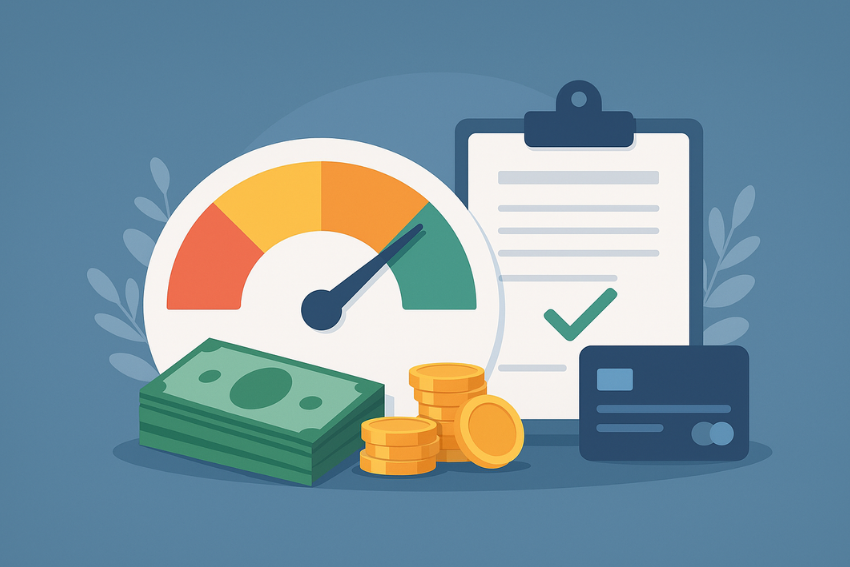
Credit score influences nearly all of the major money choices you make, such as which credit card is in your wallet and which mortgage interest rate the bank offers, as well as the degree to which a landlord reads between your lines. Imagine it as your financial reputation summarized into one or two easy to remember numbers that can be checked by lenders in few seconds.
This is the ultimate guide where you will get to know what a credit score is, how it is formed, why it matters, the typical reasons why your credit score is low, and the gradual process of raising it.
What is a Credit Score?
The credit score is a small overview of your borrowing history. It considers the dependability of your payments, the amount of credit you spend, the duration you have been using it and the type of accounts under your name. Various markets have varying ranges, although the concept remains similar. The increase in the score indicates reduced risk to a lender.
Beyond that figure is your credit report that records accounts, limits, balances, payment patterns and any negative flags. The information about banks and lenders is gathered by bureaus. Patterns in such data are then converted into a score using scoring models. There is no need to memorize the formula. All you need to do is to control behaviors that are rewarded by models.
How Does a Credit Score Work?
Scoring systems look at a familiar set of ingredients. They differ in exact weights, yet the pillars rarely change.
- Payment history. On time payments build trust. Missed or late payments erode it quickly.
- Credit utilization. Using a small share of your revolving limits shows control. When balances swell against limits, risk rises.
- Length of history. Older, well-kept accounts tell a reassuring story.
- Mix of credit. Managing both revolving credit and installment loans shows breadth.
- New credit activity. Many hard inquiries in a short burst can look like urgency.
These inputs do not act in isolation. A missed payment on a thin file hit harder than the same slip on a thick file. A low utilization ratio across all cards matters more than a single card in isolation. Treat the score as an evolving reaction to patterns, not a fixed label.
Importance of a Good Credit Score
A strong score creates a ripple of benefits throughout your financial life:
- Easier approvals for credit cards, personal loans, vehicle loans, and home loans
- Lower interest rates that shrink total interest paid over the life of a loan
- Higher credit limits which improve your utilization ratio and flexibility
- Faster processing during underwriting because your risk profile looks clean
- Better non lending opportunities such as favorable insurance premiums or smoother rental applications in some markets
When your score is high, lenders compete for your business. When your score is fragile, you end up negotiating from the back foot.
What is Considered Good or Bad?
Labels vary, but direction matters most. If your score climbs month after month, you are doing the right things. If it drifts downward, your habits need a reset. Use ranges only as a rough compass, not a verdict.
- Excellent. You qualify for premium products and top rates.
- Good. You receive approvals at competitive terms.
- Average. You can borrow, but at higher cost.
- Poor. Options narrow and rates climb.
Reasons for a Low Credit Score
Low scores rarely come from one cause. They reflect repeated signals that suggest higher risk. Here are the most common culprits and the practical fixes that work in the real world.
Late or Missed Payments
Delayed payments on loans or credit cards punch above their weight. Even a brief delay can be recorded, and repeated delays create a pattern that models do not forgive quickly. The fix is straightforward.
- Automate minimum payments so you never miss a due date.
- Set calendar reminders one week before due dates for the full payoff.
- If you expect cash flow pressure, talk to your lender early to arrange a plan.
High Credit Utilization
Using a large share of your available limit signals stress. If you regularly cross 50 percent utilization on a card, the model may assume you lean on credit to cover gaps. Most experts suggest keeping utilization below 30 percent. That is a guideline, not a law. Lower is usually better.
- Pay mid cycle to pull balances down before the statement cuts.
- Request higher limits on well managed cards to widen your denominator.
- Spread purchases across cards to avoid spiking one account.
Too Many Loan or Credit Applications
Each hard inquiry can shave a few points. Many applications in a short window look like urgency. Lenders worry you might overextend after multiple approvals.
- Batch your rate shopping within a short timeframe, when possible, since some models treat clustered inquiries for the same product as a single event.
- Apply only when you genuinely need the credit.
Defaulting on Loans
Defaults or settlements leave deep marks and can linger in your file for years. They carry more weight than late payments because they imply a breakdown in the ability or willingness to repay.
- If hardship strikes, engage your lender before default risk escalates.
- Explore restructuring options or hardship programs rather than walking away.
- After recovery, rebuild with a secured card or a small installment loan you can comfortably manage.
Short Credit History
A thin file makes your score volatile. With little data, each new event swings the number more than you expect.
- Keep older accounts open and active with small recurring charges.
- Avoid resetting your average age of accounts by closing long standing cards without a strong reason.
Closing Old Credit Accounts
Closing an old card can shorten your average age of credit and tighten your total available limits. Both effects can nudge your score down.
- If the card has no annual fee, keep it open and automate a small subscription to keep the line active.
- If you must close a card, consider timing it when your utilization is low and your other accounts have matured.
Errors in Your Credit Report
Mistakes happen. A payment may post to the wrong account, or a fraudulent account may sneak into your file.
- Check your report regularly for inaccuracies.
- Dispute errors through the appropriate credit bureau channel with supporting documents.
- Freeze your credit if you suspect identity theft to stop new fraudulent accounts.
How to Improve a Low Credit Score
Improving your credit score is a steady process. There is no magic trick. There is a repeatable playbook that works across markets and models.
- Pay on time, every time: Set up autopay for at least the minimum due. Then pay the full statement balance wherever possible to avoid interest.
- Lower utilization: Target an overall utilization below 30 percent and, for bonus points, keep individual cards below that threshold too. Mid-cycle payments help.
- Avoid unnecessary applications: Space out applications and apply only for credit that supports your goals.
- Keep old accounts active: The longer you maintain positive behavior, the more credit models reward you. Aged accounts are an asset.
- Build a healthy mix over time: If you only have cards, consider a small installment product you can pay comfortably. Do not rush this step. Stability matters more than variety.
- Monitor your report: Schedule a quarterly or semiannual check. Correct errors quickly to reclaim lost points.
- Use targeted rebuilding tools: If your score has taken a hit, a secured credit card or a credit builder loan can create new positive history. Treat these tools as steppingstones, not permanent solutions.
A Weekly Rhythm That Works
- Glance at balances and schedule a top up payment if utilization creeps up.
- Make sure autopay still works after any card or bank changes.
- Review your calendar for upcoming bills so nothing slips.
A Monthly Check In
- Read statements line by line. Small errors become big problems if they compound.
- Rotate a tiny subscription across your older cards to keep them active.
- Track utilization at the account level and the total level.
A Helpful Mindset
Think like an underwriter who wants predictability. Show calm usage, timely payments, and a stable pattern month after month. You do not need perfection. You need reliability. The longer you behave like the kind of borrower a bank loves, the more your score reflects that story.
Conclusion
Your credit score is not a moral judgment. It is a moving snapshot of how you handle borrowed money. If your score is low today, start small this week. Autopay the minimum. Make one mid cycle payment. Move a subscription to an older card. Set two reminders. Keep going next week. In six to twelve months, your report will read like a new chapter, and your options will open up.
FAQs
How quickly can I raise a low score?
Most people notice visible improvement within a few months of on time payments and lower utilization. The timeline depends on how severe the negatives are and how much history your report contains.
Does checking my own score hurt it?
No. Pulling your score through a bank or bureau uses a soft inquiry, which does not affect the number. Hard inquiries for new applications can trim a few points.
Is it better to pay in full or before the statement date?
Pay in full to avoid interest. If you care about the number reported, make an extra payment a few days before the statement date so a smaller balance shows up.
Should I close a paid loan early?
Paying a loan off cleanly is positive. Your mix may shift slightly, but the long run benefit of a paid loan outweighs any small, temporary movement.