










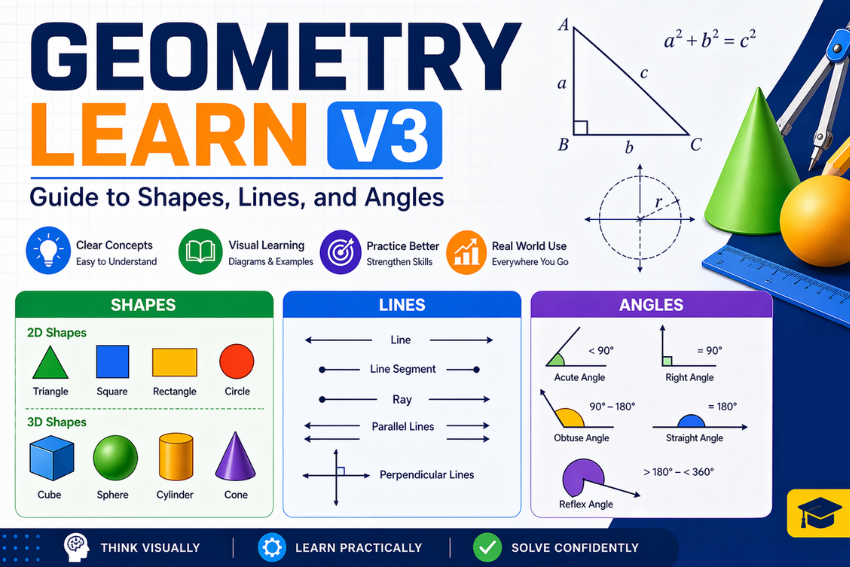
Geometry Learn V3 brings a structured yet intuitive way to understand shapes, lines, and angles, helping learners connect theory with real world application in a natural, engaging way. At first, geometry may seem rigid. Numbers, diagrams, rules. But once you spend time with it, something shifts. Patterns start to feel familiar. Shapes begin to tell stories. And suddenly, it clicks.
This guide goes deeper than surface level explanations. It walks you through concepts step by step, while also showing how geometry quietly influences the world around you.
What is Geometry?
Geometry studies the properties of space and the relationships between points, lines, surfaces, and solids. It answers questions like:
- How far apart are two objects?
- What shape best fits a structure?
- How angles interact in space?
At its core, geometry is about understanding structure. That structure exists in buildings, roads, screens, and even nature.
Why Geometry Still Matters Today
Some subjects feel disconnected from everyday life. Geometry is not one of them.
It plays a role in:
- Architecture and construction.
- Computer graphics and animation.
- Interior and product design.
- Navigation and mapping systems.
- Robotics and automation.
Even basic decisions, like arranging furniture or planning a room layout, rely on geometric thinking.
Foundational Elements You Must Know
Before tackling complex problems, you need clarity on the core elements. These act like the alphabet of geometry.
Points Define Position
A point represents a location in space. It has no dimension. You cannot measure it, but you can mark it.
Lines Create Direction
A line extends infinitely in both directions. It forms the basis for angles and shapes.
Key types include:
- Horizontal lines
- Vertical lines
- Diagonal lines
Line Segments Define Distance
A line segment connects two points. Its length can be measured. This is where geometry becomes practical.
Rays Show Movement
A ray begins at one point and extends forever in one direction. Think of it as a path that never ends.
Understanding Angles
Angles form when two lines meet at a point. That point is called the vertex.
Angles measure rotation. They tell you how far one line turns from another.
Types of Angles
- Acute Angle: Less than 90 degrees
- Right Angle: Exactly 90 degrees
- Obtuse Angle: More than 90 but less than 180
- Straight Angle: Exactly 180 degrees
- Reflex Angle: More than 180 degrees
Angles show up in everything from door hinges to road intersections.
Shapes in Geometry
Shapes are where geometry becomes visual and intuitive. You can see them, draw them, and measure them.
Two-Dimensional Shapes
These shapes lie flat. They have length and width.
Common 2D Shapes
- Triangle
- Square
- Rectangle
- Circle
- Pentagon
- Hexagon
Each shape carries its own properties.
Triangles
Triangles are the simplest polygons. They have three sides and three angles.
Types include:
- Equilateral
- Isosceles
- Scalene
Each classification depends on side length and angle measure.
Quadrilaterals
These shapes have four sides.
Examples:
- Square
- Rectangle
- Rhombus
- Trapezoid
Each one behaves differently, especially when it comes to symmetry and angles.
Three-Dimensional Shapes
Now we move beyond flat surfaces.
3D shapes have:
- Length
- Width
- Height
Common 3D Shapes
- Cube
- Sphere
- Cylinder
- Cone
- Pyramid
These shapes are not just theoretical. You interact with them daily.
A can of soda resembles a cylinder. A ball is a sphere.
Understanding Relationships Between Lines
Geometry becomes more interesting when elements interact.
Parallel Lines
- Never meet
- Maintain constant distance
Perpendicular Lines
- Meet at 90 degrees
- Create right angles
Transversal Lines
A transversal crosses two or more lines. This creates angle patterns that follow predictable rules.
These relationships form the backbone of geometric proofs.
Measuring in Geometry
Geometry is not just visual. It is measurable.
Length: Measured using units like meters or inches.
Area: Represents the surface covered by a shape.
Examples:
- Square: Area equals side times side
- Rectangle: Area equals length times width
Perimeter: The total distance around a shape.
Volume: Applies to 3D shapes. It measures how much space an object occupies.
How Geometry Builds Problem Solving Skills
Geometry does more than teach shapes. It trains your brain.
You learn to:
- Analyze patterns
- Break down problems
- Think logically
- Visualize outcomes
These skills transfer to other subjects and real-life challenges.
Real World Applications for Geometry
Geometry does not stay in textbooks. It plays a role in everyday life.
- Architecture: Buildings rely on geometric precision. Angels must align. Shapes must be balanced.
- Engineering: Machines require exact measurements. Even small errors can cause failure.
- Art and Design: Patterns, symmetry, and proportions define visual appeal.
- Navigation: GPS systems use geometric principles to calculate positions.
Geometry Learn V3 Approach
What makes Geometry Learn V3 different?
It focuses on clarity and application rather than rote memorization.
Key Features
- Step by step progression
- Real world examples
- Visual explanations
- Practice driven learning
Instead of overwhelming learners, it builds confidence gradually.
Tips to Master Geometry Faster
Learning geometry becomes easier with the right strategy.
- Practice Regularly: Consistency matters more than intensity.
- Visualize Concepts: Draw diagrams. Sketch shapes. Seeing helps understanding.
- Break Down Problems: Complex problems often become simple when divided into smaller parts.
- Use Real Examples: Relate concepts to everyday objects.
- Focus on Understanding: Memorization fades quickly. Understanding stays.
Common Mistakes to Avoid
Even motivated learners stumble. Awareness helps prevent errors.
- Ignoring diagrams
- Rushing through problems
- Memorizing without understanding
- Skipping basic concepts
- Misreading angle measurements
Geometry rewards patience. Slow down when needed.
Geometry in Daily Life
Geometry quietly shapes daily experiences.
- Road intersections rely on angle calculations
- Buildings depend on structural geometry
- Mobile screens use rectangular grids
- Art uses symmetry and proportion
Once you notice these patterns, geometry becomes more relatable.
Connecting Geometry with Technology
Modern technology relies heavily on geometric principles.
- In Computer Graphics: Shapes define objects on screen.
- In Navigation Systems: Coordinates help track location accurately.
- In Artificial Intelligence: Spatial awareness models use geometric data.
Geometry continues to evolve with technology, making it more relevant than ever.
Advanced Concepts Preview
Once you master basics, geometry expands further.
- Coordinate Geometry: Uses graphs to represent shapes numerically.
- Transformations: Includes rotation, reflection, and translation.
- Trigonometry: Connects angles with ratios.
These topics build on the same foundation you are learning now.
Why Geometry Learn V3 Works for Modern Learners
Traditional learning often feels rigid. Geometry Learn V3 takes a more adaptive approach.
It respects how people actually learn today.
- Short focused lessons
- Clear explanations
- Practical examples
- Flexible learning pace
It bridges the gap between theory and application.
Final Thoughts
Geometry Learn V3 transforms how you approach shapes, lines, and angles. It replaces confusion with clarity. It replaces memorization with understanding.
As you continue learning, geometry stops feeling like a subject. It becomes a lens. A way to interpret the world with structure and precision.
Stay consistent. Keep exploring. The deeper you go, the more rewarding it becomes.
FAQs About Geometry Learn V3
What is Geometry Learn V3 designed for?
It targets learners who want a structured yet practical approach to geometry. Beginners and intermediate learners both benefits.
Is Geometry Learn V3 suitable for beginners?
Yes. It starts from the basics and builds gradually.
How can I learn geometry quickly?
Practice regularly, focus on understanding, and apply concepts to real situations.
Do I need to memorize formulas?
Memorization helps but understanding how formulas work is more important.
Can geometry help in career growth?
Yes. It is essential in fields like engineering, architecture, and data visualization.
Do I need prior knowledge?
No. It starts from the basics and builds upward.
How long does it take to learn geometry?
It depends on consistency. With daily practice, noticeable improvement can happen within weeks.
Is geometry useful outside academics?
Absolutely. It applies to design, engineering, navigation, and even everyday problem solving.